

Research
Characterizing cytosine methylation of polymorphic transposable element insertions using the human pangenome resources
- First Published May 14, 2026


Perspective
Notable challenges posed by long-read sequencing for the study of transcriptional diversity and genome annotation
- First Published March 3, 2025

Research
Gaps and complex structurally variant loci in phased genome assemblies
- First Published May 10, 2023

Resource
Discovery of high-confidence human protein-coding genes and exons by whole-genome PhyloCSF helps elucidate 118 GWAS loci
- First Published September 19, 2019

Method
Read clouds uncover variation in complex regions of the human genome
- First Published August 18, 2015

Method
Parente2: a fast and accurate method for detecting identity by descent
- First Published October 1, 2014

Method
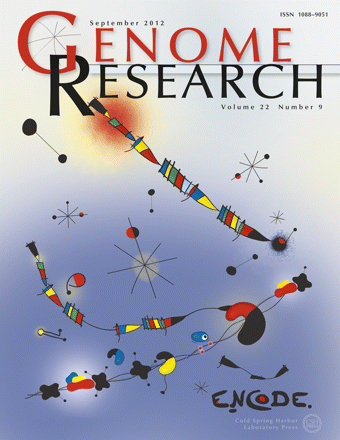
Ubiquitous heterogeneity and asymmetry of the chromatin environment at regulatory elements
- First Published September 5, 2012
Method
Combining RT-PCR-seq and RNA-seq to catalog all genic elements encoded in the human genome
- First Published September 5, 2012
Resource
GENCODE: The reference human genome annotation for The ENCODE Project
- First Published September 5, 2012
Resource
ChIP-seq guidelines and practices of the ENCODE and modENCODE consortia
- First Published September 5, 2012
Method
Linking disease associations with regulatory information in the human genome
- First Published September 5, 2012

Method
Shotgun proteomics aids discovery of novel protein-coding genes, alternative splicing, and “resurrected” pseudogenes in the mouse genome
- First Published April 1, 2011

Letter
Evolutionary constraint facilitates interpretation of genetic variation in resequenced human genomes
- First Published January 12, 2010

Resource
The consensus coding sequence (CCDS) project: Identifying a common protein-coding gene set for the human and mouse genomes
- First Published June 4, 2009

RECOMB Special/Methods
Effect of genetic divergence in identifying ancestral origin using HAPAA
- First Published March 18, 2008

ARTICLE
Prominent use of distal 5′ transcription start sites and discovery of a large number of additional exons in ENCODE regions
- First Published June 13, 2007
ARTICLE
Analyses of deep mammalian sequence alignments and constraint predictions for 1% of the human genome
- First Published June 13, 2007

ARTICLE
Distribution and intensity of constraint in mammalian genomic sequence
- First Published June 17, 2005
Methods
Automated Whole-Genome Multiple Alignment of Rat, Mouse, and Human
- First Published April 1, 2004
LETTER
Characterization of Evolutionary Rates and Constraints in Three Mammalian Genomes
- First Published April 1, 2004

Methods
Eukaryotic Regulatory Element Conservation Analysis and Identification Using Comparative Genomics
- First Published March 1, 2004

Methods
Identification of Promoter Regions in the Human Genome by Using a Retroviral Plasmid Library-Based Functional Reporter Gene Assay
- First Published June 12, 2003
LETTER
Quantitative Estimates of Sequence Divergence for Comparative Analyses of Mammalian Genomes
- First Published May 1, 2003
METHODS
LAGAN and Multi-LAGAN: Efficient Tools for Large-Scale Multiple Alignment of Genomic DNA
- First Published March 12, 2003

LETTER
Human and Mouse Gene Structure: Comparative Analysis and Application to Exon Prediction
- First Published July 1, 2000
RESEARCH
Sequencing a Genome by Walking with Clone-End Sequences: A Mathematical Analysis
- First Published December 1, 1999