

Abstract
Lahn and Page previously observed that genes on the human X chromosome were physically arranged along the chromosome in “strata,” roughly ordered by degree ofdivergence from related genes on the Y chromosome. They hypothesized that this ordering results from a historical series of suppressions ofrecombination along the mammalian Y chromosome, thereby allowing formerly recombining X and Y chromosomal genes to diverge independently. Here predictions ofthis hypothesis are confirmed in a nonprimate mammalian order, Rodentia, through an analysis ofeight gene pairs from the X and Y chromosomes ofthe house mouse, Mus musculus. The mouse X chromosome has been rearranged relative to the human X, so strata were not found in the same physical order on the mouse X. However, based on synonymous evolutionary distances, X-linked genes in M. musculus fall into the same strata as orthologous genes in humans, as predicted. The boundary between strata 2 and 3 is statistically significant, but the boundary between strata 1 and 2 is not significant in mice. An analysis ofsmaller fragments of Smcy, Smcx, Zfy, and Zfx from seven species of Mus confirmed that the strata in Mus musculus were representative ofthe genus Mus.
The mammalian X and Y chromosomes presumably evolved from an homologous autosomal pair soon after the origin of mammals. Distinguishable sex chromosomes are found in monotremes, marsupials, and in eutherian (placental) mammals (for review, see Graves 1995). There is conservation of genes on the X chromosome across these taxonomic groups, suggesting a single origin of the mammalian X (and Y) chromosomes (Ohno 1967). Over time, segments of homologous autosomes are thought to have been translocated to both the X and Y chromosomes. Eventually most of these segments lost recombination, and many Y genes deteriorated (for review, see Graves 1995).
Lahn and Page (1999) measured KS, the synonymous evolutionary distance, between related genes on the human X and Y chromosomes, and discovered that the distances fell into four distinct groups referred to as “strata.” Remarkably, the groups corresponded to the order of the genes along the human X chromosome. They hypothesized that sequential inversions of segments of the mammalian Y chromosome could have formed the four X chromosomal strata by ending recombination between groups of contiguous X chromosomal genes and their Y chromosomal homologs. These formerly recombining X-Y gene pairs will be referred to as gametologs, as suggested by Garcia-Moreno and Mindell (2000). An inversion is probably not responsible for the formation of the fourth stratum, because the break between strata three and four in human, chimpanzee, squirrel monkey, ring-tailed lemur, greater bushbaby, cow, pig, and horse is within an intron of the AMGX (also called AMELX) gene (Iwase et al. 2001, 2003).
Based on the KS between gametologs on the X and Y chromosomes, Lahn and Page (1999) further suggested that the first of these four strata was formed before the divergence of monotremes (240-320 million years ago [Mya]), the second after the divergence of monotremes and before the divergence of marsupials (130-170 Mya), and the third before the divergence of simians (80-130 Mya). The fourth stratum is hypothesized to have been formed after the divergence of simian and prosimian lineages (30-50 Mya; Lahn and Page 1999). Because the fourth stratum appears to have begun diverging after the divergence of the mammalian orders, the contents of the fourth stratum may be different in different orders (Iwase et al. 2001, 2003).
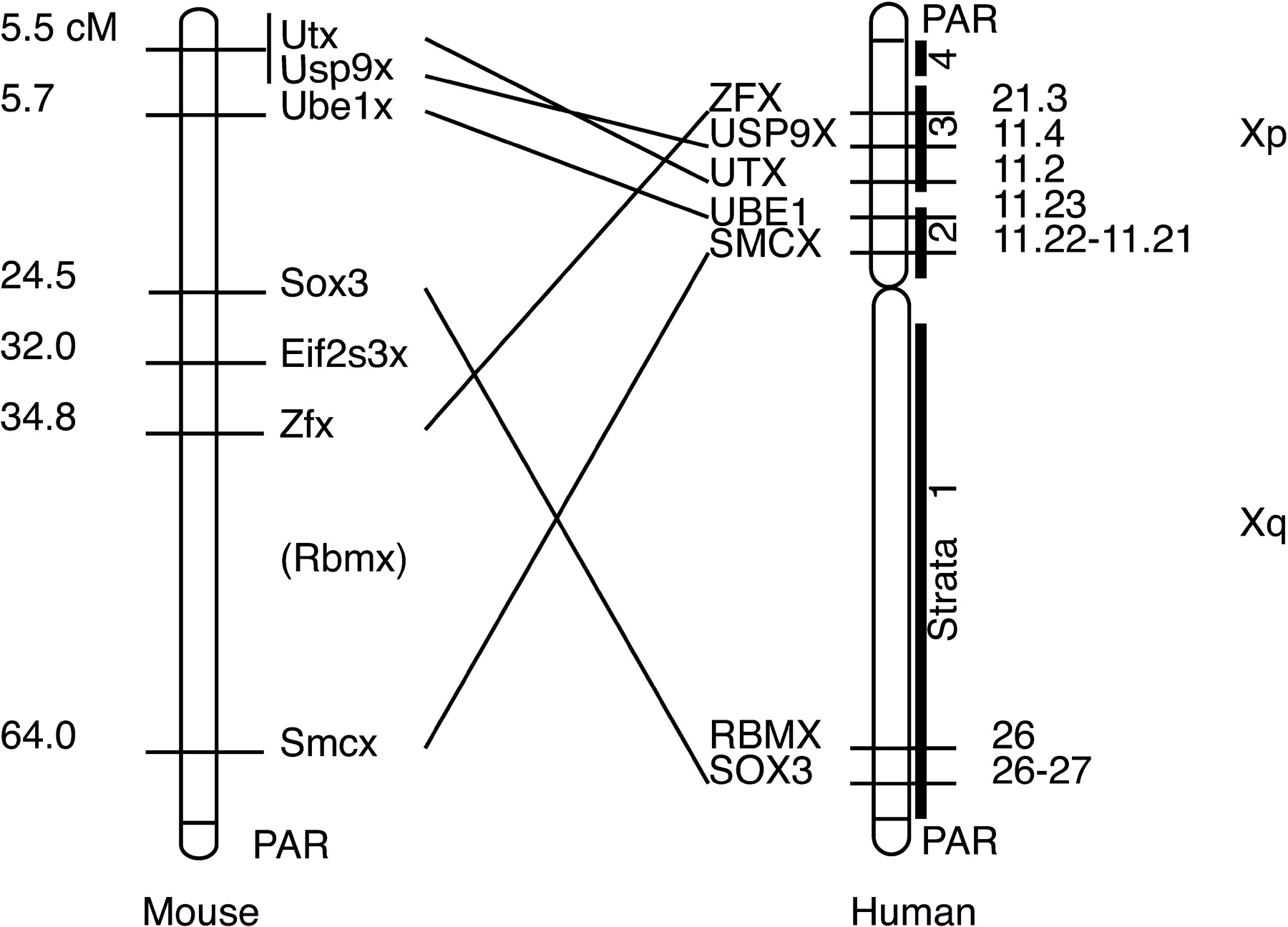
Because three of the four recombination suppressions occurred before the divergence of primates from other mammals, the strata hypothesis predicts that these should also be found in nonprimate mammals, including mice. The ancestral mammalian X chromosomal gene arrangement appears to be retained in humans, as this arrangement is also found in horses (Raudsepp et al. 2002), cattle (Band et al. 2000), pigs (McCoard et al. 2002; Quilter et al. 2002), and cats (Murphy et al. 1999). However, the physical order of genes on the mouse X chromosome has been rearranged relative to the order on other mammalian X chromosomes during evolution (Fig. 1; Amar et al. 1988; Disteche 1999). Therefore genes from each stratum are not predicted to be found in the same physical order in mice, but the relative order of divergence of groups of gametologs should be the same as in humans, if the strata hypothesis is correct.
Relative positions of genes studied herein, on mouse and human X chromosomes. The mouse X chromosome has been rearranged relative to the human X (Murphy et al. 1999). Map positions of human and mouse genes used in this study are indicated. Eif2s3x is not found in humans. Rbmx has not been mapped in mouse. UTX in human is placed on the chromosome relative to other genes according to radiation hybrid mapping (Lahn and Page 1999). Strata positions are marked along the human X chromosome (Lahn and Page 1999). Some X chromosomal genes from human were not used in this study because there were not orthologous X chromosomal genes in mouse, or because the mouse orthologs did not have Y chromosomal gametologs. Human and mouse map positions from: Human-Mouse Homology Map, Mouse Genome Database, http://www.informatics.jax.org/, February 2003.
The strata hypothesis was tested in mice by calculating the neutral divergence rate using the statistic KS (the mean number of synonymous [silent] substitutions per synonymous site) between pairs of genes in Mus musculus. Mouse orthologs that represent genes from each of the first three strata identified by Lahn and Page (1999) were used. Additionally, KS for Smcx/y and Zfx/y-2 was calculated for seven rodent taxa of the genus Mus. These data confirm that strata results obtained for Mus musculus were representative of the genus.
RESULTS
Some of the human genes that Lahn and Page (1999) used did not have sex-chromosomal orthologs in mice. For example, Rps4y is in the human stratum 1, but Southern blotting and RT-PCR confirm that it has been lost from M. musculus (Omoe and Endo 1996). We discarded 10 genes that were not present as X-Y pairs in mice. Of the remainder, at least two mouse gametologous gene pairs were available that were orthologous to human gene pairs from each of human strata 1, 2, and 3 (Lahn and Page 1999). From stratum 1, we used Rbmx/y and Sry/Sox3. From stratum 2, we used Ubex/y and Smcx/y. From stratum 3, we used Usp9x/y (formerly Dffrx/y), Utx/y, and Zfx/y-2. In addition, we used one gene pair, Eif2s3x/y, that is not present on the human X and Y chromosomes (Ehrmann et al. 1998). The gametologs were ordered by the KS between the X and Y chromosomal members (Table 1).
Sequence Divergence and Assigned Strata for X-Y Gene Pairs, Mus musculus
Gene pair | cM position on mouse Xa | Mouse sequence compared (nt) | Ks (s.d.)b | Mouse stratumc | Human stratumd | |
|---|---|---|---|---|---|---|
| A | Sox3/Srye | 24.5 | 231 | 1.587 (0.7066) | 1 | 1 |
| B | Rbmx/y | NA | 1092 | 0.986 (0.1595) | 1 | 1 |
| C | Smcx/y | 64.0 | 4608 | 0.966 (0.0646) | 1 | 2 |
| H | Eif2s3x/y | 32.0 | 1419 | 0.758 (0.0935) | 2 | NA |
| D | Ube1x/Ube1y1 | 5.7 | 3174 | 0.739 (0.0605) | 2 | 2 |
| E | Usp9x/y | 5.5 | 7623 | 0.579 (0.0333) | 3 | 3 |
| F | Zfx/y-2 | 34.8 | 2343 | 0.569 (0.0603) | 3 | 3 |
| G | Utx/y | 5.5 | 3543 | 0.467 (0.0389) | 3 | 3 |
a Mouse Genome Database, Mouse Genome Informatics Web Site, The Jackson Laboratory, Bar Harbor, Maine, http://www.informatics.jax.org, February 2003
b Ks: synonymous substitutions per synonymous site and standard deviation calculated using a modification of Li's (1993) method implemented in the “diverge” program in the GCG software package (Wisconsin Package Version 10.3, Accelrys)
c Strata based on Ks distances between X-Y gene pairs
d Strata correspond to Lahn and Page (1999)
e HMG box sequences only
The mouse KS data formed three clearly identifiable strata; however, a conservative statistical test distinguished only two strata (Table 1). Two-tailed Z tests were significant for the break between strata 2 and 3 (P = 0.0205), but not for the break between strata 1 and 2 (P = 0.0672). Our analysis shows that Eif2s3x belongs in mouse stratum 2. All but one of the mouse gene pairs formed the same groups as in human (Table 1; Lahn and Page 1999). Smcx did not fit into stratum 2 as had been expected. Instead, the KS of Smcx/y (0.966) is similar to the KS of Rbmx/y (0.986) in stratum 1.
The KS for two gametologous pairs was determined for seven taxa within the genus Mus to determine whether the results from M. musculus were representative of the genus. Small fragments of Smcx/y and Zfx/y-2 were available for all seven taxa. We used 657 bases from exons 23 and 24 of Smcx/y, and 996 bases from exon 11 of Zfx/y. The KS of the smaller fragment of Smcx/y was lower than the KS of the entire coding sequence in M. musculus. Likewise, the KS of the smaller fragment of Zfx/y was lower than the KS of the entire coding sequence in M. musculus. Similar, low, KS values were found for the smaller fragments of both genes in all seven taxa (Table 2).
Sequence Divergence of Zfx/y-2 and Smcx/y in Mus
Species | Smcx/y KS (s.d.)a,b,c | Zfx/y-2 KS (s.d.)d |
|---|---|---|
| Mus cookii | 0.627 (0.1099) | 0.381 (0.0596) |
| Mus spicilegus | 0.636 (0.1110) | 0.420 (0.0662) |
| Mus caroli | 0.639 (0.1115) | 0.418 (0.0628) |
| Mus macedonicus | 0.647 (0.1127) | 0.427 (0.0669) |
| Mus domesticus | 0.649 (0.1152) | 0.438 (0.0707) |
| Mus musculus musculus | 0.661 (0.1167) | 0.451 (0.0741) |
| Mus spretus | 0.681 (0.1191) | 0.426 (0.0691) |
a KS: synonymous substitutions per synonymous site and standard deviation calculated using a modification of the method described by Li (1993) implemented in the “diverge” program in the GCG software package (Wisconsin Package Version 10.3, Accelrys)
b Other gene pairs in stratum 2 in Mus musculus have KS ranging from 0.739 to 0.758. Other gene pairs in stratum 3 in Mus musculus have KS ranging from 0.467 to 0.579 (Table 1). The smaller fragments of both Smcx/y and Zfx/y have lower KS values than their full-length counterparts
c Smcx/y KS calculated from 657 bases
d Zfx/y-2 KS calculated from 996 bases
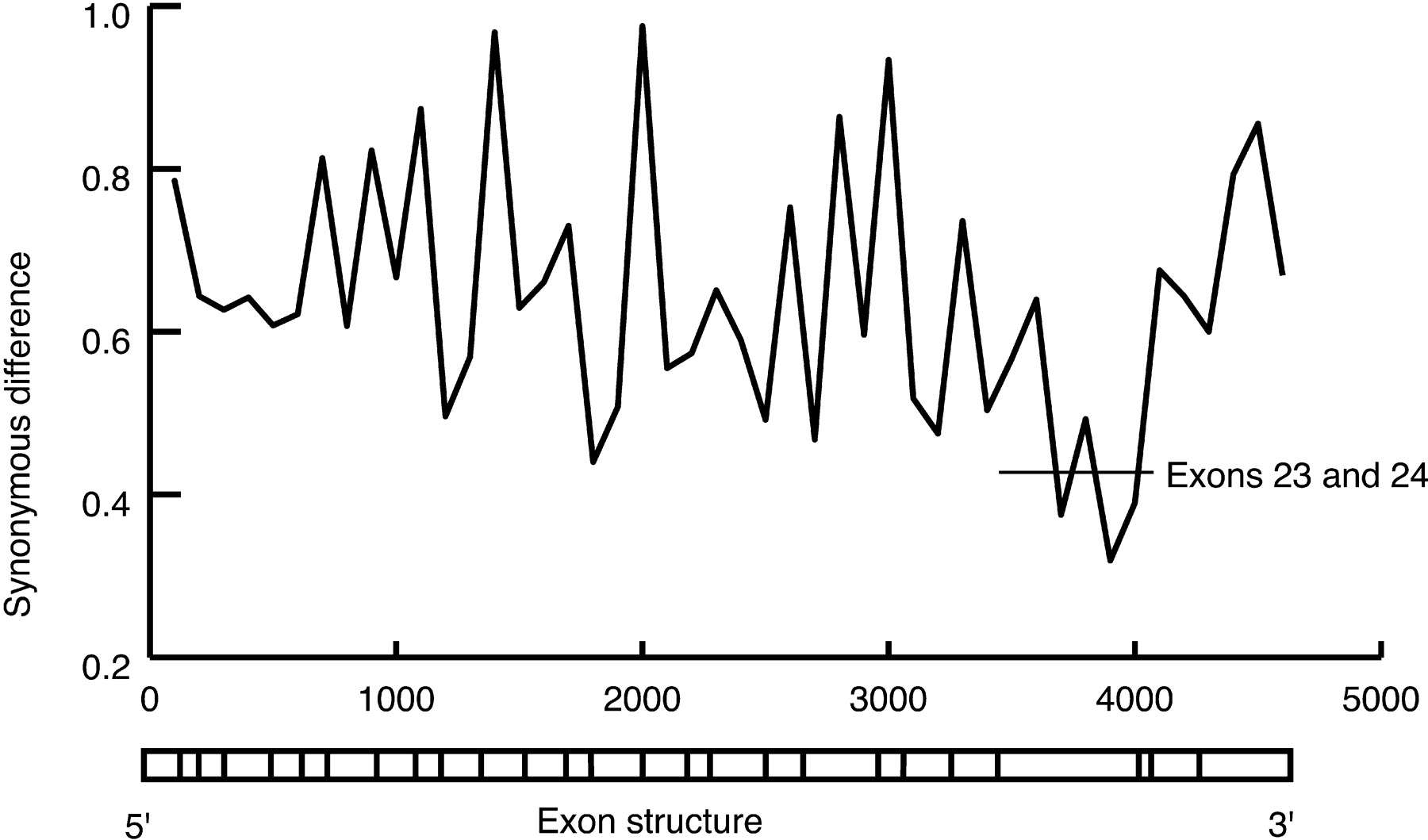
The synonymous difference was calculated for nonoverlapping 100-nucleotide (nt) windows across Smcx/y exon sequences. Because the Nei-Gojobori (Nei and Gojobori 1986) uncorrected synonymous p-value was used to calculate the distances for these windows, these distances (Fig. 2) are lower than the distances for the same sequences calculated using a modification of the method described by Li (1993) shown in Table 1. This is an artifact of the methods, and does not change the conclusions drawn from these calculations. Exon 23, which makes up most of the fragment used in the seven-taxon analysis, was in a region of relatively low X-Y distance.
Synonymous distance between Smcx and Smcy in M. musculus. Nonoverlapping 100-nt windows were examined along the length of the aligned Smcx and Smcy exons. A dip in the Nei-Gojobori synonymous distance (p) occurs at ∼exons 23-24, marked with bar. Exon structure is mapped along the bottom of the graph, showing approximate exon-exon boundaries as vertical lines. Introns were not alignable between Smcx and Smcy; introns are thus not shown.
DISCUSSION
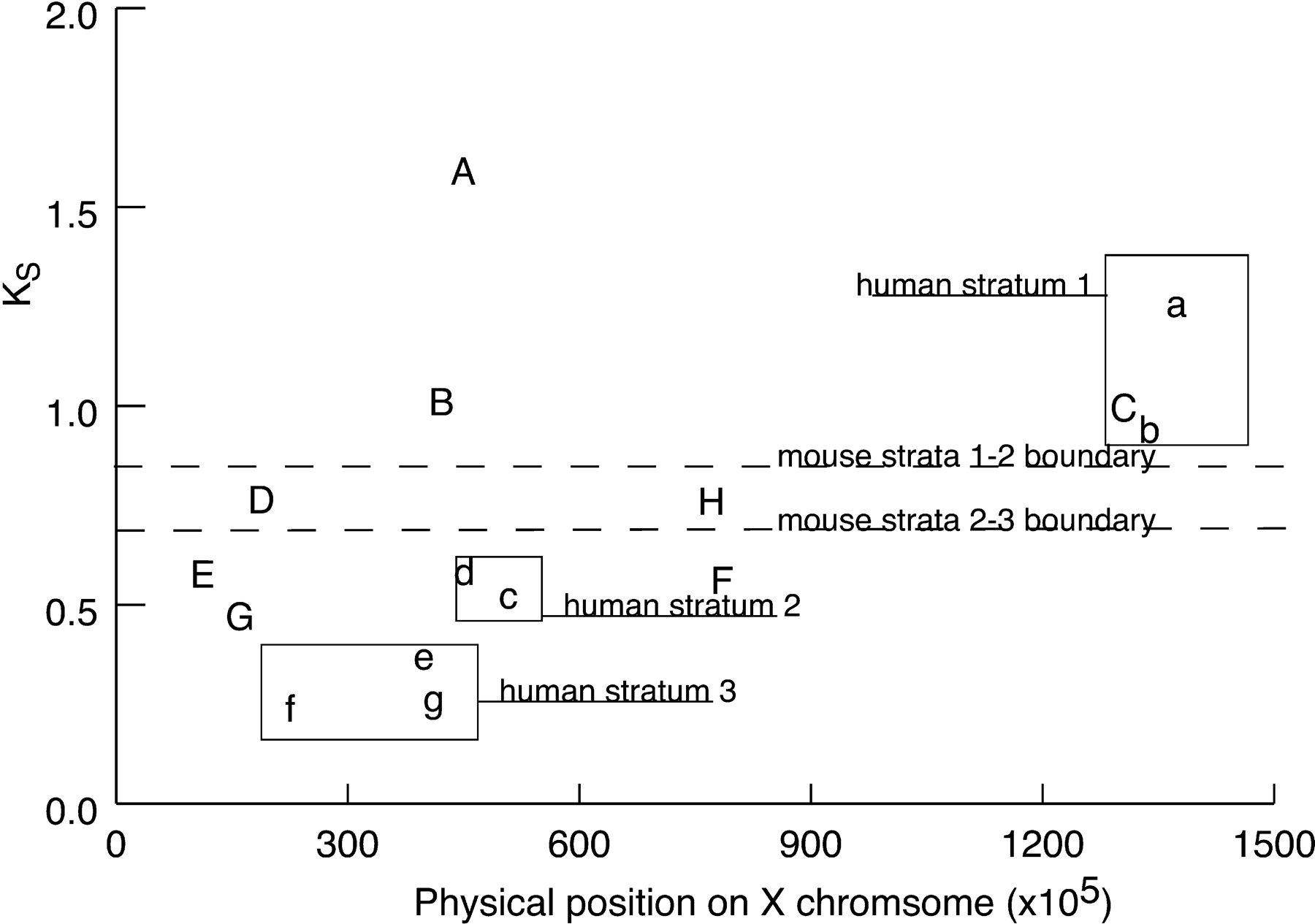
Comparative sequence data from related X and Y chromosomal gene pairs in mice support Lahn and Page's (1999) strata hypothesis for the evolution of the mammalian X chromosome. Because the mouse X chromosome is rearranged relative to the human X, strata in mice are not found in physical or genetic map order along the mouse X (Fig. 1). Instead, they are recognized by their similar KS values (Table 1). The M. musculus KS values are higher than the human KS values for the same gene pairs (Fig. 3). This probably reflects the higher neutral mutation rate in mice after the human and mouse divergence (Wu and Li 1985; Mouse Genome Sequencing Consortium 2002). The KS values are similar to those published for some of the same mouse genes (Utx/y, Zfx/y, Usp9x/y, Ube1x/ Ube1y1; Hall et al. 2003). The visually apparent breaks between strata were statistically significant between strata 2 and 3, but not between strata 1 and 2.
Plot of KS vs. physical position on X chromosome for mouse and human X- and Y-linked gene pairs. Physical positions on the X chromosome are from the UCSC Genome Browser Web site (http://genome.ucsc.edu/), assembly February 2003. Mouse gametologs are marked by uppercase letters; human gametologs (Lahn and Page 1999) by lowercase letters. Human strata as identified by Lahn and Page (1999) are boxed and labeled. Mouse strata boundaries are marked by dotted lines. Human X chromosome genes cluster in strata by both their physical positions on the X and by their divergence from their gametologs (KS). Mouse X chromosomal genes cluster in strata by degree of divergence from their Y-linked gametologs only, not by map position. A/a, Sox3/Sry; B/b, Rbmx/y; C/c, Smcx/y; D/d, Ube1x/Ube1y1; E/e, Usp9x/y; F/f, Zfx/y-2; G/g, Utx/y; H, Eif2s3x/y (mouse only).
Smcx was the only mouse gene that did not fit into the same stratum as in human. As the difference between the strata was slightly below the P < 0.05 significance level (P = 0.0672 in two-tailed tests), more research in other organisms will be needed to determine whether Smcx belongs in stratum 1 or 2. If Smcx is in stratum 1, it may be X-linked in monotremes. To be sure that Smcx/y in M. musculus is representative of the genus Mus, a small fragment of this gene pair was examined in other Mus species. Surprisingly, this smaller (657-nt) fragment had a lower KS (0.661) than the whole gene. The Smcx/y fragment's low KS was similar in all of the Mus species examined. Similarly, another partial (1764-nt) fragment of Smcx/y from M. musculus had a KS of 0.696 (Hall et al. 2003), which is also low compared to the KS of the whole coding sequence.
There are three explanations for the difference in KS between the smaller fragments and the whole Smcx/y gene pair. First, the shorter fragments may, by chance, have a lower neutral mutation rate. Second, Smcx/y may cross the breakpoint between two strata, as was discovered in the case of the AMGX/Y gene pair in humans (Iwase et al. 2001). This possibility was examined by calculating synonymous differences (p) for 100-nt windows of exon sequences. If there were a breakpoint between two strata within the gene, we would expect to see a step-like rise or fall in p along the sequence, which would not reverse itself. Instead, p begins high at the 5′ end of the gene, falls in exon 23, and rises again in the 3′ exons (Fig. 2). Because p falls, then rises again, Smcx/y probably does not span a stratum boundary. A third explanation is gene conversion in exon 23. If Smcx is a stratum 1 gene as it appears to be in mice, a gene conversion event at about the time of the formation of stratum 2 (130-170 Mya) may account for the synonymous divergence pattern of Smcx and Smcy.
Eif2s3y is not found in humans (Ehrmann et al. 1998). Our analysis showed that Eif2s3x in mice is a member of stratum 2, based on the KS of Eif2s3x/y. Thus, this gene pair is expected to have diverged with other stratum 2 genes 130-170 Mya (Lahn and Page 1999), in the ancestor of human and mouse. Our data suggest that Eif2s3y was probably lost secondarily from primates. Rps4x is X-linked in mice, but Rps4y is not found on the mouse Y chromosome (Omoe and Endo 1996). Rps4y has been found in human, macaque, and opossum, but not in pig, cow, dog, horse, rabbit, or rat (Jegalian and Page 1998). Because RPS4X is in stratum 1 in humans and Rps4y is found in opossum, it must have been ancestral in mammals, but may have been lost early in the mammalian radiation. As more X and Y chromosomal genes are sequenced in other species, a more complex history of the formation of the strata will be constructed, including gene pairs such as Eif2s3x/y and Rps4x/y that have been secondarily lost from some mammalian lineages.
The Sox3/Sry KS was the highest of the gene pairs examined in mice and in humans (Lahn and Page 1999). As Lahn and Page (1999) suggested, this is additional evidence supporting Foster and Graves's (1994) hypothesis that the sex chromosomes were formed, and the other sex chromosomal genes diverged, after the differentiation of Sox3 to form Sry. Because only the HMGbox region of Sox3 and Sry are alignable, only 231 nt could be compared in mice. Our analysis of a 657-nt fragment of Smcx/y shows that one part of a larger gene may not reflect the behavior of the whole. Therefore, we suggest that the results of analyses of Sox3 and Sry should be interpreted with caution.
When the genomic sequence for the mouse Y chromosome is published, it will be interesting to compare the X and Y sequences to each other, as has been done by Iwase et al. (2003) with human X and Y sequences. Those authors found that the percent nucleotide divergence between the sequences increased at the boundaries between the pseudoautosomal region and stratum 4, as well as at the boundary between stratum 4 and stratum 3. It may be more difficult to make alignments between large noncoding regions of the sex chromosomes in mouse than it was in human, because the mouse X and Y sequences have diverged more rapidly than the human sequences (e.g., the KS of a gametologous pair in mouse is higher than it is for the same pair in human; Fig. 3). We were unable to align mouse Smcx/y introns unambiguously, and Hall et al. (2003) report being unable to align mouse Zfx/y introns. We may find that mouse noncoding regions have diverged greatly over time, particularly in the older strata.
This study of eight gametologous gene pairs shows that X chromosomal strata are found in mice as well as in humans (Lahn and Page 1999). Evidence from studies of birds (Garcia-Moreno and Mindell 2000; Ellegren and Carmichael 2001) and plants (Atanassov et al. 2001), which evolved sex chromosomes independently from mammals, is also consistent with the evolution of their sex chromosomes in strata. Only two gametologous gene pairs have been studied on the bird W-Z chromosomes, and a separate two pairs on the plant X-Y, and so although the evidence does not conflict with the strata hypothesis, neither does it show more than that the gene pairs did not diverge at exactly the same time. To be a convincing demonstration for strata formation on the X chromosome in these organisms, it would be necessary to identify more than one gene pair per stratum in birds and plants. If found, it will suggest a common mechanism for the independent evolution of heteromorphic sex chromosomes across a broad phylogenetic spectrum.
METHODS
At least two mouse orthologs to gene pairs from each of the first three strata identified by Lahn and Page (1999) were chosen. The fourth stratum is expected to be different in different mammalian orders, because it was formed after the divergence of placental mammals, and thus the fourth stratum was not examined here. The choice of gametologous gene pairs in mice was limited because some genes have been lost from the mouse Y chromosome over evolutionary time. M. musculus gametolog sequences were obtained from GenBank: Rbmx NM_011252, Rbmy1a1 NM_011253, Sox3 AF434675, Sry U70654, Usp9x NM_009481, Usp9y NM_148943, Utx XM_135790, Uty AF057367, Eif2s3x NM_012010, Eif2s3y NM_012011, Ube1x NM_009457, Ube1y1 NM_011667, Smcx AF127245, Smcy AF127244, Zfx NM_011768, and Zfy M24401. Sry and Sox3 do not align outside the HMGbox; therefore, only the HMGbox region was used (Lahn and Page 1999). For other genes, the entire alignable coding region was used. For the analysis of multiple species of Mus, Zfx and Zfy-2 were taken from Tucker et al. (2003). (GenBank acc. nos. for Zfy-2, AY159976-AY159980, AY159983, and AY159987; for Zfx, AY160013-AY160018 and AY160022, see Table 3).
Collecting Localities
GenBank accession number | ||||
|---|---|---|---|---|
| Species | Origin of sample | Smcx, Smcy | Zfx, Zfy-2 | |
| Mus musculus musculus | 50 km E of Bratislava, Slovakia | AY260493 | AY160022 | |
| AY260481 | AY159987 | |||
| Mus domesticus | Centerville, Queen Anne County, Eastern Shore of Maryland, USA | AY260499 | AY160018 | |
| AY260487 | AY159983 | |||
| Mus spicilegus | Habturn, Burgenland Province, Austria | AY260495 | AY160014 | |
| AY260483 | AY159980 | |||
| Mus macedonicus | Gradsko, Yugoslavia | AY260503 | AY160013 | |
| AY260490 | AY159979 | |||
| Mus spretus | Puerto Real, Cadiz Province, Spain (Smcx/y); Azrou, Morocco (Zfx/Zfy-2) | AY260497 | AY160015 | |
| AY260485 | AY159978 | |||
| Mus cookii | Loei, Tak Province, Thailand | AY260498 | AY160016 | |
| AY260486 | AY159976 | |||
| Mus caroli | Chonburi Province, Thailand | AY260501 | AY160017 | |
| AY260489 | AY159977 | |||
Smcx and Smcy sequences of several Mus species were collected using polymerase chain reaction (PCR) and sequencing. The genus Mus is a member of the rodent family Muridae and the subfamily Murinae, the Old-world Mice and Rats. Muridae is the largest mammalian family, containing 281 genera and 1326 species (Musser and Carleton 1993). DNA was collected from seven Mus species and subspecies (Table 3).
Genomic DNA was extracted from frozen tissues (Jenkins et al. 1982). PCR (Saiki et al. 1985) was used to amplify a fragment of Smcy that includes two complete exons (600 and 82 basepairs [bp] in length) and a 9-bp portion of one other exon in all taxa. The beginning of the fragment corresponds to base 3443 and the end to base 4129 of an Smcy sequence from M. musculus, accession number AF127244, obtained from GenBank. The analogous fragment of Smcx had exons of 582, 70, and 9 bp in length. The beginning of this fragment corresponds to base 3728 and the end to base 4387 of an Smcx sequence from M. musculus, accession number AF127245, obtained from GenBank. These amplifications were done using primers developed for this project (Supplemental Table available online at www.genome.org). Amplifications were done using various cycling conditions determined empirically using several primer sets in different taxa. Denaturation cycles ranged from 15 sec to 1 min (94° or 95°C), annealing ranged from 30 sec to 1 min (48°-70°C), and extension ranged from 1 to 3 min (72°C). These cycles were repeated 25 to 45 times. Most reactions were preceded by a 94° or 95°C soak for 3 to 10 min, and all were followed by a 72°C extension for 7 or 10 min. Most reactions were done with AmpliTaq polymerase (Perkin-Elmer) or a TaqMaster kit (Eppendorf) using the recommended concentrations of ingredients. A Dynazyme EXT kit (Finnzymes) and AmpliTaq Gold (Perkin-Elmer) were also used in a few reactions, as directed by the manufacturer.
PCR products were separated by size and excised from agarose gels. Samples were purified using either a QIA-Quick Gel Extraction Kit (QIAGEN) or the “freeze-squeeze” method (Thuring et al. 1975) followed by clean-up with Amicon Microcon centrifugal filter columns (Millipore).
Sequencing of Smcx and Smcy PCR products was done using dye-terminator sequencing kits (ABI Perkin-Elmer). The dye-terminator reaction results were separated by size and recorded using an ABI automated sequencer. Most reactions were sequenced in-house, but some were sent to the University of Michigan DNA Sequencing Core. All sequences were verified by sequencing both strands of the template DNA. Sequences were proofed and edited using Sequencher version 4 (Gene Codes). Smcx and Smcy sequences have been deposited in GenBank (acc. nos. AY260481, AY260483, AY260485-AY260487, AY260489, AY260490, AY260493, AY260495, AY260497-AY260499, AY260501, and AY260503; see Table 3).
Exon nucleotide sequences of each X-Y gene pair were aligned using CLUSTAL X (Thompson et al. 1997). All gaps and characters that aligned with gap sites were removed from the alignments. The synonymous distance between X-Y gene pairs was determined using a modification of the method described by Li (1993) implemented in the “diverge” program in the GCG software package (Wisconsin Package Version 10.3, Accelrys).
Mouse X chromosomal strata were determined by ordering the KS values from largest to smallest, and then searching by eye for clusters of similar values. The statistical significance of the boundaries between these clusters was determined using two-tailed Z tests comparing the smallest value in a cluster with the largest value in the cluster immediately below it.
Iwase et al. (2001) used nonoverlapping 100-nt windows to determine whether there were differences in the synonymous divergence across the AMGX/Y gene. We made a similar analysis of 100-nt windows of Smcx/y sequence from Mus musculus, using the Nei-Gojobori (1986) uncorrected (p) distance method in MEGA 2.1 (Kumar et al. 2001). Intron sequences from Smcx/y could not be aligned unambiguously, and thus only exon synonymous sites were used in this analysis.
Notes
[11] Article and publication are at http://www.genome.org/cgi/doi/10.1101/gr.1796204.
[12] Corresponding author. E-MAIL [email protected]; FAX (734) 763-4080.
Access to GCG was provided by the General Clinical Research Center, funded by NIH grant M01-RR0042. This work was supported by NIH grant EY12994 and NSF grant DEB9209950.
The publication costs of this article were defrayed in part by payment of page charges. This article must therefore be hereby marked “advertisement” in accordance with 18 USC section 1734 solely to indicate this fact.
References
- ↵Amar, L.C., Dandolo, L., Hanauer, A., Cook, A.R., Arnaud, D., Mandel, J.L., and Avner, P. 1988. Conservation and reorganization of loci on the mammalian X chromosome: A molecular framework for the identification of homologous subchromosomal regions in man and mouse. Genomics 2: 220-230.
- ↵Atanassov, I., Delichere, C., Filatov, D.A., Charlesworth, D., Negrutiu, I., and Moneger, F. 2001. Analysis and evolution of two functional Y-linked loci in a plant sex chromosome system. Mol. Biol. Evol. 18: 2162-2168.
- ↵Band, M.R., Larson, J.H., Rebeiz, M., Green, C.A., Heyen, D.W., Donovan, J., Windish, R., Steining, C., Mahyuddin, P., Womack, J.E., et al. 2000. An ordered comparative map of the cattle and human genomes. Genome Res. 10: 1359-1368.
- ↵Disteche, C.M. 1999. Escapees on the X chromosome. Proc. Natl. Acad. Sci. 96: 14180-14182.
- ↵Ehrmann, I.E., Ellis, P.S., Mazeyrat, S., Duthie, S., Brockdorff, N., Mattei, M.G., Gavin, M.A., Affara, N.A., Brown, G.M., Simpson, E., et al. 1998. Characterization of genes encoding translation initiation factor eIF-2γ in mouse and human: Sex chromosome localization, escape from X-inactivation and evolution. Hum. Mol. Genet. 7: 1725-1737.
- ↵Ellegren, H. and Carmichael, A. 2001. Multiple and independent cessation of recombination between avian sex chromosomes. Genetics 158: 325-331.
- ↵Foster, J.W. and Graves, J.A. 1994. An SRY-related sequence on the marsupial X chromosome: Implications for the evolution of the mammalian testis determining gene. Proc. Natl. Acad. Sci. 91: 1927-1931.
- ↵Garcia-Moreno, J. and Mindell, D.P. 2000. Rooting a phylogeny with homologous genes on opposite sex chromosomes (gametologs): A case study using avian CHD. Mol. Biol. Evol. 17: 1826-1832.
- ↵Graves, J.A.M. 1995. The origin and function of the mammalian Y chromosome and Y-borne genes—An evolving understanding. Bioessays 17: 311-321.
- ↵Hall, N.M., Brown, G.M., Furlong, R.A., Sargent, C.A., Mitchell, M., Rocha, D., and Affara, N.A. 2003. Usp9y (ubiquitin-specific protease 9 gene on the Y) is associated with a functional promoter and encodes an intact open reading frame homologous to Usp9x that is under selective constraint. Mamm. Genome 14: 437-447.
- ↵Iwase, M., Satta, Y., and Takahata, N. 2001. Sex-chromosomal differentiation and amelogenin genes in mammals. Mol. Biol. Evol. 18: 1601-1603.
- ↵Iwase, M., Satta, Y., Hirai, Y., Hirai, H., Imai, H., and Takahata, N. 2003. The amelogenin loci span an ancient pseudoautosomal boundary in diverse mammalian species. Proc. Natl. Acad. Sci. 100: 5258-5263.
- ↵Jegalian, K. and Page, D.C. 1998. A proposed path by which genes common to mammalian X and Y chromosomes evolve to become X inactivated. Nature 394: 776-780.
- ↵Jenkins, N.A., Copeland, N.G., Taylor, B.A., and Lee, B.K. 1982. Organization, distribution and stability of endogenous ecotropic murine leukemia virus DNA sequence in chromosomes of Mus musculus. J. Virol. 43: 26-36.
- ↵Kumar, S., Tamura, Y., Jakobsen, I.B., and Nei, M. 2001. MEGA 2: Molecular evolutionary genetics analysis software. Bioinformatics 17: 1244-1245.
- ↵Lahn, B.T. and Page, D.C. 1999. Four evolutionary strata on the human X chromosome. Science 286: 964-967.
- ↵Li, W.-H. 1993. Unbiased estimation of the rates of synonymous and nonsynonymous substitution. J. Mol. Evol. 36: 96-99.
- ↵McCoard, S.A., Fahrenkrug, S.C., Alexander, L.J., Freking, B.A., Rohrer, G.A., Wise, T.H., and Ford, J.J. 2002. An integrated comparative map of the porcine X chromosome. Animal Genet. 33: 178-185.
- ↵Mouse Genome Sequencing Consortium. 2002. Initial sequencing and comparative analysis of the mouse genome. Nature 420: 520-562.
- ↵Murphy, W.J., Sun, S., Chen, Z.Q., Pecon-Slattery, J., and O'Brien, S.J. 1999. Extensive conservation of sex chromosome organization between cat and human revealed by parallel radiation hybrid mapping. Genome Res. 9: 1223-1230.
- ↵Musser, G.G. and Carleton, M.D. 1993. Family Muridae. In Mammal species of the world: A taxonomic and geographic reference (eds. D.E. Wilson and D.M. Reeder), pp. 501-756. Smithsonian Institution Press, Washington D.C.
- ↵Nei, M. and Gojobori, J. 1986. Simple methods for estimating the number of synonymous and nonsynonymous nucleotide substitutions. Mol. Biol. Evol. 3: 418-426.
- ↵Ohno, S. 1967. Sex chromosomes and sex-linked genes, pp. 1-81. Springer-Verlag, New York.
- ↵Omoe, K. and Endo, A. 1996. Relationship between the monosomy X phenotype and Y-linked ribosomal protein S4 (Rps4) in several species of mammals: A molecular evolutionary analysis of Rps4 homologs. Genomics 31: 44-50.
- ↵Quilter, C.R., Blott, S.C., Mileham, A.J., Affara, N.A., Sargent, C.A., and Griffin, D.K. 2002. A mapping and evolutionary study of porcine sex chromosome genes. Mamm. Genome 13: 588-594.
- ↵Raudsepp, T., Kata, S.R., Piumi, F., Womack, J.E., Skow, L.C., and Chowdhary, B.P. 2002. Conservation of gene order between horse and human X chromosomes as evidenced through radiation hybrid mapping. Genomics 79: 451-457.
- ↵Saiki, R.K., Scharf, S., Faloona, F., Mullis, K.B., Horn, G.T., Erlich, H.A., and Arnheim, N. 1985. Enzymatic amplification of β-globin genomic sequences and restriction site analysis for diagnosis of sickle cell anemia. Science 230: 1350-1354.
- ↵Thompson, J.D., Gibson, T.J., Plewniak, F., Jeanmougin, F., and Higgins, D.G. 1997. The CLUSTAL X windows interface: Flexible strategies for multiple sequence alignment aided by quality analysis tools. Nucleic Acids Res. 25: 4876-4888.
- ↵Thuring, R.W.J., Sanders, J.P.M., and Borst, P. 1975. Freeze-squeeze method for recovering long DNA from agarose gels. Anal. Biochem. 66: 213-220.
- ↵Tucker, P.K., Adkins, R.M., and Rest, J.S. 2003. Differential rates of evolution for the ZFY-related zinc finger genes, Zfy, Zfx and Zfa in the mouse genus Mus. Mol. Biol. Evol. 20: 999-1005.
- ↵Wu, C.-I. and Li, W.-H. 1985. Evidence for higher rates of nucleotide substitution in rodents than in man. Proc. Natl. Acad. Sci. 82: 1741-1745.
WEB SITE REFERENCES
- ↵http://www.informatics.jax.org; Mouse Genome Database (MGD), Mouse Genome Informatics Web Site, The Jackson Laboratory, Bar Harbor, Maine, February 2003.
- ↵http://genome.ucsc.edu/; UCSC Genome Browser Web site, assembly February 2003.