


Method
An extended set of yeast-based functional assays accurately identifies human disease mutations
- First Published March 14, 2016

Method
Read clouds uncover variation in complex regions of the human genome
- First Published August 18, 2015

Method
Parente2: a fast and accurate method for detecting identity by descent
- First Published October 1, 2014

Method
Ubiquitous heterogeneity and asymmetry of the chromatin environment at regulatory elements
- First Published September 5, 2012
Resource
ChIP-seq guidelines and practices of the ENCODE and modENCODE consortia
- First Published September 5, 2012
Method
Linking disease associations with regulatory information in the human genome
- First Published September 5, 2012

Letter
Evolutionary constraint facilitates interpretation of genetic variation in resequenced human genomes
- First Published January 12, 2010

Resource
C. elegans ORFeome" > Large-scale RACE approach for proactive experimental definition of C. elegans ORFeome
- First Published October 2, 2009

Resource
Analysis of the human E2 ubiquitin conjugating enzyme protein interaction network
- First Published June 23, 2009

Methods
Shifted Transversal Design smart-pooling for high coverage interactome mapping
- First Published May 15, 2009

LETTER
Saccharomyces cerevisiae predicted ORFeome" > Revisiting the Saccharomyces cerevisiae predicted ORFeome
- First Published May 23, 2008

RECOMB Special/Methods
Effect of genetic divergence in identifying ancestral origin using HAPAA
- First Published March 18, 2008

ARTICLE
Analyses of deep mammalian sequence alignments and constraint predictions for 1% of the human genome
- First Published June 13, 2007

ARTICLE
Distribution and intensity of constraint in mammalian genomic sequence
- First Published June 17, 2005

RESOURCE
C. elegans ORFeome by cloning TWINSCAN predictions" > Closing in on the C. elegans ORFeome by cloning TWINSCAN predictions
- First Published April 1, 2005

RESOURCE
Caenorhabditis elegans Promoterome" > A First Version of the Caenorhabditis elegans Promoterome
- First Published October 15, 2004
PERSPECTIVE
ORFeome Cloning and Systems Biology: Standardized Mass Production of the Parts From the Parts-List
- First Published October 15, 2004
Insight/Outlook
Academia-Industry Collaboration: An Integral Element for Building “Omic” Resources
- First Published October 15, 2004
RESOURCE
Human ORFeome Version 1.1: A Platform for Reverse Proteomics
- First Published October 15, 2004
RESOURCE
Brucella melitensis ORFeome Version 1.1" > Generation of the Brucella melitensis ORFeome Version 1.1
- First Published October 15, 2004
Methods
C. elegans Proteins" > High-Throughput Expression of C. elegans Proteins
- First Published October 15, 2004
Methods
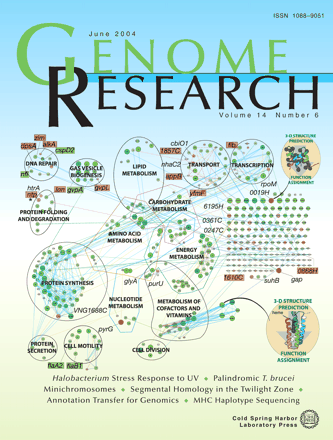
Annotation Transfer Between Genomes: Protein–Protein Interologs and Protein–DNA Regulogs
- First Published June 1, 2004
Methods
Automated Whole-Genome Multiple Alignment of Rat, Mouse, and Human
- First Published April 1, 2004
LETTER
Characterization of Evolutionary Rates and Constraints in Three Mammalian Genomes
- First Published April 1, 2004

Methods
Eukaryotic Regulatory Element Conservation Analysis and Identification Using Comparative Genomics
- First Published March 1, 2004

Methods
Identification of Promoter Regions in the Human Genome by Using a Retroviral Plasmid Library-Based Functional Reporter Gene Assay
- First Published June 12, 2003

LETTER
Quantitative Estimates of Sequence Divergence for Comparative Analyses of Mammalian Genomes
- First Published May 1, 2003
METHODS
LAGAN and Multi-LAGAN: Efficient Tools for Large-Scale Multiple Alignment of Genomic DNA
- First Published March 12, 2003


METHODS
Identification of Potential Interaction Networks Using Sequence-Based Searches for Conserved Protein-Protein Interactions or “Interologs”
- First Published December 1, 2001

LETTER
Human and Mouse Gene Structure: Comparative Analysis and Application to Exon Prediction
- First Published July 1, 2000
RESEARCH
Sequencing a Genome by Walking with Clone-End Sequences: A Mathematical Analysis
- First Published December 1, 1999
METHODS
A Genetic Strategy to Eliminate Self-Activator Baits Prior to High-Throughput Yeast Two-Hybrid Screens
- First Published November 1, 1999