

Racehorse genetics has not been a traditional topic considered in research laboratories; however, the development of molecular tools could provide new opportunities. Cold Spring Harbor Laboratory’s Banbury Center hosted a conference March 8–11, 1998, entitled “Horse Genomics and the Genetics of Factors Affecting Horse Performance.” Participants included scientists studying the genetics of the horse, horsemen, veterinarians, and scientists working in related fields with other species. The central questions for the conference were (1) How can we best investigate the genetic factors that influence racehorse performance? and (2) Has the Thoroughbred horse breeder exhausted the genetic potential within the breed to produce faster racehorses?
Genetic Diversity
Thoroughbred racehorses include some of the most valuable animals in the world. The world record sale price was set in 1985 when an untested yearling colt, named Seattle Dancer, sold at auction in Lexington, Kentucky, for the record price of $13.1 million. Clearly, this untrained, untried yearling commanded this record sale price based on its pedigree and the perception among horsemen that genetics is important. The Thoroughbred pedigree dates back to the late 1600s and may be the oldest recorded pedigree (Weatherby 1791) for any animal population. As a consequence of three centuries of selection, Thoroughbred racehorses are the fastest horses in the world over distances of 1–1.75 miles.
The Thoroughbred racehorse is descended from a group of English-bred horses, including stallions and mares, imported from North Africa and the Middle East as well locally available English mares (Willet 1981). According to pedigree records, the foundation stock numbered only 80 horses, with 21 contributing 80% of the pedigree for modern Thoroughbred horses (Fig. 1; Cunningham 1991). However, this estimate ignores additional mares introduced to the population when the Thoroughbred developed into an international breed and Thoroughbred stallions from England were crossed with non-Thoroughbred mares in the United States, Australia, and elsewhere during the 1800s (Willet 1981). Nevertheless, with such a narrow genetic base, one might expect very limited genetic variation and infertility problems associated with inbreeding. However, this does not appear to be the case.
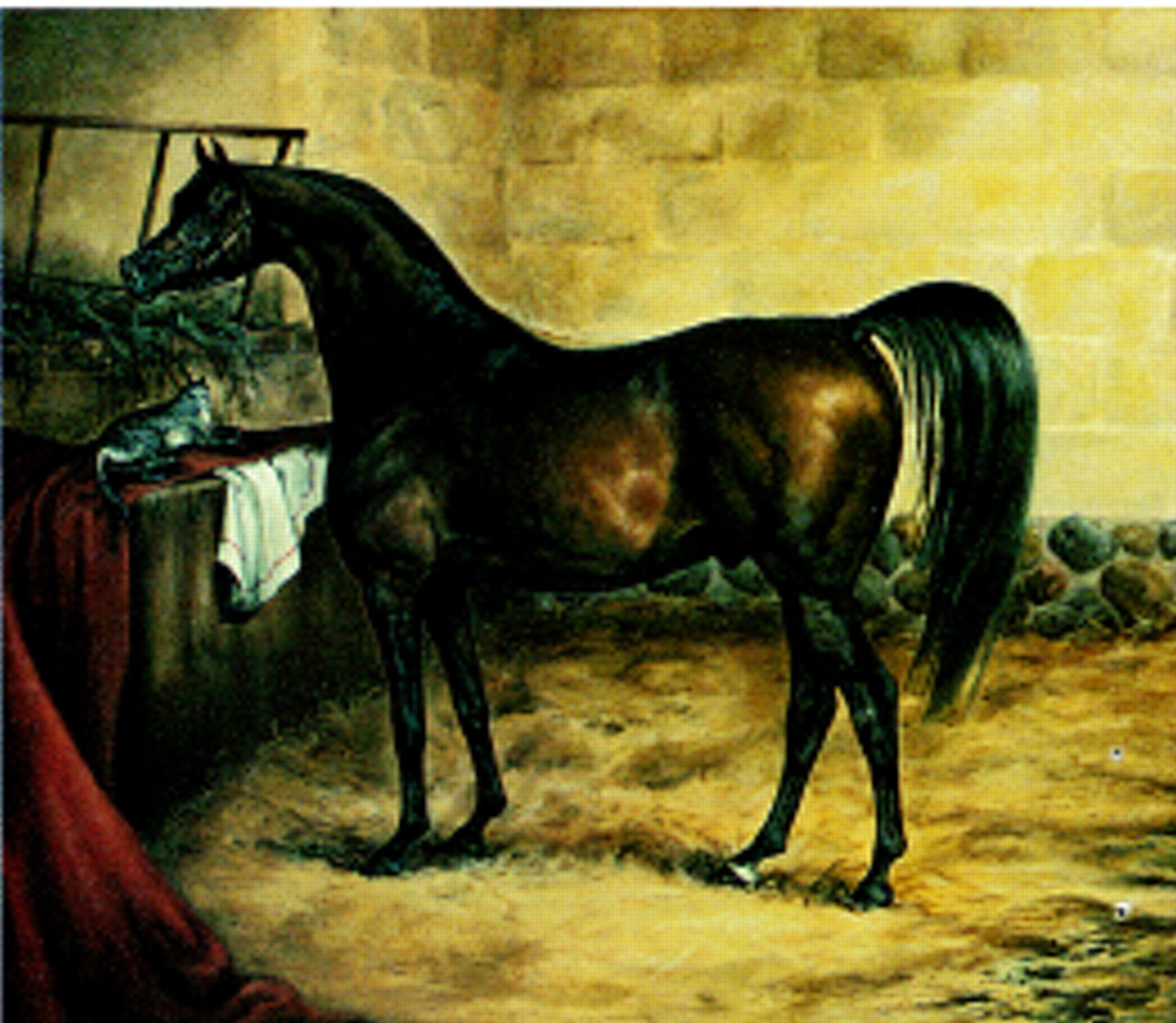
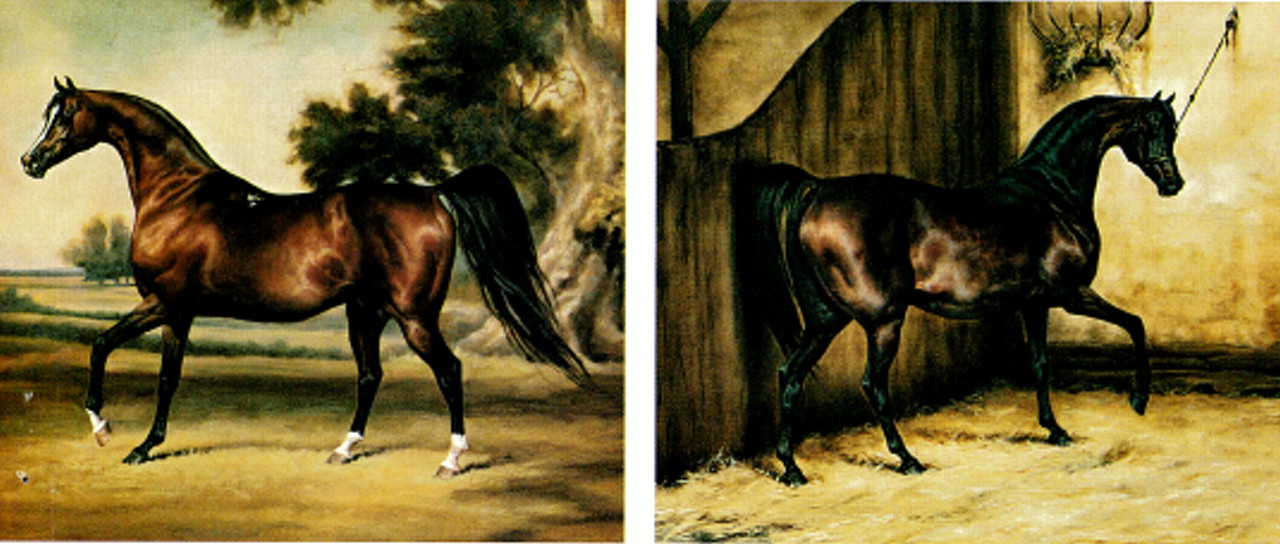
Only 10 horses have contributed >50% of the genes in the current generation of Thoroughbreds (Cunningham 1991). Four of these horses appear in the bloodlines of >30% of modern Thoroughbreds. The three horses shown are commonly called the pillars of the Stud Book.The Godolphin Arabian (top), born around 1725, contributed ∼14.6% of the genes in the present population of Thoroughbreds; the Darley Arabian (bottom left), born around 1688, contributed ∼7.5%; and the Byerly Turk (bottom right), born around 1690, contributed ∼4.8%. The fourth horse (not shown), the Curwen Bay Barb, born around 1699, contributed ∼5.5%. Six more horses add an additional 17.8%. (The paintings shown here are by Julie A. Wear. The Kentucky Derby Museum in Louisville has the Godolphin Arabian painting; the remaining two are in private collections.)
Horses are very fertile during their reproduction cycle when compared to other livestock. However, whereas cattle, pigs, sheep, and chickens are reproductively active all year long, horses are seasonal breeders. Normally, mares cease ovulation during the Fall months in response to decreasing daylight and then begin cycling again in early Spring when daylight increases. Because gestation is ∼335 days for the mare, this ensures that foals will be born during Spring months when lush grass is available to nourish the mother and the newborn foal. This also means that mares cannot conceive for several months of the year. Consequently, even though mares do have a foaling rate per cycle comparable to that of other livestock species (∼50%), their overall reproductive efficiency is less due to seasonal breeding behavior. This is a characteristic of the evolution and physiology of the horse and does not appear to be a consequence of inbreeding depression associated with increased genetic load or loss of genetic diversity.
Genetic diversity has been studied extensively among horses in connection with the development of blood-typing tests for use in parentage analysis. Although the Thoroughbred horse breed does exhibit less genetic diversity than other breeds, the difference is modest.Trommershausen-Bowling and Clark (1985) reported that heterozygosity at 14 loci for Thoroughbred horses was 0.378, whereas a breed expected to have extensive diversity, the American Standardbred horse, had a heterozygosity of 0.450. E.G. Cothran (pers. comm., this conference) reported similar results for 25 loci. Clearly, the Thoroughbred horse has less variation for these blood-typing markers than other breeds but is not in danger of becoming deficient in variation for these types of genes for many generations. However, only a few population geneticists really care about genetic diversity of blood group markers, and the central question remains: What is the extent of genetic diversity for racing performance among Thoroughbred horses?
Performance Limits
During the 1970s and 1980s several studies reported the heritability of racing times, race performance (win–place–show), handicapping, and money earned for Thoroughbred racehorses (including and reviewed inHintz 1980; Langlois 1980; Gaffney and Cunningham 1988). Racing time proved to be difficult to study, as only the winning time is recorded; heritability estimates for time were generally <0.20. Measures of money won, performance, and handicap estimates did suggest heritability between 0.30 and 0.40 (Langlois 1980). In the most recent study,Gaffney and Cunningham (1988) investigated heritability of racing performance between 1952 and 1977 using the scores from a handicapping system called TIMEFORM ratings. They reported a strong genetic component for this measure of racing performance and a steady genetic gain of 1% per year. But at the same time these same investigators reported that winning times have not improved significantly during the last 50 years for “classic races,” for example, races designed to match the best horses each year. Cunningham noted that winning times had been especially static for distance races and suggested that a physiological limit might have been reached, for example, for dealing with lactic acid buildup in muscle during performance. Therefore, although horses exhibited genetic variation for racing performance and the population continued to exhibit genetic gain during the period of study, the best times did not improve. Hill (1988) described these two observations as “Cunningham’s Paradox.” Have horse breeders reached the limit of achievement for racehorses? Twenty-five years ago Secretariat set the record for the Kentucky Derby at 1:59 2/5. Is this the limit?
In response, breeders and horse-racing enthusiasts state they pay little attention to winning times. Instead, riders, horse owners, breeders, and bettors are rewarded for horses that win races, regardless of time, and little effort is made to “beat the clock.” Furthermore, “fast tracks” are notoriously bad for the health of horses, causing damage to bones and tendons. Consequently, track surfaces are often treated to be softer, slower, and less likely to cause stress on the horse. Thus, modern racetracks may be slower than the tracks of 50 years ago. In this regard, Jim Rooney (pers. comm., this conference), an expert on biomechanics of the horse, noted that if there is a limit on performance of the racehorse, it may be on the ability of the horse to remain sound in the face of the tremendous stresses of racing. Indeed, one of the perplexing problems for the horseracing industry is that many horses never compete because of minor stress fractures, which eliminate horses from this competitive field, although they may become successful dressage or recreational riding horses (Jeffcott et al. 1982). Seattle Dancer, the $13.1 million yearling, had a very short racing career for this very reason. Conformation defects, developmental bone diseases, musculoskeletal diseases, and other complex health problems interfere with the success of racehorses. These are problems that may require molecular and genomic approaches before their origins are understood and their prevention effected by selection or treatment.
Horse Genetic Map
With the strong tradition of genetics, it is ironic that the horse is among the last of the major domestic animal species to have a genetic map. The horse industry is important for sports, entertainment, and recreation. The impact of the horse industry in the United States is large, including 6.9 million horses, generating 1.4 million full-time employment jobs, $1.9 billion in taxes, and having a $112.1 billion impact on the economy (Barents Group 1996). Horses are traded internationally, and superior horses are sought widely by buyers from all around the world. This is a strong incentive for a concerted effort to understand the genetics of horses. Toward this goal, specifically to improve the health of horses, scientists have begun work on a gene map for the horse.
Research on a gene map for the horse began in late 1995. Scientists from 25 laboratories around the world met in Lexington, Kentucky, and agreed to a collaborative effort to construct a 300-marker linkage map. The premise for the workshop was that no laboratory had the resources to do the work alone and, therefore, collaboration was very important. So far, accomplishments of the workshop include development of an international standard idiogram for the 64 chromosome horse karyotype (ISCNH 1997) and construction of the first linkage map for the horse (to be published during the coming year). In addition, scientists have been actively building the map using other approaches including synteny mapping, chromosome painting, and fluorescence in situ hybridization (FISH). Progress is readily apparent: In 1995 only 5 genes had been mapped to chromosomes for the horse; today chromosome locations have been published for >70 DNA markers using FISH (for review, see Bailey and Binns 1998). Currently the horse map has ∼230 markers mapped physically or by linkage to 25 of the 31 autosomes and the X and Y chromosomes. Two databases are being developed for this information:http://www.ri.bbsrc.ac.uk/cgi-bin/arkdb/browsers/browser.sh?species=horseand http://locus.jouy.inra.fr/cgi-bin/horsemap/Horsemap/main.pl. With 230 mapped loci, the horse map may exceed the cat map (141 loci) but is still well below the mapping levels for cattle (2338 loci), pigs (1708 loci), chickens (1893 loci), and sheep (627 loci). Meanwhile, scientists are collecting family material valuable for investigations of developmental bone diseases, muscle diseases, infectious diseases, and other traits important to horse breeders.
Finally, it should be noted that conference participants did not address the broader philosophical questions raised by Cunningham’s Paradox. What is the limit on performance of a biological system under selection? If horses are not at their limit, how might they evolve? For myself, I will bet you that 100 years from now, Secretariat’s time in the Kentucky Derby will be worth third place.
Acknowledgments
The Banbury Conference was supported by the Dorothy Russell Havemeyer Foundation and Robert McNair. Charlie Harris conceived the idea for the conference. Jan Witkowski and Doug Antozak were co-organizers.
Footnotes
[1] E-MAIL ; FAX (606) 257-8542.
REFERENCES
- ↵E. BaileyM. Binns(1998) Int. Lab. Anim. Rev. (in press)..
- ↵Barents Group (1996) Volume 1: National Summary. (American Horse Council Foundation, Washington, D.C.).
- ↵P. Cunningham(1991) Sci. Am. 265:92–98.
- ↵B. GaffneyE.P. Cunningham(1988) Nature 332:722–724.
- ↵W.G. Hill(1988) Nature 332:678.
- ↵R.L. Hintz(1980) J. Anim. Sci. 51:582–594.
- ↵International System for Cytogenetic Nomenclature for the Horse (ISCNH) (1997) Chrom. Res. 5:433–443.
- ↵L.B. JeffcottP.D. RossdaleJ. FreestoneC.J. FrankP.F. Towers-Clark(1982) Equine Vet. J. 14:185–198.
- ↵B. Langlois(1980) Livestock Prod. Sci. 7:591–605.
- ↵A. Trommershausen-BowlingR.S. Clark(1985) Anim. Blood Groups Biochem. Genet. 16:93–108.
- ↵J. Weatherby(1791) The general stud book. (Newmarket, UK).
- ↵P. Willet(1981) The classic racehorse. (Kentucky University Press, Lexington, KY).