


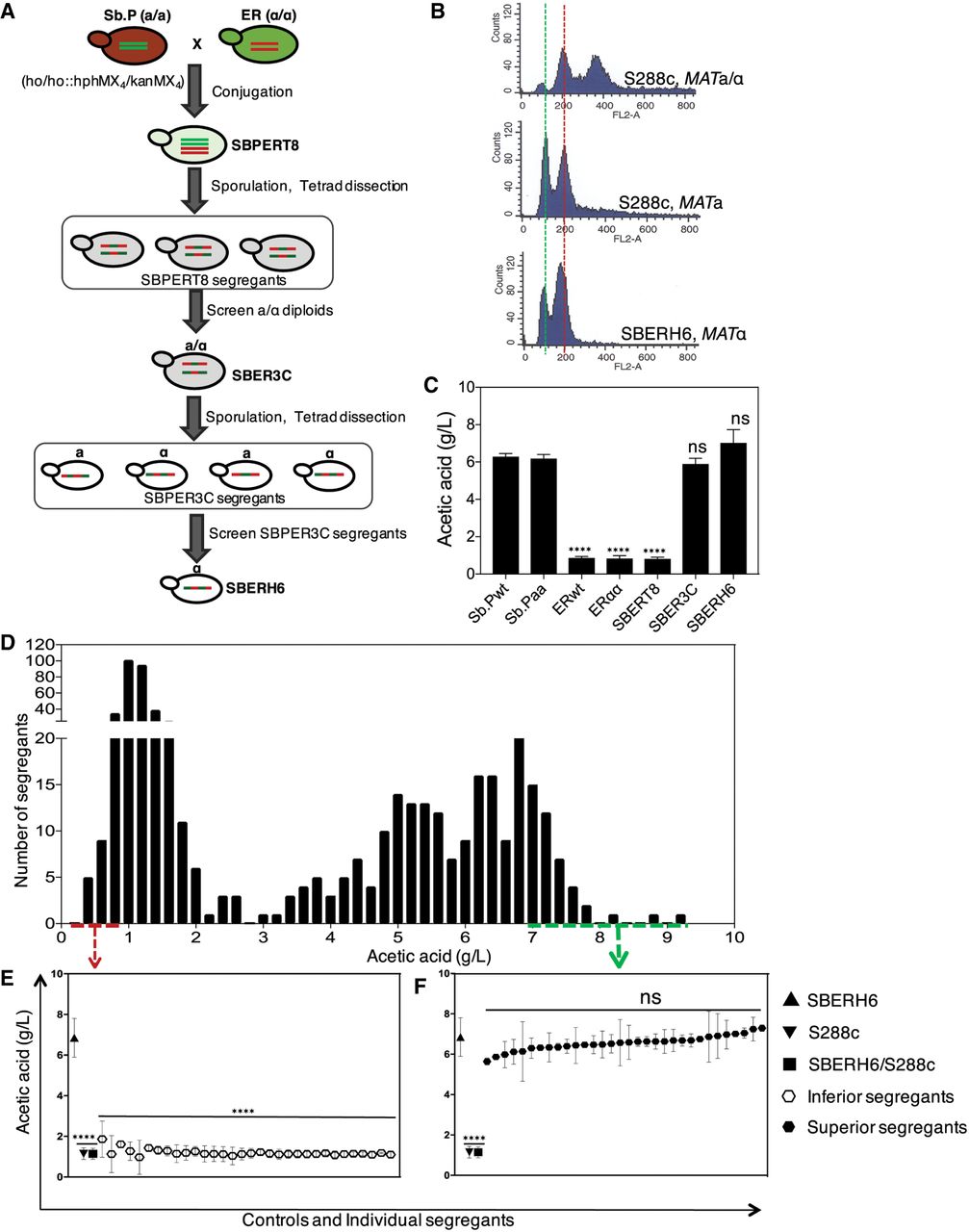
Origin of the superior haploid parent strain SBERH6 and phenotyping of its progenitors and segregants after crossing with the inferior haploid parent strain S288c. (A) Breeding scheme used to obtain the superior haploid strain SBERH6. (B) Determination of SBERH6 ploidy by comparison with diploid and haploid S288c strains. (C) Acetic acid production level of SBERH6 and its progenitor strains. Sb.Pwt and ERwt are wild-type Sb.P and ER strains, respectively. Sb.Paa and ERαα are derivatives of Sb.P and ER with homozygous MAT loci. SBERT8 is a tetraploid hybrid derived from Sb.Paa and ERαα, while SBER3C is a diploid segregant of SBERT8. SBERH6 is a segregant from SBER3C. Bars show mean values of two independent experiments, while error bars show standard deviation. Data were analyzed by one-way ANOVA (Dunnet correction for multiple comparisons). Significant differences for acetic acid accumulation in comparison with Sb.Pwt are indicated with asterisks, (****) P < 0.0001, (ns) nonsignificant. (D) Distribution curve of acetic acid production in segregants of the SBERH6/S288c hybrid diploid strain. (E,F) Acetic acid production of segregants selected for the inferior pool (left panel), superior pool (right panel), and control strains SBERH6, S288c, and SBERH6/S288c. Values are means from two independent experiments, while error bars represent standard deviation. Data were analyzed by one-way ANOVA (Dunnet correction for multiple comparisons). Significantly different values for acetic acid accumulation in comparison with SBERH6 are indicated with asterisks, (****) P < 0.0001, (ns) nonsignificant.



