


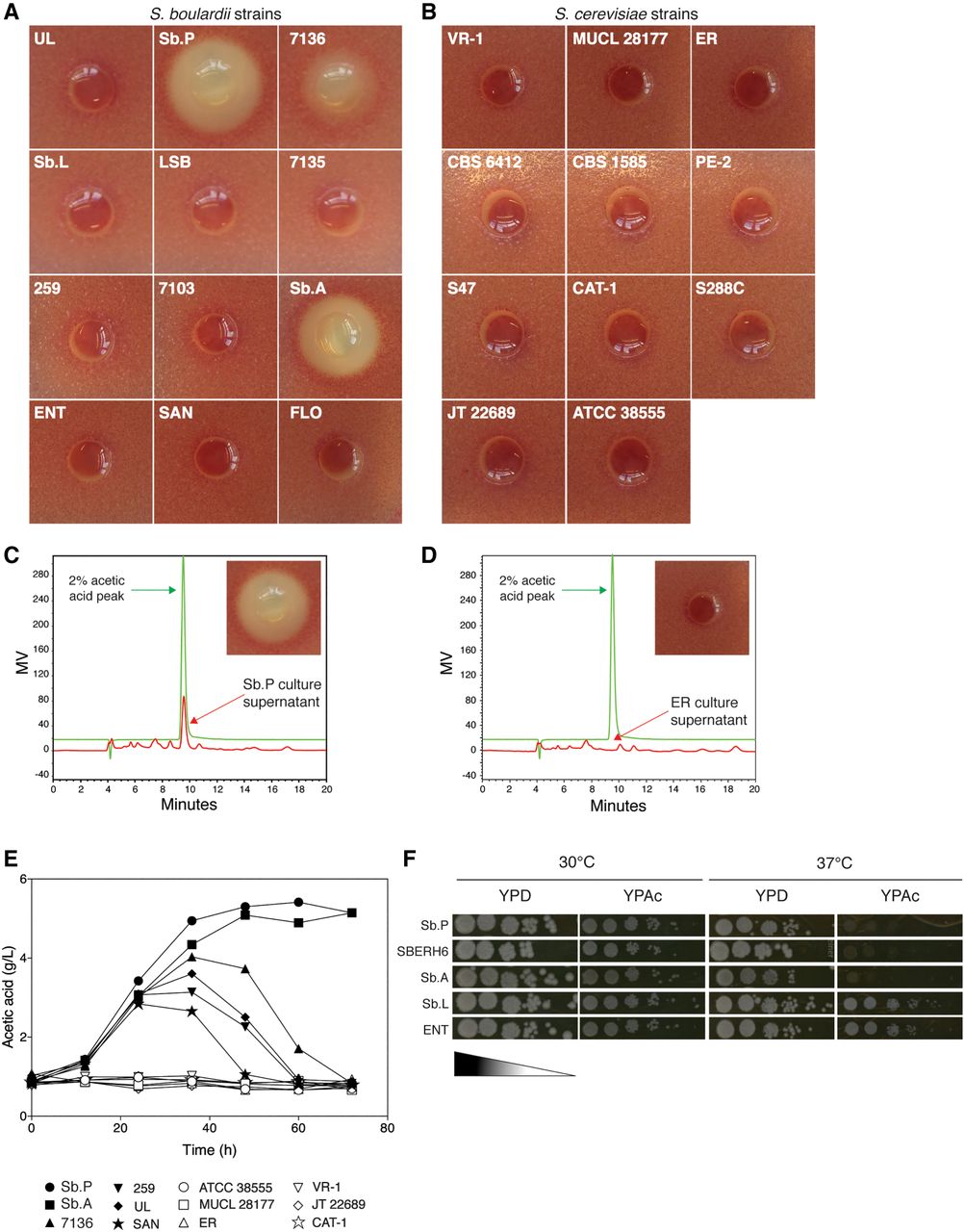
S. boulardii produces acetic acid at levels with antibacterial potency. (A,B) Agar-well diffusion assays assessing antibacterial activity of cell-free YPD with 2% glucose culture supernatants from S. boulardii strains (left panel) and S. cerevisiae strains (right panel), as visualized with plates containing E. coli MG1655 as indicator strain and staining of cells with iodonitrotetrazolium chloride (INT). (C,D) HPLC chromatograms of cell-free culture supernatants (red line) from Sb.P (S. boulardii) and ER (S. cerevisiae) compared with the 2% acetic acid standard (green line). Insets: antibacterial activity agar-well diffusion assay using E. coli MG1655 as indicator strain. (E) Acetic acid accumulation as a function of time for wild-type S. boulardii (Sb.P, Sb.A, 7136, 259, UL, SAN) (filled symbols) and S. cerevisiae strains (ATCC 38555, MUCL 28177, ER, VR-1, JT22689, CAT-1) (open symbols). (F) Spot growth assays on solid YPD (2%) and YPAc (1%, pH 5) agar medium for S. boulardii strains capable of accumulating very high acetic acid levels (Sb.P and Sb.A) versus strains with lower and transient acetic acid accumulation (Sb.L and ENT). SBERH6 is a hybrid haploid segregant derived from Sb.P and ER with very high acetic acid accumulation capacity. Gradient dark color on wedge indicates cell culture dilution strength prior to spotting.



