
Abstract
X chromosomes are preferentially transmitted through females, which may favor the accumulation of X-linked alleles/genes with female-beneficial effects. Numerous studies have shown that genes with sex-biased expression are under- or over-represented on the X chromosomes of a wide variety of organisms. The patterns, however, vary between different animal species, and the causes of these differences are unresolved. Additionally, genes with sex-biased expression tend to be narrowly expressed in a limited number of tissues, and narrowly expressed genes are also non-randomly X-linked in a taxon-specific manner. It is therefore unclear whether the unique gene content of the X chromosome is the result of selection on genes with sex-biased expression, narrowly expressed genes, or some combination of the two. To address this problem, we measured sex-biased expression in multiple Drosophila species and at different developmental time points. These data were combined with available expression measurements from Drosophila melanogaster and mouse to reconcile the inconsistencies in X-chromosome content among taxa. Our results suggest that most of the differences between Drosophila and mammals are confounded by disparate data collection/analysis approaches as well as the correlation between sex bias and expression breadth. Both the Drosophila and mouse X chromosomes harbor an excess of genes with female-biased expression after controlling for the confounding factors, suggesting that the asymmetrical transmission of the X chromosome favors the accumulation of female-beneficial mutations in X-linked genes. However, some taxon-specific patterns remain, and we provide evidence that these are in part a consequence of constraints imposed by the dosage compensation mechanism in Drosophila.
Sexual dimorphism is widespread among animal species. Because males and females share nearly identical genomes, differences in phenotypes are in part the result of the biased expression of certain genes in one sex or the other (Ellegren and Parsch 2007); these genes are said to have “sex-biased expression.” Selection pressures can differ between males and females, and these sex-specific or sexually antagonistic selection pressures are expected to act on genes with sex-biased expression (Vicoso and Charlesworth 2006; Innocenti and Morrow 2010). X chromosomes are found in females two-thirds of the time, whereas autosomes are equally transmitted via the two sexes. The net selection pressure acting on X-linked genetic variation may therefore be biased in favor of female-beneficial alleles (Rice 1984; Connallon and Clark 2010; Fry 2010). Assuming that genes with sex-biased expression perform sex-specific-beneficial functions (Innocenti and Morrow 2010), the X-linkage of genes with sex-biased expression can thus be a valuable readout of historical sex-specific selection pressures (Vicoso and Charlesworth 2006).
The degree to which the sexes are dimorphic also varies across tissues. For example, some somatic tissues are highly homogeneous between the sexes, other somatic tissues are unique to one sex (e.g., male accessory glands in insects, the prostate in mammals), and the gonads are extremely differentiated between males and females. Each tissue expresses a subset of the genes in a genome—the more sexually dimorphic the tissue, the more differentiated is the pattern of female versus male gene expression in that tissue (Jin et al. 2001; Arbeitman et al. 2002, 2004; Parisi et al. 2003, 2004). In addition, the expression breadth of individual genes can range from broad (i.e., the gene is expressed in multiple tissues/developmental stages/environments) to narrow (expressed in very few tissues/stages/environments). Sex-specific selection pressures may differ if a gene is narrowly expressed in a sex-limited reproductive tissue or a tissue shared by both sexes (Meisel 2011). Furthermore, sexually antagonistic selection pressures are expected to be greatest in sexually mature adults and minimal in sexually immature juveniles (Chippindale et al. 2001; Rice and Chippindale 2001; Gibson et al. 2002). The fitness of a genotype is a composite of the performance of that genotype integrated across all tissues, developmental stages, and environments in which the gene(s) is/are expressed. Therefore, if one is to interpret the selection pressures acting on genes based on their X-linkage, one must consider both when and where each gene is expressed in the organism.
Multiple experiments have revealed that genes with male- or testis-biased expression are under-represented on the Drosophila X chromosome, while there is an excess of X-linked genes with female- and ovary-biased expression (e.g., Parisi et al. 2003; Ranz et al. 2003; Sturgill et al. 2007; Mikhaylova and Nurminsky 2011). Additionally, the right arm (XR or neo-X) of the Drosophila pseudoobscura X chromosome (which is autosomal in most other species) also contains a significant deficiency of genes with male-biased expression (Sturgill et al. 2007), suggesting that the paucity of X-linked genes with male-biased expression is an emergent property of the Drosophila X chromosome and not intrinsic to the proto-X.
Three hypotheses have been put forth to explain the deficiency of genes with male-biased expression on the Drosophila X chromosome. First, sexually antagonistic selection may prevent the accumulation of X-linked male-beneficial mutations because the X chromosome is preferentially transmitted through females (Rice 1984; Connallon and Clark 2010). Second, male meiotic sex-chromosome inactivation (MSCI) may prevent the expression of X-linked genes during spermatogenesis (Betrán et al. 2002; Hense et al. 2007; Vibranovski et al. 2009), which could decrease the proportion of X-linked genes with testis-biased expression. Third, dosage compensation, via hyperexpression, of the hemizygous X chromosome in males may limit the degree to which X-linked genes can acquire male-biased expression (Vicoso and Charlesworth 2009; Bachtrog et al. 2010). It is still unclear, however, the extent to which sexual antagonism, MSCI, and “dosage limits” each contributes to the deficiency of X-linked genes with male-biased expression.
In mammals, the X chromosome also harbors a unique collection of gene types, but in a way that is thought to differ from the patterns in Drosophila (Vicoso and Charlesworth 2006; Gurbich and Bachtrog 2008). For example, the Drosophila accessory gland and the mammalian prostate are both male-limited reproductive organs that contribute seminal proteins to the ejaculate. The Drosophila melanogaster X chromosome is depauperate in genes encoding accessory gland proteins (ACPs) (Wolfner et al. 1997; Swanson et al. 2001; Mueller et al. 2005) and genes with accessory-gland-biased expression (Mikhaylova and Nurminsky 2011), while there is an excess of X-linked human genes with prostate-biased expression (Lercher et al. 2003).
In addition, unlike in Drosophila, the mammalian X chromosome has an excess of genes with testis-biased expression (Wang et al. 2001; Lercher et al. 2003; Mueller et al. 2008). A closer examination, however, has revealed that this excess is limited to genes with pre-meiotic expression, whereas post-meiotically expressed genes are under-represented on the X chromosome because of MSCI (Khil et al. 2004). Similarly, the paucity of X-linked testis-expressed D. melanogaster genes may be limited to genes expressed during later stages of spermatogenesis such as meiosis (Vibranovski et al. 2009; Gan et al. 2010). Furthermore, new genes with testis- or male-biased expression tend to be preferentially located on the X or Z chromosome in Drosophila (Zhang et al. 2010a), mammals (Zhang et al. 2010b), and chicken (Ellegren 2011). Therefore, the X- (or Z-) linkage of testis-expressed genes may not differ substantially between taxa.
Analyses of non-reproductive tissues have also revealed similarities in the X-linkage of genes with sex-biased expression in Drosophila and mammals. For example, genes with male-biased expression in mouse brain are over-represented on the X chromosome (Yang et al. 2006), as are genes with male-biased expression in the D. melanogaster head (Chang et al. 2011). Also, genes with female-biased expression in brain, liver, and muscle are over-represented on the mouse X chromosome (Yang et al. 2006), and there is evidence for an excess of X-linked D. melanogaster genes with female- or ovary-biased expression (Parisi et al. 2003; Ranz et al. 2003; Mikhaylova and Nurminsky 2011). These results suggest that, while there are some differences in gene content between the Drosophila and mammalian X chromosomes, they may be more similar than previously thought (Vicoso and Charlesworth 2006; Gurbich and Bachtrog 2008). The remaining differences between the X chromosomes could be the result of differences in dosage compensation (Vicoso and Charlesworth 2006), different dominance coefficients of sexually antagonistic genetic variants (Rice 1984), or artifacts of how expression data are collected and analyzed in each taxon. To distinguish between these hypotheses, we must analyze comparable data from Drosophila and mouse using the same approaches.
In addition to the X chromosome harboring a non-random proportion of genes with sex-biased expression, the expression breadth of X-linked genes also differs from that of autosomal genes: The D. melanogaster X chromosome contains a deficiency of narrowly expressed genes (Mikhaylova and Nurminsky 2011), while there is an excess of X-linked narrowly expressed human genes (Lercher et al. 2003). Genes with sex-biased expression in non-reproductive tissues tend to be more narrowly expressed in both D. melanogaster and mouse (Mank et al. 2008; Meisel 2011). Additionally, D. melanogaster genes with female-biased expression are often highly expressed in ovary, and ovary-expressed genes tend to be broadly expressed (Parisi et al. 2004; Meisel 2011). It is therefore not clear whether the selection pressures that drive differences in gene content between the X chromosome and the autosomes are acting on genes with sex-biased expression, narrowly expressed genes, or some combination of the two (Mikhaylova and Nurminsky 2011).
The X-linkage of genes with sex-biased expression is an informative metric of sex-specific selection pressures (Vicoso and Charlesworth 2006), but to properly interpret these patterns and compare across taxa, one must control for when and where genes are expressed. To address the limitations of previous studies, we measured sex-biased expression in the heads of four Drosophila species (D. melanogaster, D. pseudoobscura, Drosophila willistoni, and Drosophila mojavensis) using a combination of microarrays and high-throughput RNA sequencing (RNA-seq), in whole flies from three species (D. melanogaster, D. pseudoobscura, and D. mojavensis) using RNA-seq, in thorax and abdomen of D. willistoni using RNA-seq, and in larvae of D. melanogaster using microarrays. D. pseudoobscura and D. willistoni are particularly informative because they have independently derived X-autosome fusions (creating neo-X chromosome arms) that involved the same ancestral autosome (see Meisel et al. 2009). We combined these expression measurements with available data on sex-biased and tissue-specific expression from both D. melanogaster and Mus musculus to more comprehensively examine how and why gene content differs between the X chromosome and autosomes in Drosophila and mammals.
Results
X-linkage and sex-biased expression in Drosophila
To confirm the results of microarray analyses (Parisi et al. 2003; Ranz et al. 2003; Sturgill et al. 2007), we measured sex-biased expression in whole flies using RNA-seq. As in the microarray experiments, our RNA-seq data show that the Drosophila X chromosome and D. pseudoobscura neo-X contain a dearth of genes with male-biased expression. We also find that genes with female-biased expression are over-represented on the X and neo-X chromosomes, and there is an excess of genes with male-biased expression on the arm homologous to D. melanogaster chromosome 2L (Muller element B) in all species (Fig. 1A), confirming patterns observed previously only in D. melanogaster (Parisi et al. 2003; Ranz et al. 2003). Most sex-biased expression is the result of genes expressed in reproductive tissues (Parisi et al. 2003, 2004), so we measured expression in abdomen from male and female D. willistoni using RNA-seq to determine if the ancestral and neo-X chromosome arms have an excess/deficiency of genes with sex-biased expression. Genes with male-biased expression in D. willistoni abdomen are, indeed, under-represented, and genes with female-biased expression are over-represented on both arms of the X chromosome (Fig. 1A).
Frequency of genes with sex-biased expression on each chromosomal arm of Drosophila genomes. The percentages of genes on each chromosome arm that have female-biased (white), male-biased (black), or unbiased (gray) expression are indicated by the height of the bars. (Dashed lines) Genome-wide percent of genes in each sex-bias class. (*) Significant deviations between observed and expected frequencies (as determined by a permutation test); (*) P < 0.05, (**) P < 0.01, (***) P < 0.001. Chromosome arms are sorted such that homologous arms are in the same order for each species with the dot chromosome (Muller element F) omitted: (Dmel) D. melanogaster; (Dpse) D. pseudoobscura; (Dwil) D. willistoni; (Dmoj) D. mojavensis. Expression was measured with RNA-seq using RNA from whole flies (Dmel, Dpse, and Dmoj) or abdomen (Dwil) (A), microarrays or RNA-seq from head (B), RNA-seq from thorax (C), and microarrays using RNA from third instar larva (D). In the case of the RNA-seq data, reads were aligned to the genome using BWA, and differential expression was determined using edgeR (see Methods). Species in panels A and B are sorted by increasing evolutionary distance from D. melanogaster.
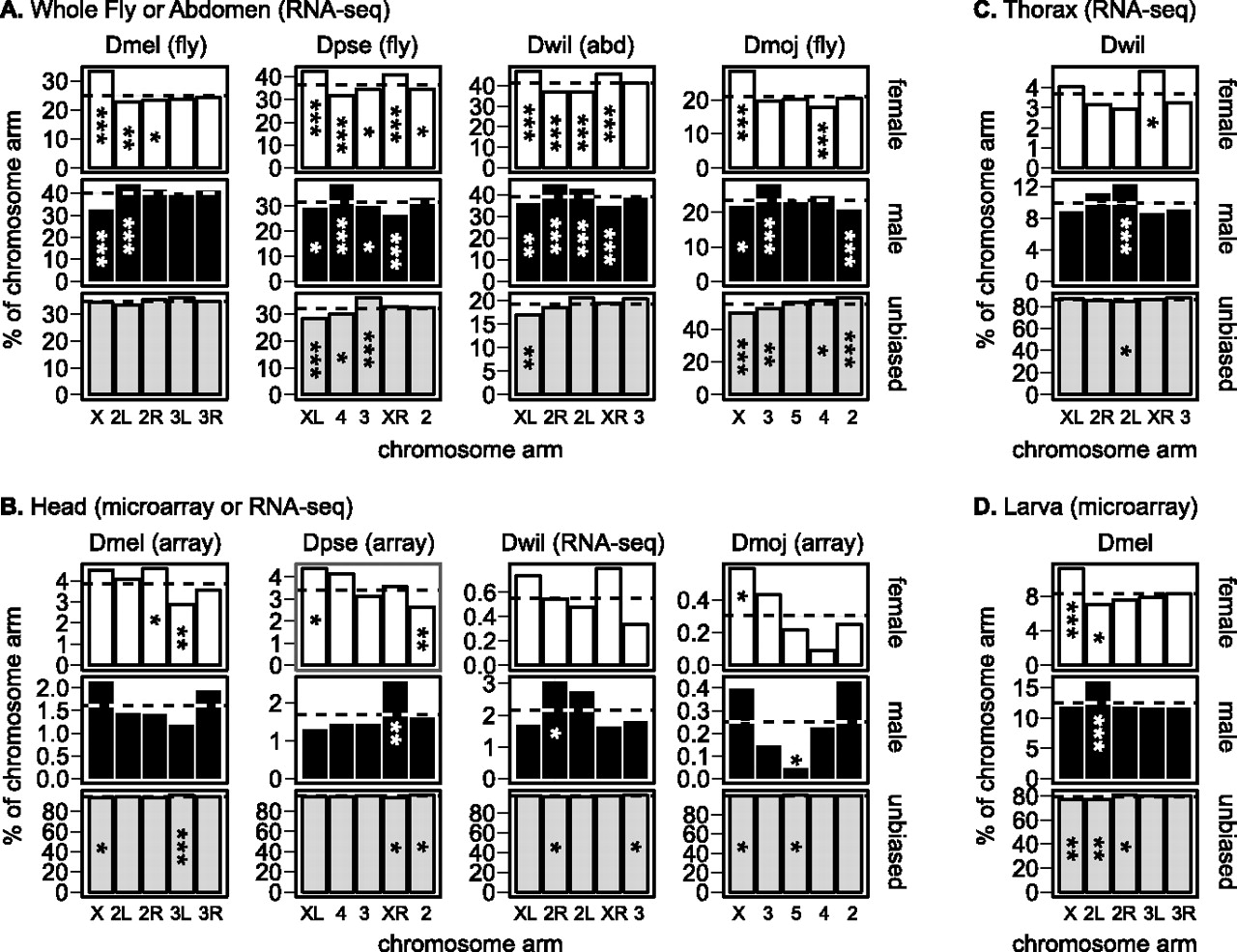
To test whether genes with sex-biased expression in non-reproductive tissues are over- or under-represented on the X chromosome, we measured expression in heads of males and females of four Drosophila species using microarrays and RNA-seq. A previous analysis of RNA-seq data found an excess of X-linked genes with male-biased expression in D. melanogaster head (Chang et al. 2011), and we confirmed this pattern with our RNA-seq data (Supplemental Fig. 1). While we detect a similar trend in our microarray data, the excess is not significant (Fig. 1B). However, the X-linkage of genes with male-biased expression in non-reproductive tissues in other species is not consistent with the pattern in D. melanogaster. For example, genes with male-biased expression in head are not significantly over-represented on the D. mojavensis X chromosome when we analyze our microarray data (Fig. 1B), and they are under-represented on the X chromosome in our RNA-seq data (Supplemental Fig. 1). The ancestral X chromosome in D. pseudoobscura is similarly depauperate in genes with male-biased expression in head (Fig. 1B; Supplemental Fig. 1). Interestingly, we detect an excess of genes with male-biased expression on the D. pseudoobscura neo-X based on our microarray data (Fig. 1B), but the RNA-seq data show the opposite pattern (Supplemental Fig. 1). In addition, genes with male-biased expression in head are neither significantly over- nor under-represented on the D. willistoni X or neo-X (Fig. 1B; Supplemental Fig. 1), and genes with male-biased expression in thorax may be under-represented on the D. willistoni X chromosome (Fig. 1C; Supplemental Fig. 2). Therefore, unlike the pattern observed when reproductive tissues are included, there is not a consistent under-representation of X-linked genes with male-biased expression in non-reproductive tissues. On the other hand, genes with female-biased expression in head or thorax tend to be over-represented on the X chromosome (Fig. 1B,C; Supplemental Figs. 1, 2), consistent with the pattern we observe when reproductive tissues are included (Fig. 1A).
We next tested whether ontogenic changes in sex-specific selection pressures (Chippindale et al. 2001; Rice and Chippindale 2001; Gibson et al. 2002) affect the X-linkage of genes with sex-biased expression by measuring gene expression in female and male wandering third instar larvae of D. melanogaster using microarrays. We failed to detect a significant deficiency of X-linked genes with male-biased expression in larvae (Fig. 1D), suggesting that the factors responsible for the paucity of X-linked genes with male-biased expression do not on average act on larval-expressed genes. However, genes with male-biased expression in both larvae and adults may be under-represented on the X chromosome (Supplemental Fig. 3), indicating that the dearth of X-linked genes with male-biased expression may not be solely the result of genes specifically expressed in adults. We also find that genes with male-biased expression in larvae are over-represented on chromosome arm 2L, and genes with female-biased expression are over-represented on the X chromosome, consistent with the patterns observed in adults (Fig. 1). These trends are also observed when we consider genes that have the same sex-biased expression in both larvae and adults (Supplemental Fig. 3).
On the X-linkage of Drosophila genes with testis-biased expression
We confirmed that D. melanogaster genes with enriched expression in testis relative to ovary are under-represented on the X chromosome (Supplemental Fig. 4; Sturgill et al. 2007; Vibranovski et al. 2009). Genes with testis-biased expression in mammals are identified by comparing across multiple tissues (e.g., Lercher et al. 2003). To parallel that analysis, we tested for a deficiency of X-linked D. melanogaster genes with testis-biased expression using microarray measurements of expression from 14 adult tissues (Chintapalli et al. 2007).
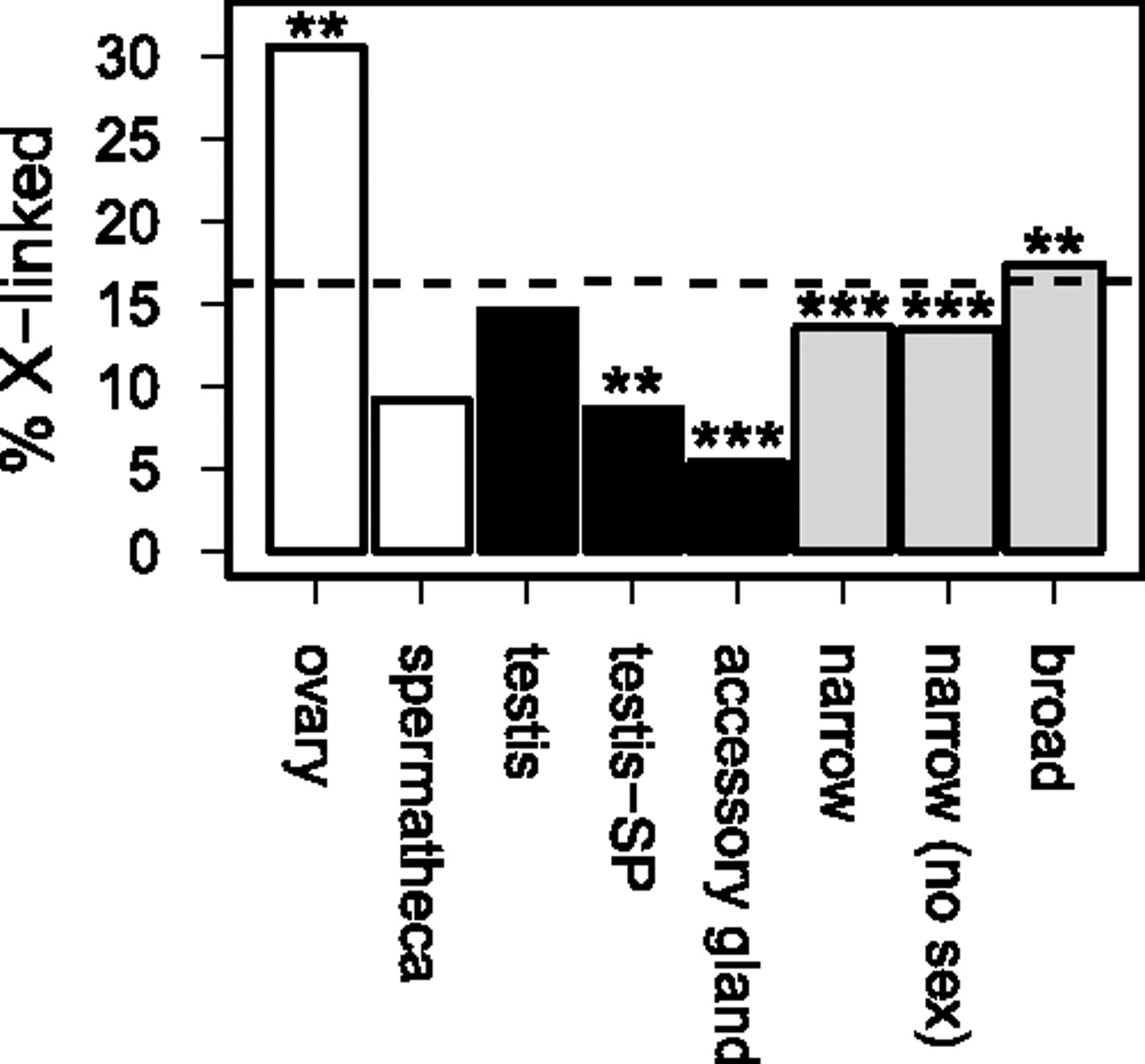
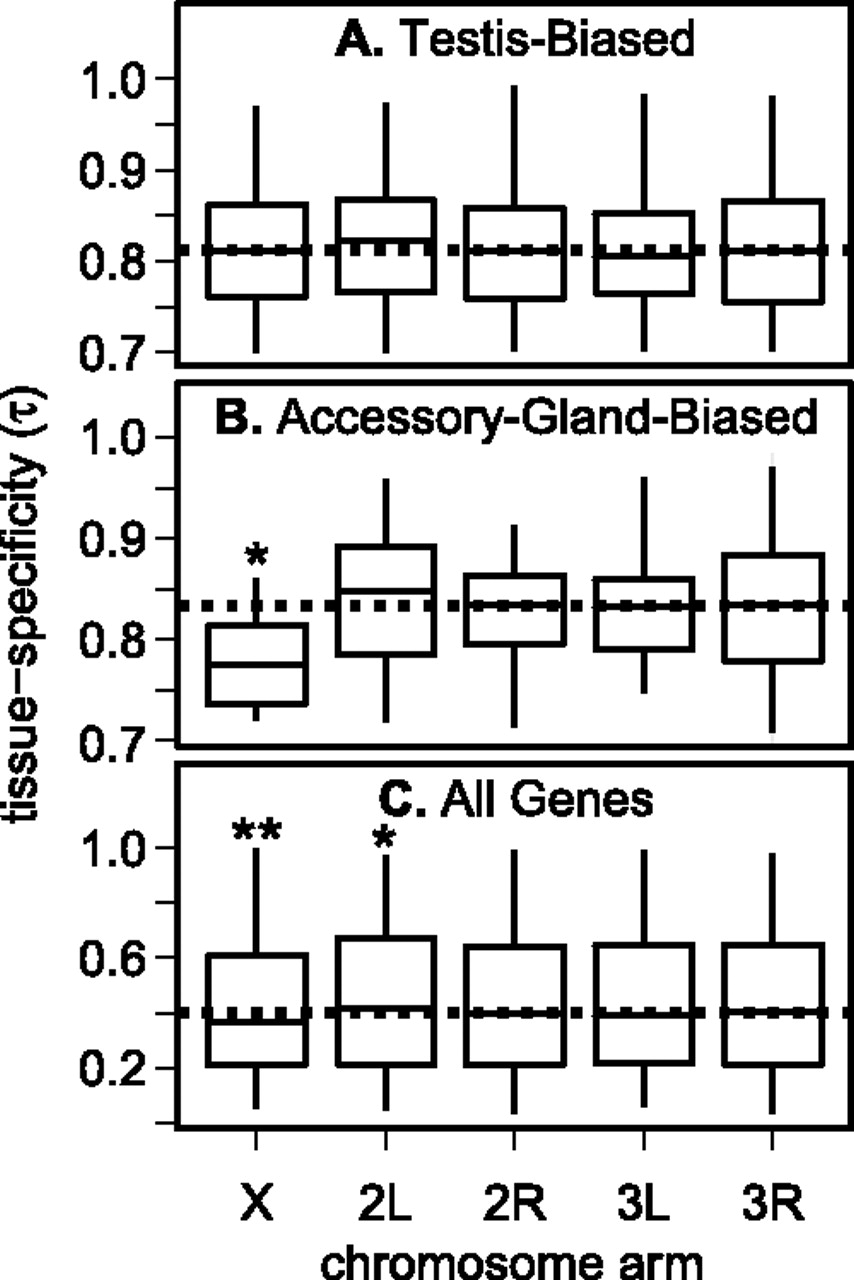
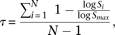
First, we applied an approach in which the minimal ratio of testis expression level (microarray signal intensity) to the expression level in other tissues is used as a measure of the degree of testis-biased expression (Mikhaylova and Nurminsky 2011), and we failed to detect a significant deficiency of X-linked genes with testis-biased expression (Supplemental Fig. 5). Next, we calculated τ (Yanai et al. 2005), a metric of expression breadth that ranges from 0 (for broadly expressed genes) to 1 (for narrowly expressed genes). We applied τ cutoffs to call genes as narrowly expressed in a single tissue or broadly expressed in multiple tissues, and we did not observe a significant deficiency of X-linked genes with testis-biased expression (Fig. 2), even at the highest τ cutoffs (Supplemental Fig. 6). This result is not because of low power to detect significant differences—genes with testis-biased expression are the largest class of narrowly expressed genes, which means that we have the greatest power to detect significant differences from the expectation. In addition, X-linked genes with testis-biased expression have statistically indistinguishable τ values when compared with autosomal genes with testis-biased expression (Fig. 3A; Supplemental Fig. 7), demonstrating that there is not a difference in the degree of testis-biased expression between X-linked and autosomal genes.
X-linkage of D. melanogaster broadly and narrowly expressed genes. (Barplots) Percent of D. melanogaster genes with narrow expression (τ > 0.7) in each of four sex-limited tissues, with testis-biased expression and detectable in the sperm proteome (testis-SP), narrowly expressed in any of 14 tissues (narrow), narrowly expressed in one of 10 non-sex-limited tissues (no sex) or broadly expressed genes (τ ≤ 0.4) that are X-linked. (Dashed lines) Percent of the entire genome that is X-linked. (*) Observed values that significantly differ from the expectation based on the size of the X chromosome as determined by a permutation test; (**) P < 0.01, (***) P < 0.001.
Distribution of τ for each D. melanogaster chromosome arm. (Boxes) Interquartile range; (horizontal line in the middle of the boxes) median value; (whiskers) 1.5× the interquartile range (outliers were omitted), (dashed line) genome-wide average. Significant differences between τ for a given chromosome and the rest of the genome were assessed using a Mann-Whitney test; (*) P < 0.05; (**) P < 0.005. Distributions of τ were calculated for (A) genes with testis-biased expression (τ > 0.7), (B) genes with accessory-gland-biased expression (τ > 0.7), and (C) all genes.
Interestingly, genes with testis-biased expression that encode components of the sperm proteome (Dorus et al. 2006; Wasbrough et al. 2010) are under-represented on the X chromosome (Fig. 2; Supplemental Fig. 8). Therefore, while genes with enriched expression in testis relative to ovary are under-represented on the X chromosome (Sturgill et al. 2007; Vibranovski et al. 2009), the only genes with testis-biased expression that are deficient on the X chromosome when additional tissues are considered are those that encode proteins incorporated in the ejaculate.
Dosage compensation, sex-specific selection, and the X-linkage of Drosophila genes with accessory-gland-biased expression
We detect a significant deficiency of genes with accessory-gland-biased expression on the D. melanogaster X chromosome (Fig. 2; Supplemental Figs. 5, 6), consistent with the paucity of X-linked ACP genes (Wolfner et al. 1997; Swanson et al. 2001; Mueller et al. 2005). X-linked genes with accessory-gland-biased expression also tend to have broader expression profiles than autosomal genes with accessory-gland-biased expression (Fig. 3B; Supplemental Fig. 7). Therefore, genes with accessory-gland-biased expression are under-represented on the X chromosome, and those that are X-linked are not as narrowly expressed in accessory gland as are autosomal genes. This suggests that the exclusion of accessory-gland-expressed genes from the X chromosome may be responsible for the dearth of X-linked genes with male-biased expression. However, if we exclude genes with accessory-gland-biased expression, the X chromosome is still depauperate in genes with male-biased expression (Supplemental Fig. 9), demonstrating that the deficiency of X-linked accessory-gland-biased genes is not solely responsible.
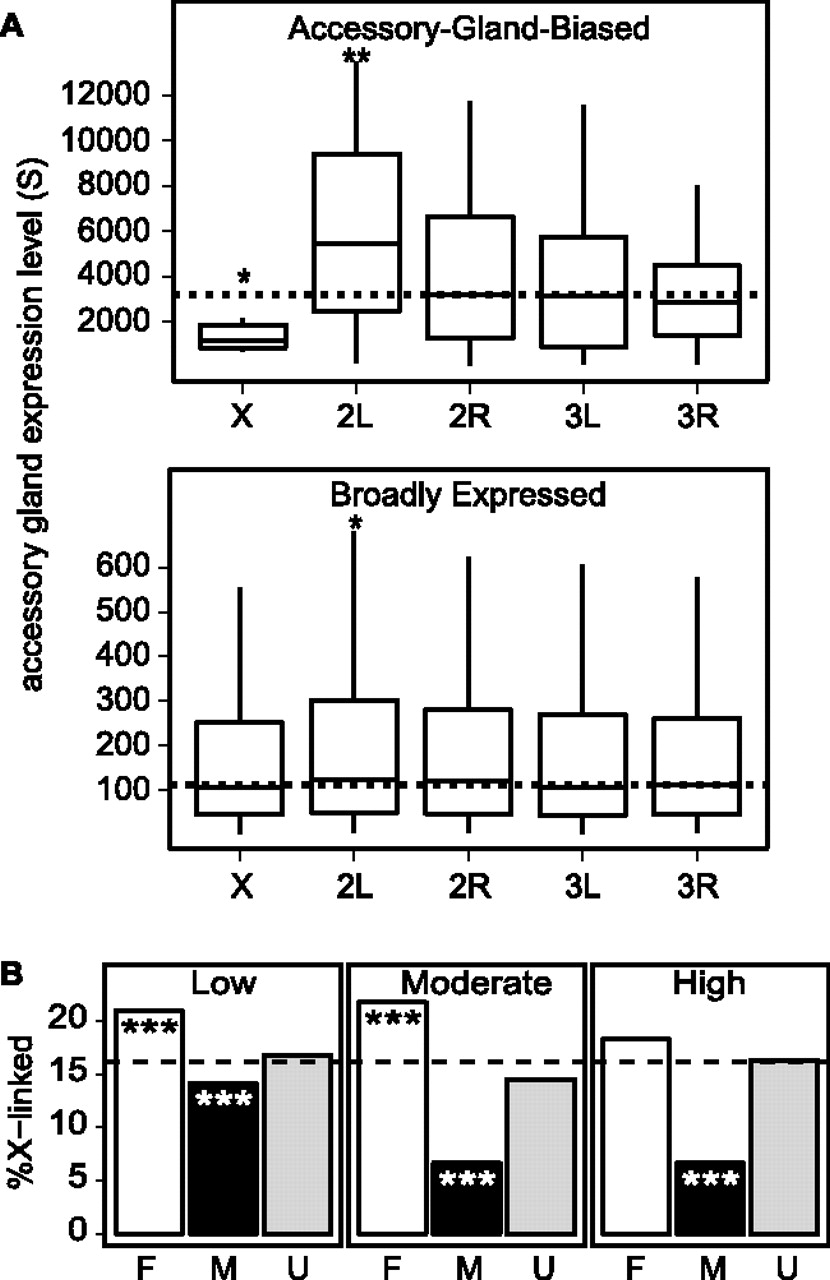
X-linked genes with accessory-gland-biased expression have lower expression levels in accessory gland than similarly narrowly expressed autosomal genes (Fig. 4A; Supplemental Fig. 10), suggesting that limits imposed by dosage compensation may be responsible for the dearth of genes with accessory-gland-biased expression on the X chromosome (Vicoso and Charlesworth 2009; Bachtrog et al. 2010). In comparison, the accessory-gland-expression levels of broadly expressed genes do not differ significantly between the X chromosome and the autosomes (Fig. 4A). If dosage limits in accessory gland were responsible for the paucity of X-linked genes with male-biased expression, we would expect to see the greatest deficiency of X-linked genes with male-biased expression among those genes that are highly expressed in accessory gland. Using sex-biased expression calls from our RNA-seq data, we found that genes with male-biased expression that are expressed in accessory gland at low, moderate, and high levels are all under-represented on the X chromosome (Fig. 4B). This suggests that dosage limits in accessory gland are not solely responsible for the deficiency of X-linked genes with male-biased expression. However, genes with male-biased expression that are moderately or highly expressed in accessory gland are more under-represented on the X chromosome than genes with male-biased expression that are lowly expressed in accessory gland (P < 10−7, Fisher's exact test, FET). These results are robust to using different data to make the sex-biased expression calls (Supplemental Fig. 11). We therefore conclude that dosage limits in the accessory gland are partially responsible for the dearth of X-linked genes with male-biased expression.
Accessory-gland expression level and X-linkage. (A) Boxplots show the distribution of the accessory gland expression level (S) for genes on each chromosome arm in D. melanogaster (chromosome 4 was omitted). (Boxes) Interquartile range; (horizontal line in the middle of the boxes) median value; (whiskers) 1.5× the interquartile range (outliers were omitted), (dashed line) genome-wide average. Genes were divided into those with accessory-gland-biased expression (τ > 0.7) or those that are broadly expressed (τ ≤ 0.4). Significant differences in the expression level for a given chromosome and the rest of the genome were assessed using a Mann-Whitney test; (*) P < 0.05; (**) P < 0.005. (B) D. melanogaster genes were divided into those with low expression in accessory gland (S < 100), moderate expression in accessory gland (100 ≤ S < 1000), and highly expressed in accessory gland (S ≥ 1000). Within each panel is shown the percent of genes with female-biased (F), male-biased (M), and unbiased (U) expression that are X-linked. Genes were assigned to sex-biased expression classes using RNA-seq data (BWA alignments and edgeR to call differential expression). (*) Observed values that significantly differ from the expectation based on the size of the X chromosome as determined by a permutation test; (*) P < 0.05, (**) P < 0.01, (***) P < 0.001.
Expression breadth, sex-biased expression, and X-linkage in Drosophila
We confirmed that the D. melanogaster X chromosome has a dearth of narrowly expressed genes and an excess of broadly expressed genes (Fig. 2; Supplemental Figs. 5, 6), and we also found that X-linked genes tend to have broader expression profiles than autosomal genes (Fig. 3C). Additionally, the deficiency of narrowly expressed genes on the X chromosome remains when genes that are narrowly expressed in sex-limited tissues are excluded (Fig. 2; Supplemental Figs. 5, 6), indicating that genes with accessory-gland-biased expression are not solely responsible for the deficiency of X-linked narrowly expressed genes.
If the paucity of X-linked genes with male-biased expression is a by-product of the correlation between expression breadth and sex bias (Meisel 2011; Mikhaylova and Nurminsky 2011), we do not expect to observe a deficiency of genes with male-biased expression on the X chromosome when we control for expression breadth. However, there is a significant deficiency of X-linked genes in D. melanogaster with male-biased expression among both broadly and narrowly expressed genes (Fig. 5A; Supplemental Figs. 12, 13), suggesting that the dearth of X-linked genes with male-biased expression is independent of expression breadth. The excess of X-linked genes with female-biased expression is also independent of expression breadth (Fig. 5A; Supplemental Figs. 12, 13), further demonstrating that the non-random X-linkage of genes with sex-biased expression is not a by-product of the correlation with expression breadth.
X-linkage, expression breadth, and sex-biased expression of D. melanogaster genes. (Barplots) Percent of D. melanogaster genes in various expression classes that are X-linked. (Dashed lines) Percent of all genes within that panel that are X-linked. (*) Observed values that significantly differ from the expectation based on the size of the X chromosome as determined by a permutation test; (*) P < 0.05, (***) P < 0.001. (A) Percent of broadly or narrowly expressed genes with either female-biased (F), male-biased (M), or unbiased (U) expression is plotted. (B) Percent of genes with unbiased expression that are either broadly (τ ≤ 0.4) or narrowly (τ > 0.7) expressed is plotted. Genes were assigned to sex-biased expression classes using RNA-seq data (BWA alignments and edgeR to call differential expression).
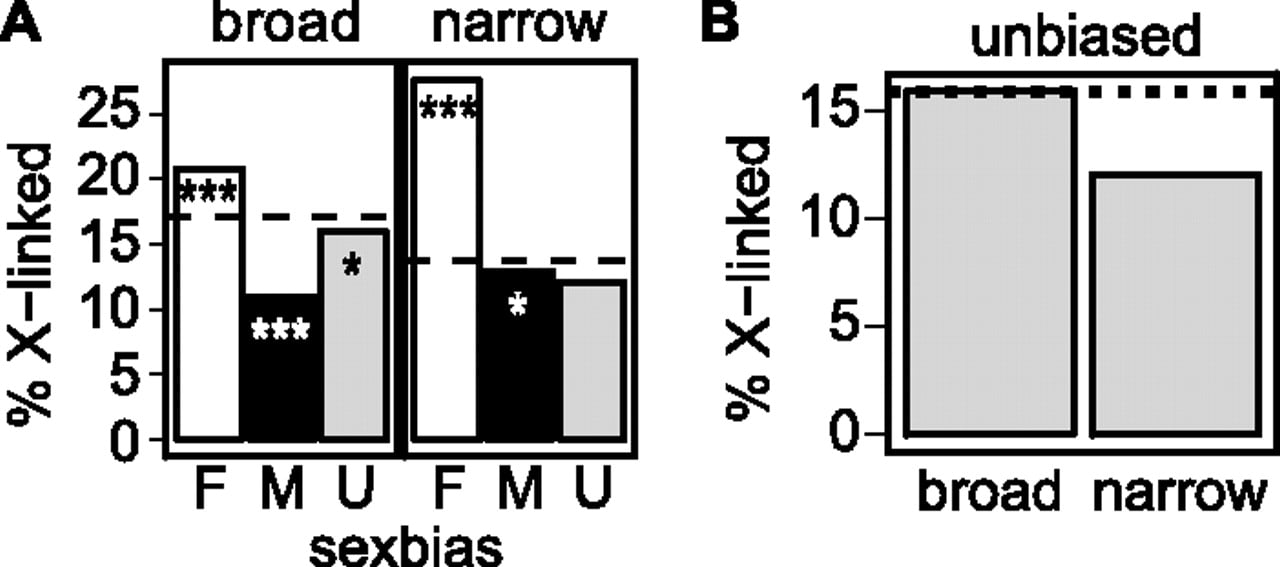
On the other hand, narrowly expressed genes with non-sex-biased (unbiased) expression are not significantly under-represented on the X chromosome (Fig. 5; Supplemental Figs. 13, 14). Additionally, there is not a significant difference in the proportion of narrowly expressed genes with unbiased expression that are X-linked when compared with the proportion of more broadly expressed genes with unbiased expression (P = 0.102, FET) (Fig. 5B), and this result is robust to most τ cutoffs (Supplemental Table 1). We therefore conclude that the deficiency of X-linked narrowly expressed genes is an artifact of the correlation between expression breadth and sex bias, but the deficiency of X-linked genes with male-biased expression and excess with female-biased expression are independent of expression breadth.
Reconciling the differences in gene content between the Drosophila and mouse X chromosomes
To examine the apparent differences in gene content between the Drosophila and mammalian X chromosomes (Vicoso and Charlesworth 2006; Gurbich and Bachtrog 2008), we analyzed expression measurements from mouse in a similar manner as the Drosophila data described above. First, using microarray data (Yang et al. 2006), we confirmed that the mouse X chromosome has an excess of genes with female-biased expression in brain, liver, and muscle (Fig. 6A), much like the excess of X-linked genes with female-biased expression in Drosophila (Fig. 1). In addition, there is an excess of X-linked genes with male-biased expression in brain and a deficiency of X-linked genes with male-biased expression in muscle (Fig. 6A), demonstrating that in both Drosophila (Fig. 1) and mammals, the X-linkage of genes with male-biased expression is tissue-dependent.
Sex-biased expression, expression breadth, and X-linkage in mouse. (Barplots) Percent of mouse genes in various expression classes that are X-linked. (Dashed lines) Percent of the entire genome that is X-linked. (*) Observed values that significantly differ from the expectation based on the size of the X chromosome as determined by a permutation test; (*) P < 0.05, (**) P < 0.01, (***) P < 0.001. (A) Percent of genes with female-biased (F), male-biased (M), and unbiased (U) expression that are X-linked is shown for data from four mouse tissues. (B) Percent of genes with narrow expression (τ > 0.7) in each of four sex-limited tissues (white and black), with narrow expression in one of 25 tissues (gray), narrow expression in one of 21 non-sex-limited tissues (gray, no sex) or broad expression (τ ≤ 0.4; white) that are X-linked is plotted. Genes with testis-biased expression were identified using all testis EST libraries (testis), EST libraries from adult testis (UniGene IDs 2511 and 2547), or EST libraries from 13-d and 15-d embryonic testis (UniGene IDs 2555 and 2594). (C) Percent of X-linked broadly expressed (τ ≤ 0.4), not narrowly expressed (τ ≤0.7), or narrowly expressed (τ > 0.7) genes with either female-biased (F), male-biased (M), or unbiased (U) expression that are X-linked is plotted. (D) Percent of X-linked genes with unbiased expression that are either broadly or narrowly expressed is plotted.
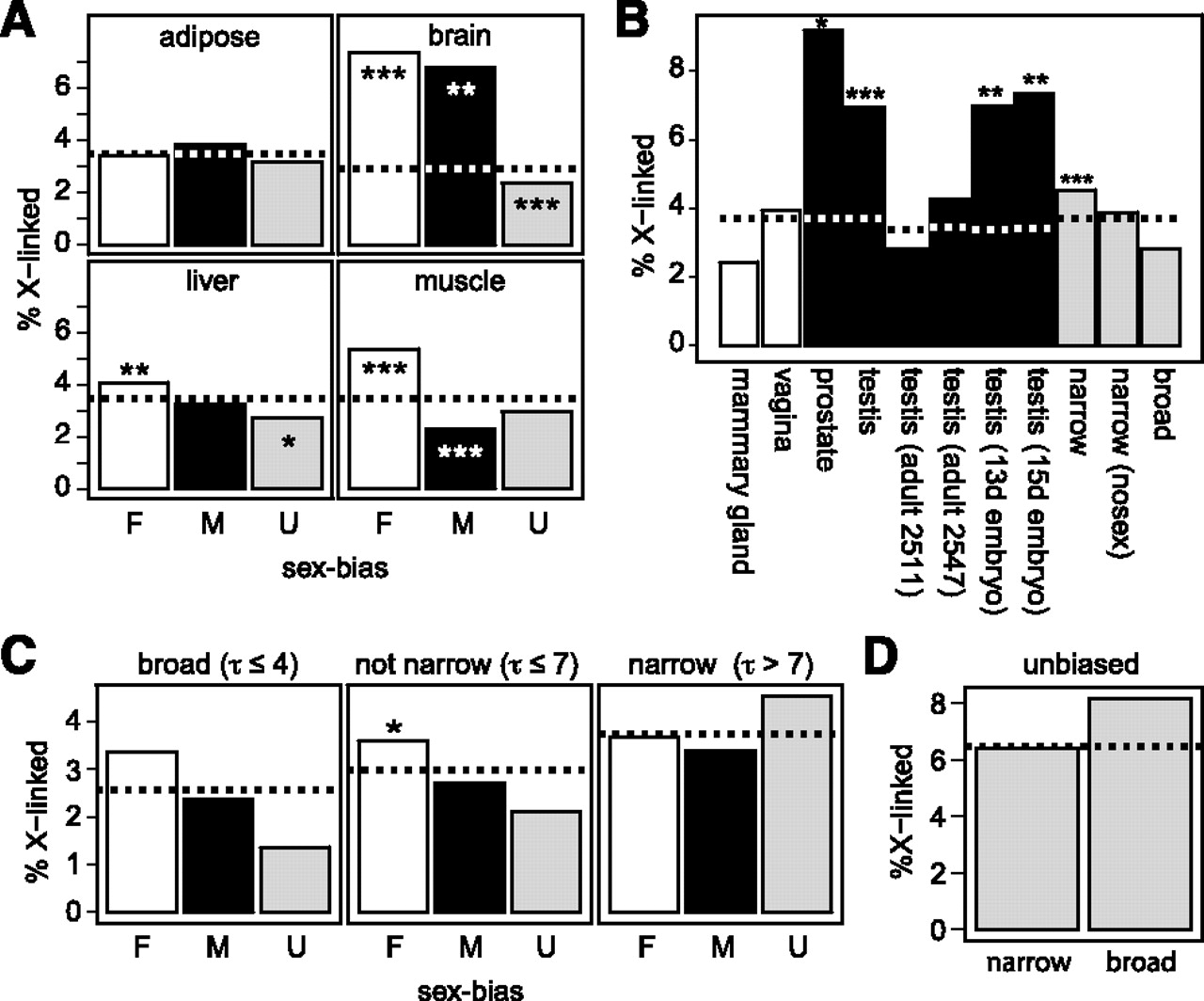
We used mapped expressed sequence tags (ESTs) from adult mouse testes and unfertilized mouse ovaries to identify genes with enriched expression in testis relative to ovary. As in D. melanogaster (Supplemental Fig. 4; Sturgill et al. 2007; Vibranovski et al. 2009), there is a deficiency of X-linked genes with testis-enriched expression (Supplemental Fig. 15). We next used mapped ESTs from 25 mouse tissues to calculate τ, and we found that there is an excess of X-linked genes with testis-biased expression (Fig. 6B; Supplemental Fig. 16). However, the testis samples include a mixture of cell types from different developmental stages, including embryos (which should contain only pre-meiotic cells unaffected by MSCI) and adults (with pre-meiotic, meiotic, and post-meiotic cells) (Khil et al. 2004). To adequately mirror our analysis of the Drosophila data (Fig. 2), we only included EST libraries from adult testis, and we failed to detect a significant excess or deficiency of X-linked genes with testis-biased expression (Fig. 6B). This is true for most EST libraries and τ cutoffs (Supplemental Figs. 16, 17). On the other hand, genes with biased expression in embryonic testis are over-represented on the X chromosome (Fig. 6B; Supplemental Fig. 16). Therefore, when similar analyses are performed on comparable tissue samples, genes with testis-biased expression in adults are found at their expected frequencies on both the Drosophila and mouse X chromosomes.
The mammalian prostate and Drosophila accessory gland are analogous male-specific organs that secrete seminal proteins necessary for male fertility. The D. melanogaster X chromosome has a paucity of genes with accessory-gland-biased expression (Fig. 2), and, similar to the pattern observed in humans (Lercher et al. 2003), there is an excess of X-linked mouse genes with prostate-biased expression (Fig. 6B; Supplemental Fig. 16). We hypothesize as to why the patterns differ between Drosophila and mammals in the Discussion.
While the Drosophila X chromosome appears to be deficient in narrowly expressed genes (Fig. 1; Mikhaylova and Nurminsky 2011), the mammalian X chromosome is enriched for narrowly expressed genes (Fig. 6B; Supplemental Fig. 16; Lercher et al. 2003; Deng et al. 2011). Sex bias and expression breadth are correlated in mouse (Mank et al. 2008; Meisel 2011), so we tested whether the non-random X-linkage of genes with sex-biased or narrow expression is an artifact of this correlation. When we exclude genes that are narrowly expressed in sex-limited tissues, there is no longer significant excess of X-linked narrowly expressed mouse genes (Fig. 6B; Supplemental Fig. 16). Additionally, narrowly expressed genes with non-sex-biased expression are not significantly over-represented on the mouse X chromosome (Fig. 6C,D; Supplemental Figs. 18, 19). Therefore, as in Drosophila, narrowly expressed mouse genes merely appear to be non-randomly X-linked because of the correlation between sex bias and expression breadth. Lastly, the mouse X chromosome has an excess of genes with female-biased expression that are not narrowly expressed (Fig. 6C; Supplemental Fig. 18), much like the excess of X-linked Drosophila genes with female-biased expression (Fig. 5A).
Discussion
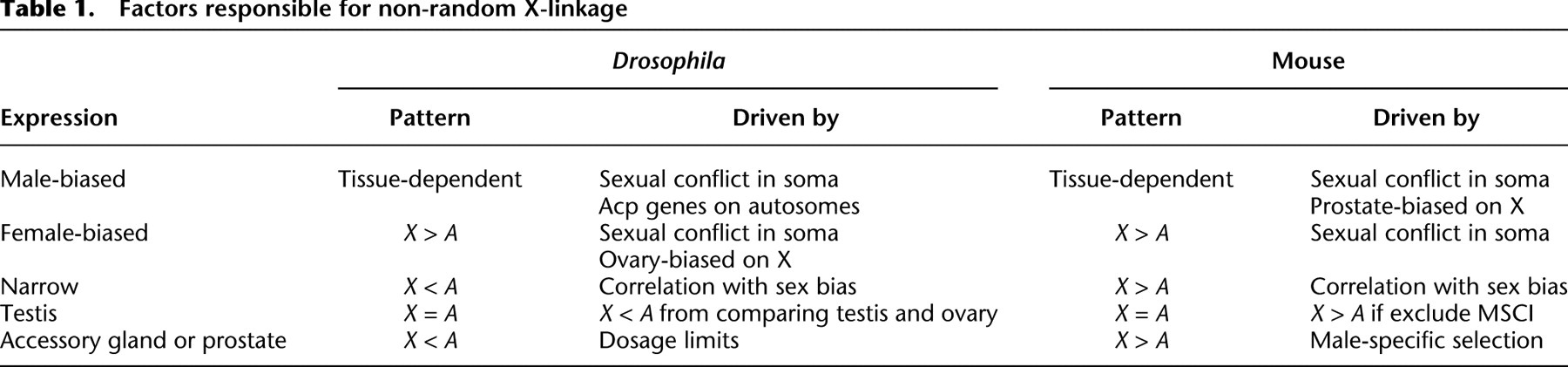
Our analyses combined measurements of sex-biased expression and expression breadth to determine more precisely what types of genes are over- or under-represented on the Drosophila and mouse X chromosomes so that we can infer the historical effects of sex-specific selection pressures. We have attempted to consider all possible confounding factors and correlations exhaustively, and our results suggest the following conclusions (summarized in Table 1).
Factors responsible for non-random X-linkage
X-linkage and sex-biased expression in non-reproductive tissues
Consistent with previous results (e.g., Parisi et al. 2003; Yang et al. 2006; Chang et al. 2011), we showed that genes with sex-biased expression in non-reproductive tissues in both Drosophila and mammals are often non-randomly X-linked. Genes with female-biased expression are consistently over-represented on the X chromosome in both taxa (Figs. 1, 5A, 6), possibly because the female-biased transmission of the X chromosome favors the retention of alleles/genes with female-beneficial functions (Rice 1984; Connallon and Clark 2010). The X-linkage of genes with male-biased expression varies across tissues, changes throughout development, differs between taxa, and can depend on the methodology used to measure expression (Figs. 1, 5A, 6; Supplemental Fig. 1). The proportion of X-linked genes with male-biased expression in Drosophila head, for example, seems particularly labile (Fig. 1B; Supplemental Fig. 1). We do, however, find some support for the hypothesis that stronger net selection in females prevents the accumulation of X-linked genes with male-biased expression in non-reproductive tissues (Figs. 1, 5A; Supplemental Figs. 2, 9; Parisi et al. 2003).
Interestingly, we detect an excess of X-linked genes with female-biased expression in larvae (Fig. 1C). If this excess is the result of female-beneficial substitutions being favored because of the X-chromosome's transmission bias, it would contradict the prediction that sexually antagonistic selection pressures are minimal in juveniles (Chippindale et al. 2001; Rice and Chippindale 2001; Gibson et al. 2002). However, third instar larvae have developing gonads (Hartenstein 1993), and this pattern could be driven by the excess of X-linked genes with ovary-biased expression (Fig. 2). In addition, while genes with male-biased expression in larvae are found on the X chromosome at the expected proportion (Fig. 1C), genes with male-biased expression in both larvae and adults may be under-represented on the X chromosome (Supplemental Fig. 3). The male-biased expression profile found in adults begins to manifest in the larval stages (Graveley et al. 2011), suggesting that selection on genes expressed in adults could affect the X-linkage of some larval-expressed genes. Additional data should be collected from larvae lacking gonadal tissues and from earlier stages of development to further interrogate how ontogenic changes in sexually antagonistic selection can affect the X-linkage of genes encoding proteins that perform sex-beneficial functions.
X-linkage and biased expression in male reproductive tissues
The D. melanogaster X chromosome has a deficiency of ACP genes (Wolfner et al. 1997; Swanson et al. 2001; Mueller et al. 2005) and genes with accessory-gland-biased expression (Fig. 2; Mikhaylova and Nurminsky 2011). We hypothesize that this is the result of dosage limits on X-linked genes in males, and these dosage limits in accessory gland appear to be partially responsibly for the paucity of genes with male-biased expression on the Drosophila X chromosome (Fig. 4B). Our expression data from larvae support this hypothesis. Male third instar larvae contain gonads with cells that have begun spermatogenesis (Fuller 1993), but they have yet to develop accessory glands (Hartenstein 1993). There is not a significant deficiency of X-linked genes with male-biased expression in larvae (Fig. 1D), suggesting that genes expressed in accessory gland make an important contribution to the dearth of X-linked genes with male-biased expression in adults. Genes with testis-biased expression that encode components of the sperm proteome are also under-represented on the Drosophila X chromosome (Fig. 2). Both ACPs and sperm proteins must be synthesized at high levels (Wolfner et al. 2005), which could exacerbate the dosage limits imposed by being X-linked.
The Drosophila accessory gland plays an important role in male fertility, secreting proteins that are incorporated into the seminal fluid, which mediate post-mating inter- and intrasexual conflict (Swanson and Vacquier 2002; Ravi Ram and Wolfner 2007). While it is tempting to invoke sexually antagonistic selection models (e.g., Rice 1984; Patten and Haig 2009; Connallon and Clark 2010) to explain the paucity of X-linked ACP genes, these models assume intralocus sexual antagonism. Drosophila male reproductive proteins, such as ACPs, are thought to mediate intersexual conflict by interacting with proteins expressed in the female reproductive tract (e.g., Yapici et al. 2008). Therefore, new models will be required to examine whether interlocus sexual conflict can explain the non-random X-linkage of male reproductive proteins.
Mammalian genes with prostate-biased expression, unlike Drosophila ACPs, are over-represented on the X chromosome (Fig. 6B; Lercher et al. 2003), as are mouse genes with testis-biased expression prior to meiosis (Fig. 6B; Khil et al. 2004). X-chromosome dosage in eutherian mammals is equilibrated by up-regulation of X-linked expression in both sexes followed by random inactivation of one X in each female cell (Payer and Lee 2008), which does not appear to impose dosage limits on highly expressed X-linked genes in males.
The excess of genes with prostate-biased and early spermatogenic expression on the mammalian X chromosome (Fig. 6B; Lercher et al. 2003; Khil et al. 2004) could be the result of sex-specific selection pressures. Unlike Drosophila ACPs, mammalian seminal proteins do not alter female physiology at a large scale (Pitnick et al. 2009), but they do mediate male–male sexual selection (Pizzari and Parker 2009). Therefore, the selection pressures on genes with prostate- and testis-biased expression likely act in a male-limited manner. If this is the case, the female-biased transmission of the X chromosome will not affect the X-linkage of these genes. We hypothesize that the hemizygous transmission of the X chromosome in males allows for the selective fixation of male-beneficial recessive mutations in X-linked mammalian genes (Charlesworth et al. 1987), promoting the accumulation of genes expressed in male reproductive tissues on the X chromosome.
MSCI and the X-linkage of genes with testis-biased expression
We detect a paucity of X-linked D. melanogaster genes with enriched expression in testis relative to ovary (Supplemental Fig. 4), but not when we examine genes with testis-biased expression compared with multiple tissues (Fig. 2). The previously noted deficiency of X-linked genes with testis-enriched expression (Sturgill et al. 2007; Vibranovski et al. 2009) is likely a methodological artifact for the following reasons. First, genes with ovary-biased expression are over-represented on the X chromosome (Fig. 2). Second, testis-expressed genes tend to be narrowly expressed (Meisel 2011), and narrowly expressed genes are under-represented on the X chromosome (Fig. 2). Furthermore, ovary-expressed genes are broadly expressed (Meisel 2011), and there is an excess of X-linked broadly expressed genes (Fig. 3C). While the relationship between expression breadth and X-linkage appears to be an artifact of the correlation between expression breadth and sex-biased expression (Fig. 5), direct comparisons between testis and ovary expression do not control for this. Therefore, by comparing testis and ovary expression, one artificially obtains evidence for a paucity of X-linked testis-enriched genes.
The lack of a deficiency of X-linked genes with testis-biased expression does not, however, reveal insights into the debate over MSCI in Drosophila (Hense et al. 2007; Vibranovski et al. 2009; Meiklejohn et al. 2011; Mikhaylova and Nurminsky 2011). Mouse genes with testis-biased expression are also not under-represented on the X chromosome even when meiotic tissues are included (Fig. 6B; Khil et al. 2004), and MSCI is well documented in mouse (Turner 2007). On the other hand, our results as well as others—e.g., the X chromosome is deficient in genes with male-biased expression even when testis-expressed genes are excluded (Sturgill et al. 2007)—suggest that, even if MSCI occurs in Drosophila, it is not an important proximate cause of the paucity of X-linked genes with male-biased expression.
Conclusions
In summary, our results suggest that most of the observed differences in X-chromosome content between Drosophila and mammals are confounded by the correlation between sex bias and expression breadth, or they are affected by taxon-specific data collection and approaches to the analysis. The female-biased transmission of the X chromosome appears to favor the accumulation of female-beneficial alleles/genes on the X chromosome in both taxa, but the effects on male-beneficial alleles/genes are not consistent between taxa or across tissues. While models assuming intralocus sexual antagonism may explain many of these patterns, further work is required to develop theoretical models of the effects of interlocus conflict on the X-linkage of genes that are under sex-specific selection pressures.
Methods
Samples
Flies were grown under the following conditions: D. melanogaster (y1 w67c for whole fly, OreR for head and larvae) at 22°C on cornmeal media; D. pseudoobscura (Drosophila Species Stock Center [DSSC] 14011-0121.94) at 22°C on banana-opuntia media; D. willistoni (DSSC 14030-0811.25) at 18°C on cornmeal media; D. mojavensis (DSSC 15081-1352.22) at 22°C on banana-opuntia media. For the whole flies from D. melanogaster, D. pseudoobscura, and D. mojavensis, 5- to 7-d-old females and males were sampled. For the head samples, newly eclosed D. melanogaster, D. pseudoobscura, and D. mojavensis were aged in vials (males and females together) for 7 d. The sexes were separated on day 7 under CO2 and stored in separate vials for 24 h. Flies were flash-frozen on dry ice after 24 h and stored at −80°C; heads were dissected from frozen flies using forceps on ceramic plates chilled on dry ice. Males and females of newly eclosed D. willistoni were separated under CO2 and aged for 5–7 d; whole flies were placed live in Ringers solution, and heads, thoraxes, and abdomens were dissected; samples from each segment were flash-frozen in liquid N2 and stored at −80°C. D. melanogaster wandering third instar larva were collected and sexed based on the size of the visible gonad (Demerec 1950). Males and females were separately flash-frozen in liquid N2 and stored at −80°C. RNA was extracted from the samples using TRIzol (Invitrogen) following the manufacturer's instructions.
Microarrays
Microarray measurements of gene expression were performed on RNA samples from the heads of D. melanogaster using the stock Nimblegen 60-mer array (Dmel r. 4.2.1), heads of D. pseudoobscura and D. mojavensis using custom Nimblegen 50-mer arrays (Zhang et al. 2007), and larvae of D. melanogaster using Agilent 4-sector 60-mer arrays (G2519F). Four biological replicates were collected of the head microarray data, and three biological replicates were collected of the larval microarray data. Total RNA was reverse-transcribed to cDNA, samples were dye-labeled, and hybridization was performed per the manufacturers' instructions. For the head data, RMA normalization was performed using Nimblescan v 2.4 software (Roche Nimblegen Inc.). We tested the null hypothesis that a gene is expressed at the same level in females and males using a moderated t-test implemented in the LIMMA package of Bioconductor in the R statistical software environment (R Development Core Team 2009) with the empirical Bayes function to pool sample variances toward a common value (Smyth 2004). For the larval data, the LIMMA package was used to normalize channel intensities between arrays (Smyth and Speed 2003) and test for differential expression between samples (Smyth 2004). P-values from statistical tests were corrected for the false discovery rate (FDR) using the Benjamini and Hochberg (1995) adjustment. Additional information can be found in GEO accessions GSE23309 and GSE31722.
RNA-seq
Illumina libraries were prepared using RNA extracted from males and females from the following samples: D. melanogaster whole fly, D. melanogaster head, D. pseudoobscura whole fly, D. pseudoobscura head, D. willistoni head, D. willistoni thorax, D. willistoni abdomen, D. mojavensis whole fly, D. mojavensis head. Standard Illumina library sample preparation procedures were used: Poly-adenylated mRNA was isolated using either the QIAGEN Oligotex mRNA kit or oligo-dT Dynabeads (Invitrogen); mRNA was fragmented using alkaline hydrolysis; double-stranded cDNA was created using random hexamer primers; sequencing adaptors were ligated to the cDNA; fragments were size-selected by gel purification; and the size-selected fragments were amplified by PCR. Samples were run on the following instrumentation: Illumina Genome Analyzer I (one lane each of male and female D. melanogaster, D. pseudoobscura, and D. mojavensis head samples), Illumina Genome Analyzer II (one lane each of male and female D. melanogaster, D. pseudoobscura, and D. mojavensis whole fly samples; three lanes each of male and female D. melanogaster head samples; three lanes each of male and female D. pseudoobscura head samples; four lanes each of male and female D. mojavensis head samples; one lane each of male and female D. melanogaster, D. pseudoobscura, and D. mojavensis whole fly samples; one lane each of male and female D. willistoni head, thorax, and abdomen samples), Illumina HiSeq (one lane each of male and female D. melanogaster, D. pseudoobscura, and D. mojavensis whole fly samples; one lane each of male and female D. willistoni head samples). Additional details can be found in GEO accessions GSE20348, GSE20882, GSE19989, GSE28078, and GSE31723 (Graveley et al. 2011; Malone and Oliver 2011). A full list of the NCBI Sequence Read Archive runs can be found in Supplemental Table 2.
Reads were processed using the standard Illumina pipeline (see GEO accessions), and all reads longer than 36 bp were shortened to 36 bp to avoid biases introduced by different read lengths and to eliminate low-quality sequences at the 3′ end of longer reads. For paired-end runs, we only used the reads in the forward direction. The reads were aligned to the annotated protein-coding sequences using BWA (Li and Durbin 2009) and Bowtie (Langmead et al. 2009). The following annotations were used: D. melanogaster r5.36, D. pseudoobscura r2.19, D. willistoni r1.3, and D. mojavensis r1.3. Only the longest annotated protein-coding sequence was used for each gene. Reads that mapped to multiple locations were not counted, and genes with fewer than 50 mapped reads (males and females combined) were excluded from subsequent analyses. We then tested for differential expression between male and female samples using DESeq (Anders and Huber 2010), edgeR (Robinson et al. 2010), and Cufflinks (Trapnell et al. 2010), using P-values corrected for an FDR of 0.05 (Benjamini and Hochberg 1995). Our results are robust to the alignment algorithm and statistical analysis used (Supplemental Fig. 1) unless otherwise mentioned above.
Additional sex-biased expression data sets
We obtained microarray measurements of sex-biased expression in whole D. melanogaster and head from SEBIDA (Gnad and Parsch 2006). We also obtained microarray measurements of sex-biased gene expression from four mouse tissue samples (Yang et al. 2006). For the mouse data, we used the results of a Mann-Whitney test to assign genes to sex-biased expression categories (Mank et al. 2008), and we applied an FDR cutoff of 0.05. This was done separately for each tissue. We called genes as sex-biased in mouse (Fig. 6C,D) if they were assigned to a sex-biased expression class in one tissue and were either put in the same sex-biased expression class or not called as sex-biased in all other tissues.
Expression breadth
Microarray signal intensities (S) from 14 adult D. melanogaster tissues (brain, eye, thoracicoabdominal ganglion, salivary gland, crop, midgut, tubule, hindgut, heart, fat body, ovary, testis, accessory gland, and spermatheca) were obtained from FlyAtlas (Chintapalli et al. 2007). Measurements from spermatheca of virgin and mated females were averaged to obtain a single spermatheca signal because they are well correlated (Meisel 2011). Genes were said to be moderately expressed in a tissue if S ≥ 100 and highly expressed if S ≥ 1000, per the curators' instructions (Chintapalli et al. 2007).
The number of ESTs mapping to each gene in the mouse genome was obtained for 25 tissues (adipose, bladder, blood, bone, bone marrow, brain, dorsal root ganglion, eye, vagina, intestine, heart, inner ear, liver, lung, lymph node, mammary gland, muscle, pancreas, prostate, skin, spinal cord, spleen, sympathetic ganglion, testis, and thymus) from UniGene build 190. Additionally, the following individual EST libraries were extracted from adult or embryonic testis: 254 (Yuan et al. 1995), 483, 1336 (Marra et al. 1999), 1784, 2511, 2555, 2594, 18007 (Okazaki et al. 2002), 2547 (Carninci et al. 2003), and 7009 (Strausberg et al. 2002).
Expression breadth was calculated two ways. In the first approach (applied only to the D. melanogaster data), we calculated the minimal ratio of the expression level in a particular tissue relative to all other tissues (Mikhaylova and Nurminsky 2011). In the second approach, we calculated a metric of expression breadth as follows:
Sperm proteome
Genes were said to encode proteins in the sperm proteome if they were detected in at least one of two mass spectrometry analyses of D. melanogaster sperm proteins (Dorus et al. 2006; Wasbrough et al. 2010).
Statistical analysis
We permuted the chromosomal locations of the genes in our data sets 1000 times to estimate a null distribution of the number of genes in each expression class on each chromosome arm in Drosophila and each chromosome in mouse. Depending on the comparison being made, this was either done for all genes or a subset of genes under consideration. All permutations were performed in the R statistical package (R Development Core Team 2009).
Data access
All microarray and RNA-seq data presented in this manuscript have been submitted to the NCBI Gene Expression Omnibus (GEO) (http://www.ncbi.nlm.nih.gov/geo/) under accession numbers GSE23309, GSE31722, and GSE31723.
Acknowledgments
This work was supported in part by the Intramural Research Program of the National Institute of Diabetes and Digestive and Kidney Diseases. R.P.M. was supported by National Institutes of Health fellowship F32GM087611, and J.H.M. completed this work while in the laboratory of Brian Oliver. We would like to thank Caroline Sartain for assisting in the sexing of larvae, Amanda Manfredo for preparing RNA-seq libraries, and the Cornell University Genomics Core Laboratory for running RNA-seq and microarray samples. This manuscript benefited from discussions with Brian Oliver, Colin Meiklejohn, and members of the Clark laboratory, as well as comments from three anonymous reviewers.
References
- ↵S Anders, W Huber. 2010. Differential expression analysis for sequence count data. Genome Biol 11: R106. doi: 10.1186/gb-2010-11-10-r106.
- ↵MN Arbeitman, EEM Furlong, F Imam, E Johnson, BH Null, BS Baker, MA Krasnow, MP Scott, RW Davis, KP White, . 2002. Gene expression during the life cycle of Drosophila melanogaster. Science 297: 2270–2275.
- ↵MN Arbeitman, AA Fleming, ML Siegal, BH Null, BS Baker. 2004. A genomic analysis of Drosophila somatic sexual differentiation and its regulation. Development 131: 2007–2021.
- ↵D Bachtrog, NR Toda, S Lockton. 2010. Dosage compensation and demasculinization of X chromosomes in Drosophila. Curr Biol 20: 1476–1481.
- ↵Y Benjamini, Y Hochberg. 1995. Controlling the false discovery rate: A practical and powerful approach to multiple testing. J R Stat Soc Ser B Methodol 57: 289–300.
- ↵E Betrán, K Thornton, M Long. 2002. Retroposed new genes out of the X in Drosophila. Genome Res 12: 1854–1859.
- ↵P Carninci, K Waki, T Shiraki, H Konno, K Shibata, M Itoh, K Aizawa, T Arakawa, Y Ishii, D Sasaki, . 2003. Targeting a complex transcriptome: The construction of the mouse full-length cDNA encyclopedia. Genome Res 13: 1273–1289.
- ↵PL Chang, JP Dunham, SV Nuzhdin, MN Arbeitman. 2011. Somatic sex-specific transcriptome differences in Drosophila revealed by whole transcriptome sequencing. BMC Genomics 12: 364. doi: 10.1186/1471-2164-12-364.
- ↵B Charlesworth, JA Coyne, NH Barton. 1987. The relative rates of evolution of sex chromosomes and autosomes. Am Nat 130: 113–146.
- ↵VR Chintapalli, J Wang, JAT Dow. 2007. Using FlyAtlas to identify better Drosophila melanogaster models of human disease. Nat Genet 39: 715–720.
- ↵AK Chippindale, JR Gibson, WR Rice. 2001. Negative genetic correlation for adult fitness between sexes reveals ontogenetic conflict in Drosophila. Proc Natl Acad Sci 98: 1671–1675.
- ↵T Connallon, AG Clark. 2010. Sex linkage, sex-specific selection, and the role of recombination in the evolution of sexually dimorphic gene expression. Evolution 64: 3417–3442.
- ↵M Demerec. 1950. Biology of Drosophila. Wiley, New York.
- ↵X Deng, JB Hiatt, DK Nguyen, S Ercan, D Sturgill, LW Hillier, F Schlesinger, CA Davis, VJ Reinke, TR Gingeras, . 2011. Evidence for compensatory upregulation of expressed X-linked genes in mammals, Caenorhabditis elegans and Drosophila melanogaster. Nat Genet 43: 1179–1185.
- ↵S Dorus, SA Busby, U Gerike, J Shabanowitz, DF Hunt, TL Karr. 2006. Genomic and functional evolution of the Drosophila melanogaster sperm proteome. Nat Genet 38: 1440–1445.
- ↵H Ellegren. 2011. Emergence of male-biased genes on the chicken Z-chromosome: Sex-chromosome contrasts between male and female heterogametic systems. Genome Res 21: 2082–2086.
- ↵H Ellegren, J Parsch. 2007. The evolution of sex-biased genes and sex-biased gene expression. Nat Rev Genet 8: 689–698.
- ↵JD Fry. 2010. The genomic location of sexually antagonistic variation: Some cautionary comments. Evolution 64: 1510–1516.
- ↵MT Fuller. 1993. Spermatogenesis. In The development of Drosophila melanogaster (ed. M Bate and A Martinez-Arias), Vol. I, pp. 71–147. Cold Spring Harbor Laboratory Press, Cold Spring Harbor, NY.
- ↵Q Gan, I Chepelev, G Wei, L Tarayrah, K Cui, K Zhao, X Chen. 2010. Dynamic regulation of alternative splicing and chromatin structure in Drosophila gonads revealed by RNA-seq. Cell Res 20: 763–783.
- ↵JR Gibson, AK Chippindale, WR Rice. 2002. The X chromosome is a hot spot for sexually antagonistic fitness variation. Proc R Soc Lond B Biol Sci 269: 499–505.
- ↵F Gnad, J Parsch. 2006. Sebida: A database for the functional and evolutionary analysis of genes with sex-biased expression. Bioinformatics 22: 2577–2579.
- ↵Graveley BR, Brooks AN, Carlson JW, Duff MO, Landolin JM, Yang L, Artieri CG, van Baren MJ, Boley N, Booth BW, et al. 2011. The developmental transcriptome of Drosophila melanogaster. Nature 471: 473–479.
- ↵TA Gurbich, D Bachtrog. 2008. Gene content evolution on the X chromosome. Curr Opin Genet Dev 18: 493–498.
- ↵V Hartenstein. 1993. Atlas of Drosophila development. Cold Spring Harbor Laboratory Press, Cold Spring Harbor, NY.
- ↵W Hense, JF Baines, J Parsch. 2007. X chromosome inactivation during Drosophila spermatogenesis. PLoS Biol 5: e273. doi: 10.1371/journal.pbio.0050273.
- ↵P Innocenti, EH Morrow. 2010. The sexually antagonistic genes of Drosophila melanogaster. PLoS Biol 8: e1000335. doi: 10.1371/journal.pbio.1000335.
- ↵W Jin, RM Riley, RD Wolfinger, KP White, G Passador-Gurgel, G Gibson. 2001. The contributions of sex, genotype and age to transcriptional variance in Drosophila melanogaster. Nat Genet 29: 389–395.
- ↵PP Khil, NA Smirnova, PJ Romanienko, RD Camerini-Otero. 2004. The mouse X chromosome is enriched for sex-biased genes not subject to selection by meiotic sex chromosome inactivation. Nat Genet 36: 642–646.
- ↵B Langmead, C Trapnell, M Pop, SL Salzberg. 2009. Ultrafast and memory-efficient alignment of short DNA sequences to the human genome. Genome Biol 10: R25. doi: 10.1186/gb-2009-10-3-r25.
- ↵AM Larracuente, TB Sackton, AJ Greenberg, A Wong, ND Singh, D Sturgill, Y Zhang, B Oliver, AG Clark. 2008. Evolution of protein-coding genes in Drosophila. Trends Genet 24: 114–123.
- ↵MJ Lercher, AO Urrutia, LD Hurst. 2003. Evidence that the human X chromosome is enriched for male-specific but not female-specific genes. Mol Biol Evol 20: 1113–1116.
- ↵H Li, R Durbin. 2009. Fast and accurate short read alignment with Burrows-Wheeler transform. Bioinformatics 25: 1754–1760.
- ↵Malone JH, Oliver B. 2011. Microarrays, deep sequencing and the true measure of the transcriptome. BMC Biol 9: 34. doi: 10.1186/1741-7007-9-34.
- ↵JE Mank, L Hultin-Rosenberg, M Zwahlen, H Ellegren. 2008. Pleiotropic constraint hampers the resolution of sexual antagonism in vertebrate gene expression. Am Nat 171: 35–43.
- ↵M Marra, L Hillier, T Kucaba, M Allen, R Barstead, C Beck, A Blistain, M Bonaldo, Y Bowers, L Bowles, . 1999. An encyclopedia of mouse genes. Nat Genet 21: 191–194.
- ↵CD Meiklejohn, EL Landeen, JM Cook, SB Kingan, DC Presgraves. 2011. Sex chromosome-specific regulation in the Drosophila male germline but little evidence for chromosomal dosage compensation or meiotic inactivation. PLoS Biol 9: e1001126. doi: 10.1371/journal.pbio.1001126.
- ↵RP Meisel. 2011. Towards a more nuanced understanding of the relationship between sex-biased gene expression and rates of protein coding sequence evolution. Mol Biol Evol 28: 1893–1900.
- ↵RP Meisel, MV Han, MW Hahn. 2009. A complex suite of forces drives gene traffic from Drosophila X chromosomes. Genome Biol Evol 1: 176–188.
- ↵LM Mikhaylova, DI Nurminsky. 2011. Lack of global meiotic sex chromosome inactivation, and paucity of tissue-specific gene expression on the Drosophila X chromosome. BMC Biol 9: 29. doi: 10.1186/1741-7007-9-29.
- ↵JL Mueller, KR Ram, LA McGraw, MC Bloch Qazi, ED Siggia, AG Clark, CF Aquadro, MF Wolfner. 2005. Cross-species comparison of Drosophila male accessory gland protein genes. Genetics 171: 131–143.
- ↵JL Mueller, SK Mahadevaiah, PJ Park, PE Warburton, DC Page, JMA Turner. 2008. The mouse X chromosome is enriched for multicopy testis genes showing postmeiotic expression. Nat Genet 40: 794–799.
- ↵Y Okazaki, M Furuno, T Kasukawa, J Adachi, H Bono, S Kondo, I Nikaido, N Osato, R Saito, H Suzuki, . 2002. Analysis of the mouse transcriptome based on functional annotation of 60,770 full-length cDNAs. Nature 420: 563–573.
- ↵M Parisi, R Nuttall, D Naiman, G Bouffard, J Malley, J Andrews, S Eastman, B Oliver. 2003. Paucity of genes on the Drosophila X chromosome showing male-biased expression. Science 299: 697–700.
- ↵M Parisi, R Nuttall, P Edwards, J Minor, D Naiman, J Lu, M Doctolero, M Vainer, C Chan, J Malley, . 2004. A survey of ovary-, testis-, and soma-biased gene expression in Drosophila melanogaster adults. Genome Biol 5: R40. doi: 10.1186/gb-2004-5-6-r40.
- ↵MM Patten, D Haig. 2009. Maintenance or loss of genetic variation under sexual and parental antagonism at a sex-linked locus. Evolution 63: 2888–2895.
- ↵B Payer, JT Lee. 2008. X chromosome dosage compensation: How mammals keep the balance. Annu Rev Genet 42: 733–772.
- ↵S Pitnick, MF Wolfner, S Suarez. 2009. Sperm–female interactions. In Sperm biology: An evolutionary perspective (ed. TR Birkhead et al.), pp. 247–304. Academic Press, London.
- ↵T Pizzari, GA Parker. 2009. Sperm competition and sperm phenotype. In Sperm biology: An evolutionary perspective (ed. TR Birkhead et al.), pp. 207–245. Academic Press, London.
- ↵R Development Core Team. 2009. R: A Language and Environment for Statistical Computing. R Foundation for Statistical Computing, Vienna, Austria.
- ↵JM Ranz, CI Castillo-Davis, CD Meiklejohn, DL Hartl. 2003. Sex-dependent gene expression and evolution of the Drosophila transcriptome. Science 300: 1742–1745.
- ↵K Ravi Ram, MF Wolfner. 2007. Seminal influences: Drosophila Acps and the molecular interplay between males and females during reproduction. Integr Comp Biol 47: 427–445.
- ↵WR Rice. 1984. Sex chromosomes and the evolution of sexual dimorphism. Evolution 38: 735–742.
- ↵WR Rice, AK Chippindale. 2001. Intersexual ontogenetic conflict. J Evol Biol 14: 685–693.
- ↵MD Robinson, DJ McCarthy, GK Smyth. 2010. edgeR: A Bioconductor package for differential expression analysis of digital expression data. Bioinformatics 26: 139–140.
- ↵GK Smyth. 2004. Linear models and empirical Bayes methods for assessing differential expression in microarray experiments. Stat Appl Genet Mol Biol 3: 1544–6115.
- ↵GK Smyth, TP Speed. 2003. Normalization of cDNA microarray data. Methods 31: 265–273.
- ↵RL Strausberg, EA Feingold, LH Grouse, JG Derge, RD Klausner, FS Collins, L Wagner, CM Shenmen, GD Schuler, SF Altschul, . 2002. Generation and initial analysis of more than 15,000 full-length human and mouse cDNA sequences. Proc Natl Acad Sci 99: 16899–16903.
- ↵D Sturgill, Y Zhang, M Parisi, B Oliver. 2007. Demasculinization of X chromosomes in the Drosophila genus. Nature 450: 238–241.
- ↵WJ Swanson, VD Vacquier. 2002. The rapid evolution of reproductive proteins. Nat Rev Genet 3: 137–144.
- ↵WJ Swanson, AG Clark, HM Waldrip-Dail, MF Wolfner, CF Aquadro. 2001. Evolutionary EST analysis identifies rapidly evolving male reproductive proteins in Drosophila. Proc Natl Acad Sci 98: 7375–7379.
- ↵C Trapnell, BA Williams, G Pertea, A Mortazavi, G Kwan, MJ van Baren, SL Salzberg, BJ Wold, L Pachter. 2010. Transcript assembly and quantification by RNA-seq reveals unannotated transcripts and isoform switching during cell differentiation. Nat Biotechnol 28: 511–515.
- ↵JMA Turner. 2007. Meiotic sex chromosome inactivation. Development 134: 1823–1831.
- ↵MD Vibranovski, HF Lopes, TL Karr, M Long. 2009. Stage-specific expression profiling of Drosophila spermatogenesis suggests that meiotic sex chromosome inactivation drives genomic relocation of testis-expressed genes. PLoS Genet 5: e1000731. doi: 10.1371/journal.pgen.1000731.
- ↵B Vicoso, B Charlesworth. 2006. Evolution on the X chromosome: Unusual patterns and processes. Nat Rev Genet 7: 645–653.
- ↵B Vicoso, B Charlesworth. 2009. The deficit of male-biased genes on the D. melanogaster X chromosome is expression-dependent: A consequence of dosage compensation? J Mol Evol 68: 576–583.
- ↵PJ Wang, JR McCarrey, F Yang, DC Page. 2001. An abundance of X-linked genes expressed in spermatogonia. Nat Genet 27: 422–426.
- ↵ER Wasbrough, S Dorus, H Svenja, J Howard-Murkin, K Lilley, E Wilkin, A Polpitiya, K Petritis, TL Karr. 2010. The Drosophila melanogaster sperm proteome-II (DmSP-II). J Proteomics 73: 2171–2185.
- ↵MF Wolfner, HA Harada, MJ Bertram, TJ Stelick, KW Kraus, JM Kalb, YO Lung, DM Neubaum, M Park, U Tram. 1997. New genes for male accessory gland proteins in Drosophila melanogaster. Insect Biochem Mol Biol 27: 825–834.
- ↵MF Wolfner, S Applebaum, Y Heifetz. 2005. Insect gonadal glands and their gene products. In Comprehensive insect physiology, biochemistry, pharmacology and molecular biology (ed. L Gilbert et al.), pp. 179–212. Elsevier, New York.
- ↵I Yanai, H Benjamin, M Shmoish, V Chalifa-Caspi, M Shklar, R Ophir, A Bar-Even, S Horn-Saban, M Safran, E Domany, . 2005. Genome-wide midrange transcription profiles reveal expression level relationships in human tissue specification. Bioinformatics 21: 650–659.
- ↵X Yang, EE Schadt, S Wang, H Wang, AP Arnold, L Ingram-Drake, TA Drake, AJ Lusis. 2006. Tissue-specific expression and regulation of sexually dimorphic genes in mice. Genome Res 16: 995–1004.
- ↵N Yapici, Y-J Kim, C Ribeiro, BJ Dickson. 2008. A receptor that mediates the post-mating switch in Drosophila reproductive behavior. Nature 451: 33–37.
- ↵L Yuan, JG Liu, C Höög. 1995. Rapid cDNA sequencing in combination with RNA expression studies in mice identifies a large number of male germ cell-specific sequence tags. Biol Reprod 52: 131–138.
- ↵Y Zhang, D Sturgill, M Parisi, S Kumar, B Oliver. 2007. Constraint and turnover in sex-biased gene expression in the genus Drosophila. Nature 450: 233–237.
- ↵YE Zhang, MD Vibranovski, BH Krinsky, M Long. 2010a. Age-dependent chromosomal distribution of male-biased genes in Drosophila. Genome Res 20: 1526–1533.
- ↵YE Zhang, MD Vibranovski, P Landback, GA Marais, M Long. 2010b. Chromosomal redistribution of male-biased genes in mammalian evolution with two bursts of gene gain on the X chromosome. PLoS Biol 8: e1000494. doi: 10.1371/journal.pbio.1000494.
Notes
[1] [Supplemental material is available for this article.]
[2] Article published online before print. Article, supplemental material, and publication date are at http://www.genome.org/cgi/doi/10.1101/gr.132100.111.