
Abstract
Agouti signaling protein (ASIP) is an endogenous antagonist of melanocortin receptors that controls a wide range of physiological functions. Its central role in regulation of the melanocortin system implied that ASIP has been relevant to the evolution of various physiological traits in primates. In this study, we have tried to determine DNA sequences of the ASIP gene (ASIP) of various simian species to find molecular evolutionary aspects of ASIP. Unexpectedly, we found that the whole coding region of ASIP was missing only from the gibbon genome; gibbons constitute a large group of hominoid species in Southeast Asia. Our analyses revealed that unequal homologous recombination mediated by two AluSx elements erased a ∼100-kb region including ASIP from the gibbon genome. The data provide new evidence for the significant roles of Alu elements in the dynamic evolution of the primate genome.
Melanocortin receptors (MCRs) belong to the superfamily of G protein-coupled seven transmembrane receptors and participate in the regulation of a variety of physiological functions (Gantz and Fong 2003). Five subtypes of MCRs (MC1R–MC5R) are currently identified (Mountjoy et al. 1992). Proteolytic derivatives of proopiomelanocortin (POMC), including α-melanocyte simulating hormone (MSH), γ-MSH, and adrenocorticotropic hormone, are endogenous agonists of MCRs; on the other hand, agouti signaling protein (ASIP) and agouti-related protein are endogenous antagonists of MCRs. Transcripts of the ASIP gene (ASIP) have been found in hair follicles of postnatal mice, whisker plate and ventral trunk in embryonic mice (Millar et al. 1995), and various organs in humans including ovary, heart, adipose tissue, liver, kidney, and foreskin (Kwon et al. 1994; Wilson et al. 1995).
ASIP was originally identified in a mouse mutant line, lethal yellow (Ay), which shows yellow fur, diabetes, obesity, tumor susceptibility, and lethality of homozygous offspring (Bultman et al. 1992). Because of a 120- to 170-kb deletion, expression of ASIP in Ay mice is under the control of promoters of the hnRNP-associated with lethal yellow gene (RALY, Fig. 1) that encodes ubiquitously expressed RNA-binding protein (Michaud et al. 1993; Miller et al. 1993; Duhl et al. 1994). The over- and ectopic expression of ASIP primarily deregulated signaling pathways that were mediated by MC1R and MC4R in hair follicles and hypothalamus, respectively, and consequently resulted in excessive production of yellowish pheomelanin and abnormal eating behavior (Yen et al. 1994; Klebig et al. 1995; Ollmann et al. 1997). On the other hand, null mutants of ASIP showed black fur but did not show the other conspicuous traits (Bultman et al. 1992; Perry et al. 1995; Miltenberger et al. 2002).
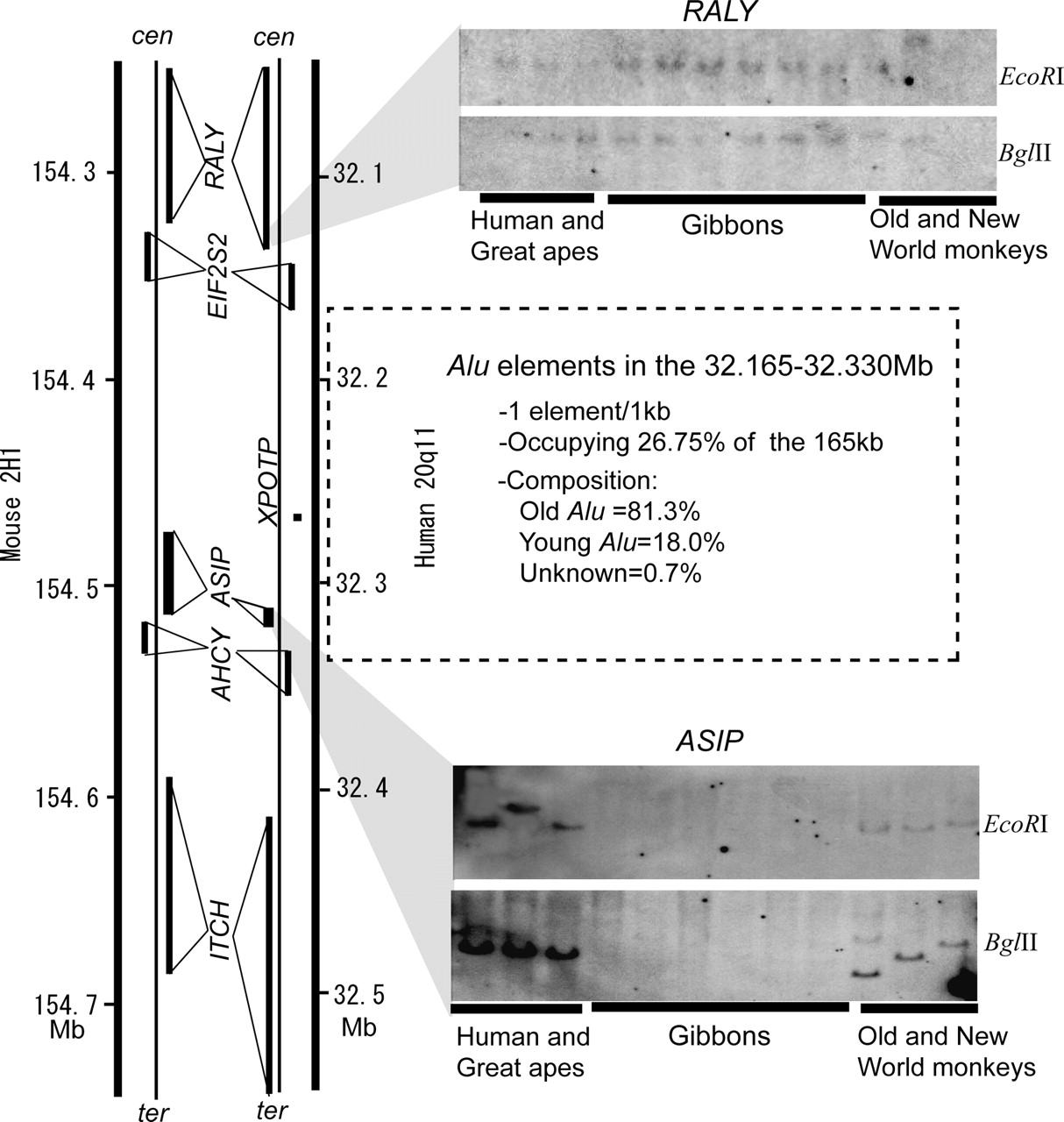
Genomic organization around ASIP. Positions of ASIP and surrounding genes in mouse chromosome 2 (left) and human chromosome 20 (right) are illustrated (Deloukas et al. 2001; Waterston et al. 2002). cen and ter indicate directions for centromere and telomere, respectively. The characteristics of the array of Alu elements in 32.165–32.330 Mb of human chromosome 20 are also described (dashed box). Old Alu includes AluSx, AluSq, AluSg, AluSc, AluSp, AluS, AluJo, and AluJb subfamilies, while Young Alu includes AluY and AluYd2 subfamilies (Shen et al. 1991; Kapitonov and Jurka 1996; Batzer and Deininger 2002). Chemiluminescence images of genomic Southern blotting for RALY and ASIP are also shown. DNA samples loaded in each lane are as follows: (Human and Great Apes) H. sapiens, P. troglodytes, and P. pygmaeus; (Gibbons) H. lar (two individuals), H. pileatus, H. agilis, S. syndactylus, and N. leucogenys; (Old and New World Monkeys) M. fuscata, C. aethiops, and S. oedipus. Restriction enzymes used in the fragmentation of genomic DNA are also indicated (see Methods).
Evolutionary homologs of ASIP have been isolated from numerous mammalian species including humans (Kwon et al. 1994; Väge et al. 1997, Leeb et al. 2000; Rieder et al. 2001; Eizirik et al. 2003; Kerns et al. 2004; Girardot et al. 2005), and, moreover, from chicken and fish (Klovins and Schiöth 2005). Genomic organization of ASIP is highly conservative in these mammalian homologs; protein-coding exons 2–4 were localized in a <10-kb region, and non-coding, alternatively transcribed exon 1, which may participate in transcriptional regulation, scattered in the larger upstream region (Bultman et al. 1992; Vrieling et al. 1994; Girardot et al. 2005). Associations between mutations in ASIP and body color variation suggest that ASIP participates in pigmentation via MC1R; details of the physiological roles of ASIP in these species remain unclear (Väge et al.1997; Kanetsky et al. 2002; Eizirik et al. 2003; Kerns et al. 2004; Bonilla et al. 2005).
The main functions of ASIP, regulation of pigmentation and energy homeostasis, are of interest in developing medical treatments for obesity, diabetes, and pigmentation disorders. Therefore, it may be fruitful to characterize the molecular evolution of ASIP in mammals, especially in the evolutionary lineage leading to modern humans. For this purpose, we tried to isolate ASIP from various primate species. Unexpectedly, we have revealed that the gibbons (Family Hylobatidae), a group of monophyletic hominoid species from Southeast Asia characterized by relatively small body size, monogamous society, and highly arboreal niches (Fleagle 1999), have lost the whole coding sequences of ASIP and adjacent genomic regions by AluSx-mediated unequal homologous recombination. Our data provide new evidence for the significant role of Alu-mediated deletion in the dynamic evolution of the primate genome.
Results
Loss of ASIP in gibbons
We determined the nucleotide sequences of ASIP from various simian species including great apes, Old World monkeys, and New World monkeys; however, no specific PCR products were obtained for the gibbons. We then performed genomic Southern blotting analyses (Fig. 1). Probes designed based on human ASIP exon 2, which encodes an evolutionarily highly conserved leader peptide region, did not detect specific DNA fragments in the gibbon genome, while a probe for RALY, which is 200 kb away from ASIP on human chromosome 20, detected a specific DNA fragment in the gibbon genome. We thus considered that the gibbons might have lost ASIP from their genome.
The genomic organization of human chromosome 22q11, in terms of the relative position of ASIP and its neighbors including RALY, the eukaryotic translation initiation factor2 subunit 2β gene (EIF2S2), the S-adenocylhomocysteine hydolase gene (AHCY), and the itchy homolog E3 ubiquitin protein gene (ITCH), was highly conserved in the mouse chromosome 2 counterpart (Fig. 1) (Deloukas et al. 2001; Waterston et al. 2002). A noticeable difference between the two homologous regions was the presence of high-density short interspersed elements, especially Alu elements, in the human counterpart. In the 165-kb region around human ASIP, 81% of Alu elements belonged to the old Alu subfamilies (Fig. 1), which experienced the peak of expansion in the primate genome 35–55 million years ago (Mya) (Shen et al. 1991; Kapitonov and Jurka 1996; Batzer and Deininger 2002). These Alu elements were considered to have existed in the primate genome prior to the diversification of the hominoids.
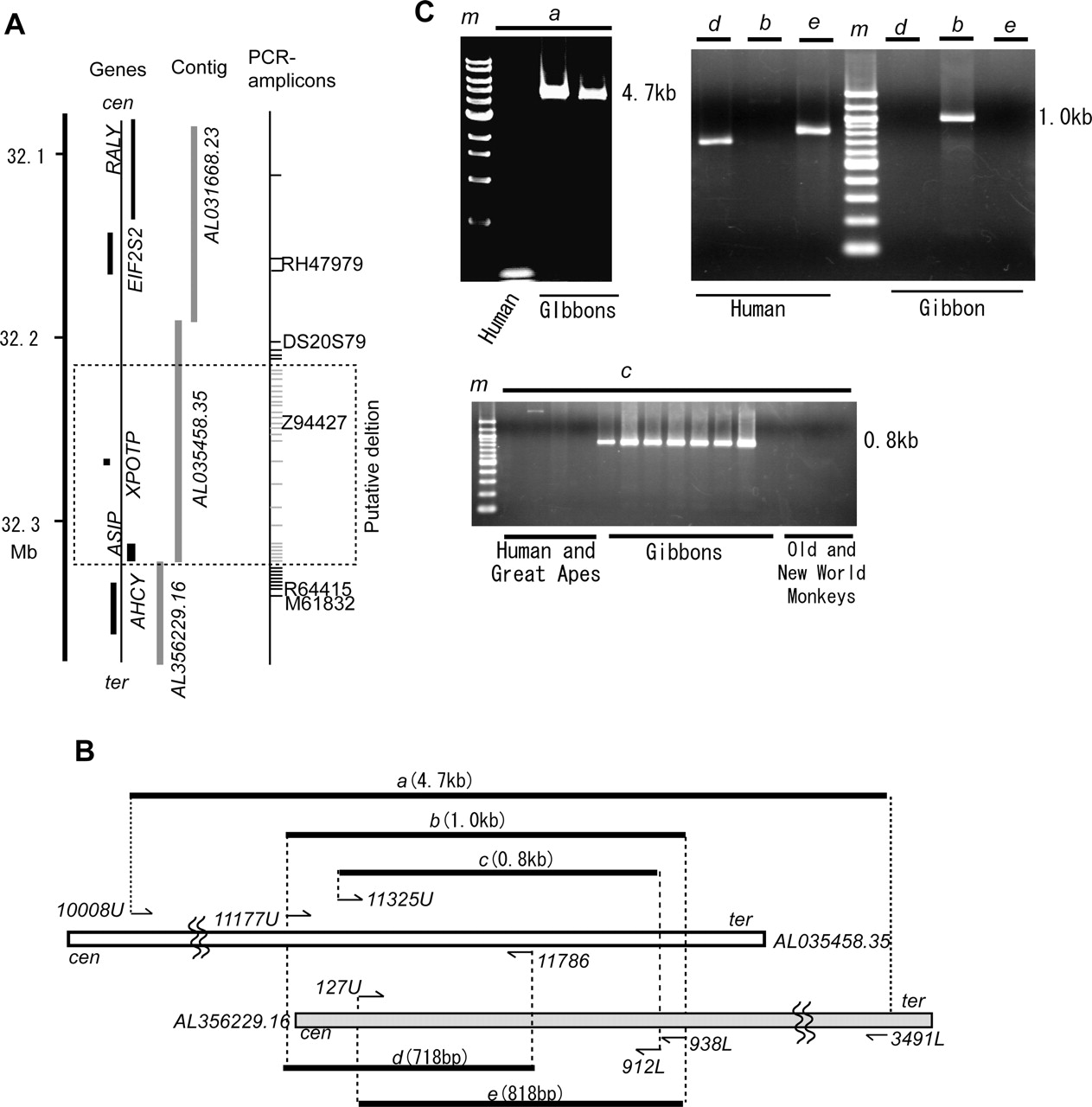
Alu elements act as a source of genomic instability among primates via several different mechanisms (Batzer and Deininger 2002). We considered that the Alu elements mediated the loss of ASIP in the gibbon genome. To identify chromosomal break points, we estimated the span of the putative deletion in the gibbon genome by using PCR and direct sequencing. A total of 36 amplicons, including five human Sequence Tagged Sites, were examined for Hylobates lar DNA. We found a missing region in the gibbon genome covering from 94 kb upstream to 2 kb downstream of the three coding exons of ASIP in the human genome (Fig. 2A). We subsequently examined the PCR amplification of AL035458.35 10008U and AL356229.16 3491L (Fig. 2B,C; Supplemental Tables 3, 4). This PCR failed to yield a specific product from human DNA since the distance between these two primers on the human genome was too large for PCR (>100 kb). We obtained a 4- to 5-kb fragment only from the gibbon DNA but not from human DNA (Fig. 2B,C). As a result of further multiple PCR assays described in Figure 2, we consequently obtained 1.0-kb and nested 0.8-kb fragments from the gibbon DNA that most likely contained the junction of the chromosomal break points. The amplification of 1.0-kb and 0.8-kb fragments was not observed in other primate species including humans, great apes, Old World monkeys, and New World monkeys (Fig. 2C).
Characterization of the deletion in the gibbon genome. (A) The putative deletion in the gibbon genome is projected on human 20q11. (Horizontal lines) Positions of the PCR amplicons; (black and gray lines) amplified and non-amplified amplicons, respectively. The positions of the human genomic contigs are also shown. (B) Positions of five PCR amplicons used to localize the break points. Estimated length of PCR amplicons are shown in parentheses. (Arrows) Primers (see Supplemental Table 3), (horizontal bars) human genomic contigs AL035458.35 and AL356299.16. For the gibbon genome with the putative deletion, amplicons a, b, and c are expected to give rise to specific amplification. By contrast, specific amplification of amplicons d and e is expected for the primates other than the gibbons. (C) The results of PCR amplification are illustrated. Letters above gel images correspond to PCR amplicons illustrated in panel B. Species of DNA template in each lane is shown below the images. (m) Molecular markers. Conditions of these PCR assays are summarized in Supplemental Table 4.
Structure of the break point
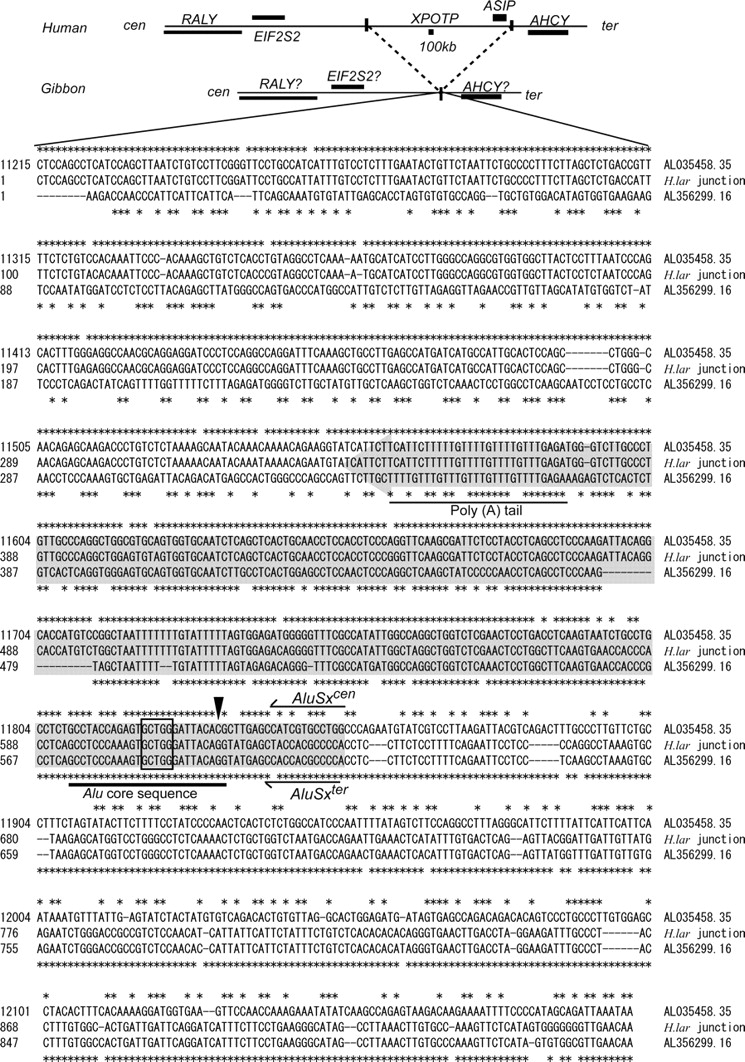
A BLAST search was performed on 960 bp of the 1.0-kb fragment against the human genome sequences. Nucleotide positions (n.p.) 1–617 showed high homologies with n.p. 11215–11567 and n.p. 11587–11832 of the human genomic contig AL035458.35 (E = 1 × 10−170, 1 × 10−76, respectively), while n.p. 512–945 showed high homology with n.p. 491–925 of the human genomic contig AL356299.16 (E = 0.0). The overlapping portion (n.p. 500–630 of the 1-kb fragment) contained a partial region of AluSx elements in AL035458.35 and AL356299.16 (AluSxcen and AluSxter in Fig. 3, respectively). The 0.8-kb fragment amplified from H. lar DNA also showed identical chimeric sequences (data not shown). A 26-bp Alu core sequence, which was considered a hotspot of recombination (Rudiger et al. 1995), was highly conserved in AluSx in the gibbon chimeric sequence, AluSxcen and AluSxter (Fig. 3). In addition, the chromosomal break point was located near the Alu core sequence (Fig. 3). These results indicated that the chimeric sequence obtained from H. lar DNA was the junction sequence created by unequal homologous recombination between evolutionary homologs of AluSxcen and AluSxter in the ancestral gibbon genome. AluSxcen and AluSxter are located at 32,218,520–32,218,810 bp and 32,322,430–32,322,700 bp, respectively, in the assembled human chromosome 20 sequence, and the extent of the region that was deleted by unequal homologous recombination was estimated to be ∼100 kb. The 100-kb deletion involved the whole coding sequence of ASIP and pseudogene 1 of exportin (XPOTP1). The junction sequences were successfully obtained for the six subjected gibbon species. The features of the junction sequence were conserved among them; therefore, it was revealed that the origin of the 100-kb deletion was older than the diversification of three genera, Nomascus, Symphalangus, and Hylobates.
An alignment of the junction sequence with a schematic representation of the 100-kb deletion in the gibbon genome. The junction sequence isolated from H. lar (middle line) and homologous sequences extracted from human genomic contings AL035458.35 and AL356299.16 (upper and lower line, respectively) are shown. Asterisks above and below the alignment indicate identical nucleotides between the H. lar junction sequence and the human homologous sequences. (–) Alignment gap, (shaded region) the AluSx elements that were involved in the unequal homologous recombination, (closed arrow) the chromosomal break point located near the 26-bp Alu core sequence containing χ-like element (open box), which is considered to be a center of homologous and non-homologous recombination (Rudiger et al. 1995). Poly(A) tails of AluSx elements are also indicated. Note all these features of AluSx elements are represented in complementary sequence.
Discussion
Alu elements have amplified in the primate genome through retroposition and exist with an extremely high copy number in the human genome (∼500,000 per haploid genome). Alu-mediated recombination in the human germ line is known to be responsible for the deletions that are found in association with several inherited diseases, such as α-thalassaemia, Duchenne muscular dystrophy, and Tay-Sachs disease (for review, see Deininger and Batzer 1999). Alu elements also abundant in the genomes of other primate species may have contributed to the evolution of their genome organization through such recombination; however, Alu-mediated recombination was reported to facilitate small deletions involving few exons in the tropoelastin gene (Szabo et al. 1999). The 100-kb deletion presently identified in the gibbon genome provides new evidence for the participation of Alu-mediated recombination in the evolution of the primate genomes.
An AluY-mediated 161-kb deletion in the human breast cancer 1 gene (Gad et al. 2003) has suggested that Alu-mediated recombination has, indeed, a potential to cause deletions >100 kb. The Alu elements causing the 100-kb deletion belong to a member of the AluSx subfamily, which is one of the oldest and most abundant Alu subfamilies in the primate genomes (Batzer and Deininger 2002). It has generally been found that homologous recombination occurs more efficiently in the presence of longer stretches of identical sequences (Hasty et al. 1991). AluSx elements have accumulated a lot of random substitutions, insertions, and deletions during primate evolution (as seen in Fig. 3), and now in the human genome, their role in homologous recombination should be smaller than in other younger Alu subfamilies that maintain stringent homology. However, it has been reported that, in the human genome, AluSx elements still work to create genetic diversity through unequal homologous recombination (Koda et al. 2000; Ringpfeil et al. 2001; Rossetti et al. 2004). In addition to homologous recombination, gene conversion and retrotransposition should be considered as alternative mechanisms of Alu-mediated deletion in the primate genomes; however, gene conversion and retrotransposition mediating much smaller deletions (Hayakawa et al. 2001; Callinan et al. 2005) may not likely fit to the ASIP deletion in the gibbon genome.
It is obvious that the 100-kb deletion is specific to the present gibbon species, although the dating of this deletion remains unclear. Fossil evidence suggested that gibbon ancestors emerged in the early middle Miocene (Fleagle 1984), and a recent molecular phylogenetic study has proposed a comparable estimate of 15–18 Mya for the divergence of the gibbons from other hominoid lineages (Raaum et al. 2005). Hence, the three genera of gibbons are considered to have shared a substantial period of common ancestry, 8–10 Myr prior to their divergence (Cronin et al. 1984; our unpublished data). The 100-kb deletion likely occurred in the period of the common ancestry.
It is a challenge to infer a phenotypic consequence of the 100-kb deletion in the gibbons. As ASIP regulates lipid metabolism via MC4R in humans (for review, see Voisey and van Daal 2002), there is room to presume a possible contribution of the 100-kb deletion to the evolution of a unique phenotype of the gibbons: remarkably small body mass that is related to energy homeostasis. The 100-kb deletion is expected to erase several putative untranslated exons of AHCY, a gene implicated in human hypermethioninemia (Baric et al. 2004). These untranslated exons were assigned based on the similarities with an expression sequence tag isolated from the human kidney (GenBank accession no. AI241007.1), where the functions of these alternative transcripts are currently unknown. Impacts of the 100-kb deletion on the expression of the neighboring genes wait to be investigated. Finally, embryonic lethality of homozygous Ay and lethal nonagouti mice was shown to be caused by mutations in RALY and AHCY, respectively (Michaud et al. 1993; Miller et al. 1994); these facts may have limited the boundaries of the 100-kb deletion in the gibbon genome.
In summary, we describe here that AluSx-mediated homologous recombination deleted the 100-kb region including the whole coding sequence of ASIP from the gibbon genome. Our data provide new evidence for the significant role of Alu elements in the dynamic evolution of the primate genome.
Methods
Samples
Homo sapiens (1), Pan troglodytes (1), Pan paniscus (1), Gorilla gorilla (1), Hylobates lar (7), Hylobates pileatus (4), Hylobates agilis (1), Hylobates muelleri (1), Symphalangus syndactylus (2), Nomascus leucogenys (2), Macaca radiata (1), Macaca fascicularis (1), Cercopithecus mitis (1), Chlorocebus aethiops (1), Erythrocebus patas (1), Trachypithecus cristatus (1), Trachypiehecus obscurus (1), Semnopithecus entellus (1), Colobus polykomos (1), Saguinus oedipus (1), and Aotus trivirgatus (1) were subjected. Number of individuals of each species are indicated in parenthesis.
Sequencing of ASIP
DNA samples were prepared from blood specimens or lymphoblastoid cell lines using the NaI method (Wang et al. 1994) or the standard phenol/chloroform method. Three coding exons (exons 2–4) of ASIP were sequenced using PCR and the following direct sequencing technique. Primers for the PCR amplification are listed in Supplemental Table 1. Pairwise combinations of two sets of upper and lower primers were examined for each exon. PCR reactions contained 1.5 mM MgCl2, 0.2 mM each dNTP, 0.4 μM forward and reverse primers, and 0.025 unit per μL AmpliTaq Gold (Applied Biosystems). Thermal cycle was 9 min at 95°C, followed by 40 cycles of 30 sec at 96°C, 30 sec at 50°C–65°C (depending on primers sets and templates), 1 min at 72°C, and a final extension for 5 min at 72°C. The PCR products were purified using Microcon PCR (Millipore). Nucleotide sequences of the PCR products were determined using a BigDye Terminator Cycle Sequencing Ready Reaction kit version 1.1 and an ABI PRISM 310 Genetic Analyzer or an ABI PRISM 3100-avant Genetic Analyzer (Applied Biosystems). Sequences of each exon were combined into continuous protein coding sequences of ASIP by referring to sequences of intron–exon boundaries of human ASIP.
Southern blotting analysis
Hybridization probes for exon 2 of human ASIP and human RALY were synthesized using a PCR-DIG labeling Kit (Roche Applied Science). The primers for the PCR-DIG labeling are listed in Supplemental Table 1. DNA (5 μg) was digested with EcoRI or BglII (New England Biolabs) for 16 h at 37°C. Digested fragments were separated by TAE-buffered 0.8% agarose gel electrophoresis for 10 h at 20 V, and then transferred to Hybond N+ (Amersham Pharmacia Biotech) using the standard capillary transfer method. After 20 h transfer, DNA was fixed on the membrane by baking for 30 min at 120°C. Pre-hybridization and hybridization were done in DIG-Easy Hyb (Roche Applied Science). Detection of signal was performed using anti-DIG alkaline phosphatase-Fab fragments (Roche Applied Science) and CDP-Star (Roche Applied Science). The chemiluminescent images were recorded by using an LAS-1000 (Fujifilm).
Localization of the chromosomal break points
The profiles of repetitive sequences in a region spanning 32.165–32.330 megabases (Mb) of human chromosome 20 were analyzed by using RepeatMasker. The extent of the deletion involving gibbon ASIP was roughly estimated by using PCR and direct sequencing. The PCR primer sets are listed in Supplemental Table 2. To design primers, sequences that might yield non-specific PCR amplification were excluded. DNA was prepared using a Blood & Cell Culture DNA Midi Kit (Qiagen) from lymphoblastoid cell lines. PCR amplification was examined by using a gradient thermal cycler with various annealing temperature ranging from 45°C–65°C, simultaneously. Successfully amplified products were sequenced, and the homology of the sequence was examined with published sequences using BLAST. Other reagents and instruments for PCR and direct sequencing procedures were the same as in the sequencing of ASIP. After the range of deletion was estimated, the precise positions of chromosomal break points in the gibbon genome were localized as described in Figure 2B. To avoid PCR jumping (Kurahashi et al. 2000), we used KOD-plus DNA polymerase, which was pronounced in fidelity and efficiency. Sequences of primers and the conditions of PCR amplification are listed in Supplemental Tables 3 and 4, respectively. Sequencing of the break points was performed using a BigDye Terminator Cycle Sequencing Ready Reaction kit version 3.1 and an ABI PRISM 3100-avant Genetic Analyzer (Applied Biosystems).
Acknowledgments
We thank Dr. Wannapa Settheetham-Ishida for cooperation in the sample collection and Ms. Ransirini Premaratna for proofreading. This study was partly supported by Japan Society for Promotion of Science, Ministry of Education, Culture, Sports, Science and Technology, Japan, and the University of Tokyo. This study constitutes a part of the doctoral thesis of Kazuhiro Nakayama submitted to The University of Tokyo, Japan.
References
- ↵I. BaricK. FumicB. GlennM. CukA. SchulzeJ.D. FinkelsteinS.J. JamesV. Mejaski-BosnjakL. PazaninI.P. Pogribny (2004) S-adenosylhomocysteine hydrolase deficiency in a human: A genetic disorder of methionine metabolism. Proc. Natl. Acad. Sci. 101:4234–4239.
- ↵M.A. BatzerP.L. Deininger (2002) Alu repeats and human genomic diversity. Nat. Rev. Genet. 3:370–379.
- ↵C. BonillaL.A. BoxillS.A. DonaldT. WilliamsN. SylvesterE.J. ParraS. DiosH.L. NortonM.D. ShriverR.A. Kittles (2005) The 8818G allele of the agouti signaling protein (ASIP) gene is ancestral and is associated with darker skin color in African Americans. Hum. Genet. 116:402–406.
- ↵S.J. BultmanE.J. MichaudR.P. Woychik (1992) Molecular characterization of the mouse agouti locus. Cell 71:1195–1204.
- ↵P.A. CallinanJ. WangS.W. HerkeR.K. GarberP. LiangM.A. Batzer (2005) Alu retrotransposition-mediated deletion. J. Mol. Biol. 348:791–800.
- ↵J.E. Cronin V.M. Sarich O. Ryder 1984 Molecular evolution and speciation in the lesser apes. In The lesser apes (eds. D.J. Chivers et al.), pp. 467–645. Edinburgh University Press Edinburgh, UK
- ↵P.L. DeiningerM.A. Batzer (1999) Alu repeats and human disease. Mol. Genet. Metab. 67:183–193.
- ↵P. DeloukasL.H. MatthewsJ. AshurstJ. BurtonJ.G. GilbertM. JonesG. StavridesJ.P. AlmeidaA.K. BabbageC.L. Bagguley (2001) The DNA sequence and comparative analysis of human chromosome 20. Nature 414:865–871.
- ↵D.M. DuhlM.E. StevensH. VrielingP.J. SaxonM.W. MillerC.J. EpsteinG.S. Barsh (1994) Pleiotropic effects of the mouse lethal yellow (Ay) mutation explained by deletion of a maternally expressed gene and the simultaneous production of agouti fusion RNAs. Development 120:1695–1708.
- ↵E. EizirikN. YuhkiW.E. JohnsonM. Menotti-RaymondS.S. HannahS.J. O’Brien (2003) Molecular genetics and evolution of melanism in the cat family. Curr. Biol. 13:448–453.
- ↵J.G. Fleagle 1984 Are there any fossil gibbons? In The lesser apes (eds. D.J. Chivers et al.), pp. 431–447. Edinburgh University Press Edinburgh, UK
- J.G. Fleagle 1999 Primate adaptation and evolution, 2d ed., pp. 236–243. Academic Press San Diego.
- ↵S. GadI. BiecheM. BarroisF. CasilliS. Pages-BerhouetC. DehainaultM. Gauthier-VillarsA. BensimonA. AuriasR. Lidereau (2003) Characterisation of a 161 kb deletion extending from the NBR1 to the BRCA1 genes in a French breast-ovarian cancer family. Hum. Mutat. 21:654.
- ↵I. GantzT.M. Fong (2003) The melanocortin system. Am. J. Physiol. Endocrinol. Metab. 284:E468–E474.
- ↵M. GirardotJ. MartinS. GuibertH. LevezielR. JulienA. Oulmouden (2005) Widespread expression of the bovine Agouti gene results from at least three alternative promoters. Pigment Cell Res. 18:34–41.
- ↵P. HastyJ. Rivera-PerezA. Bradley (1991) The length of homology required for gene targeting in embryonic stem cells. Mol. Cell. Biol. 11:5586–5591.
- ↵T. HayakawaY. SattaP. GagneuxA. VarkiN. Takahata (2001) Alu-mediated inactivation of the human CMP-N-acetylneuraminic acid hydroxylase gene. Proc. Natl. Acad. Sci. 98:11399–11404.
- ↵P.A. KanetskyJ. SwoyerS. PanossianR. HolmesD. GuerryT.R. Rebbeck (2002) A polymorphism in the agouti signaling protein gene is associated with human pigmentation. Am. J. Hum. Genet. 70:770–775.
- ↵V. KapitonovJ. Jurka (1996) The age of Alu subfamilies. J. Mol. Evol. 42:59–65.
- ↵J.A. KernsJ. NewtonT.G. BerryereE.M. RubinJ.F. ChengS.M. SchmutzG.S. Barsh (2004) Characterization of the dog Agouti gene and a nonagouti mutation in German Shepherd dogs. Mamm. Genome 15:798–808.
- ↵M.L. KlebigJ.E. WilkinsonJ.G. GeislerR.P. Woychik (1995) Ectopic expression of the agouti gene in transgenic mice causes obesity, features of type II diabetes, and yellow fur. Proc. Natl. Acad. Sci. 92:4728–4732.
- ↵J. KlovinsH.B. Schiöth (2005) Agouti-Related Proteins (AGRPs) and Agouti-Signaling Peptide (ASIP) in fish and chicken. Ann. N.Y. Acad. Sci. 1040:363–367.
- ↵Y. KodaM. SoejimaP.H. JohnsonE. SmartH. Kimura (2000) An Alu-mediated large deletion of the FUT2 gene in individuals with the ABO-Bombay phenotype. Hum. Genet. 106:80–85.
- ↵H. KurahashiT.H. ShaikhB.S. Emanuel (2000) Alu-mediated PCR artifacts and the constitutional t (11;22) breakpoint. Hum. Mol. Genet. 9:2727–2732.
- ↵H.Y. KwonS.J. BultmanC. LofflerW.J. ChenP.J. FurdonJ.G. PowellA.L. UsalaW. WilkisonI. HansmannR.P. Woychik (1994) Molecular structure and chromosomal mapping of the human homolog of the agouti gene. Proc. Natl. Acad. Sci. 91:9760–9764.
- ↵T. LeebA. DoppeB. KriegesmannB. Brenig (2000) Genomic structure and nucleotide polymorphisms of the porcine agouti signaling protein gene (ASIP). Anim. Genet. 31:335–336.
- ↵E.J. MichaudS.J. BultmanL.J. StubbsR.P. Woychik (1993) The embryonic lethality of homozygous lethal yellow mice (Ay/Ay) is associated with the disruption of a novel RNA-binding protein. Genes & Dev. 7:1203–1213.
- ↵S.E. MillarM.W. MillerM.E. StevensG.S. Barsh (1995) Expression and transgenic studies of the mouse agouti gene provide insight into the mechanisms by which mammalian coat color patterns are generated. Development 121:3223–3232.
- M.W. MillerD.M. DuhlH. VrielingS.P. CordesM.M. OllmannB.M. WinkesG.S. Barsh (1993) Cloning of the mouse agouti gene predicts a secreted protein ubiquitously expressed in mice carrying the lethal yellow mutation. Genes & Dev. 7:454–467.
- ↵M.W. MillerD.M. DuhlB.M. WinkesF. Arredondo-VegaP.J. SaxonG.L. WolffC.J. EpsteinM.S. HershfieldG.S. Barsh (1994) The mouse lethal nonagouti (a(x)) mutation deletes the S-adenosylhomocysteine hydrolase (Ahcy) gene. EMBO J. 13:1806–1816.
- ↵R.J. MiltenbergerK. WakamatsuS. ItoR.P. WoychikL.B. RussellE.J. Michaud (2002) Molecular and phenotypic analysis of 25 recessive, homozygous-viable alleles at the mouse agouti locus. Genetics 160:659–674.
- ↵K.G. MountjoyL.S. RobbinsM.T. MortrudR.D. Cone (1992) The cloning of a family of genes that encode the melanocortin receptors. Science 257:1248–1251.
- ↵M.M. OllmannB.D. WilsonY.K. YangJ.A. KernsY. ChenI. GantzG.S. Barsh (1997) Antagonism of central melanocortin receptors in vitro and in vivo by agouti-related protein. Science 278:135–138.
- ↵W.L. PerryC.M. HustadD.A. SwingN.A. JenkinsN.G. Copeland (1995) A transgenic mouse assay for agouti protein activity. Genetics 140:267–274.
- ↵R.L. RaaumK.N. SternerC.M. NovielloC.B. StewartT.R. Disotell (2005) Catarrhine primate divergence dates estimated from complete mitochondrial genomes: Concordance with fossil and nuclear DNA evidence. J. Hum. Evol. 48:237–257.
- ↵S. RiederS. TaouritD. MariatB. LangloisG. Guerin (2001) Mutations in the agouti (ASIP), the extension (MC1R), and the brown (TYRP1) loci and their association to coat color phenotypes in horses (Equus caballus). Mamm. Genome 12:450–455.
- ↵F. RingpfeilA. NakanoJ. UittoL. Pulkkinen (2001) Compound heterozygosity for a recurrent 16.5-kb Alu-mediated deletion mutation and single-base-pair substitutions in the ABCC6 gene results in pseudoxanthoma elasticum. Am. J. Hum. Genet. 68:642–652.
- ↵L.C. RossettiA. GoodeveI.B. LarripaC.D. De Brasi (2004) Homeologous recombination between AluSx-sequences as a cause of hemophilia. Hum. Mutat. 24:440.
- ↵N.S. RudigerN. GregersenM.C. Kielland-Brandt (1995) One short well conserved region of Alu-sequences is involved in human gene rearrangements and has homology with prokaryotic chi. Nucleic Acids Res. 23:256–260.
- ↵M.R. ShenM.A. BatzerP.L. Deininger (1991) Evolution of the master Alu gene(s). J. Mol. Evol. 33:311–320.
- ↵Z. SzaboS.A. Levi-MinziA.M. ChristianoC. StrumingerM. StonekingM.A. BatzerC.D. Boyd (1999) Sequential loss of two neighboring exons of the tropoelastin gene during primate evolution. J. Mol. Evol. 49:664–671.
- ↵D.I. VägeD. LuH. KlunglandS. LienS. AdalsteinssonR.D. Cone (1997) A non-epistatic interaction of agouti and extension in the fox, Vulpes vulpes. Nat. Genet. 15:311–315.
- ↵J. VoiseyA. van Daal (2002) Agouti: From mouse to man, from skin to fat. Pigment Cell Res. 15:10–18.
- ↵H. VrielingD.M. DuhlS.E. MillarK.A. MillerG.S. Barsh (1994) Differences in dorsal and ventral pigmentation result from regional expression of the mouse agouti gene. Proc. Natl. Acad. Sci. 91:5667–5671.
- ↵L. WangK. HirayasuM. IshizawaY. Kobayashi (1994) Purification of genomic DNA from human whole blood by isopropanol-fractionation with concentrated Nal and SDS. Nucleic Acids Res. 22:1774–1775.
- ↵R.H. WaterstonK. Lindblad-TohE. BirneyJ. RogersJ.F. AbrilP. AgarwalR. AgarwalaR. AinscoughM. AlexanderssonP. An (2002) Initial sequencing and comparative analysis of the mouse genome. Nature 420:520–562.
- ↵B.D. WilsonM.M. OllmannL. KangM. StoffelG.I. BellG.S. Barsh (1995) Structure and function of ASP, the human homolog of the mouse agouti gene. Hum. Mol. Genet. 4:223–230.
- ↵T.T. YenA.M. GillL.G. FrigeriG.S. BarshG.L. Wolff (1994) Obesity, diabetes, and neoplasia in yellow A(vy)/− mice: Ectopic expression of the agouti gene. FASEB J. 8:479–488.
Notes
[1] [Supplemental material is available online at www.genome.org. The sequence data from this study have been submitted to GenBank under accession nos. AB236869–AB236883.]
[2] Article and publication are at http://www.genome.org/cgi/doi/10.1101/gr.4763906