

Abstract
The human killer immunoglobulin-like receptors (KIR) are encoded within the Leukocyte Receptor Complex (LRC) on chromosome 19q13.4. Here we report the comparative genomic analysis of single KIR haplotypes in two other primates. In the common chimpanzee (Pan troglodytes), seven KIR genes (ptKIRnewI, ptKIRnewII, ptKIR2DL5, ptKIRnewIII, ptKIR3DP1, ptKIR2DL4, ptKIR3DL1/2) have been identified, and five KIR genes (mmKIRnewI, mmKIR1D, mmKIR2DL4, mmKIR3DL10, mmKIR3DL1) are present in the haplotype sequenced for the rhesus macaque (Macaca mulatta). Additional cDNA analysis confirms the genes predicted from the genomic sequence and reveals the presence of a fifth novel KIR gene (mmKIRnewII) in the second haplotype of the rhesus macaque. While all known human haplotypes contain both activating and inhibitory KIR genes, only inhibitory KIR genes (characterized by long cytoplasmic tails) were found by in silico and cDNA analyses in the two primate haplotypes studied here. Comparison of the two human and the two non-human primate haplotypes demonstrates rapid diversification of the KIR gene family members, many of which have diverged in a species-specific manner. An analysis of the intronic regions of the two non-human primates reveals the presence of ancient repeat elements, which are indicative of the duplication events that have taken place since the last common ancestor.
Human Leukocyte Antigen (HLA) class I molecules, expressed on the surface of most nucleated cells, and Natural Killer (NK) cell receptors are both involved in immune recognition in humans (Trowsdale 2001). They are encoded by large, polymorphic, gene-dense clusters in the Major Histocompatibility Complex (MHC), the Leukocyte Receptor Complex (LRC), and the Natural Killer Complex (NKC) found on chromosomes 6p21.3, 19q13.4, and 12p13.1, respectively. The killer immunoglobulin-like receptors (KIR) are members of a superfamily of immunoglobulin genes found within the LRC (Wende et al. 2000) and interact with the gene products of HLA-A, HLA-B, and HLA-C found in the MHC classical class I region. There is evidence for epistatic interactions between KIR and HLA class I genes in susceptibility to disease (Carrington and Norman 2003). On the other hand, the nonclassical class I molecule HLA-E is recognized by a C-type lectin family member in the NKC. While the KIRs represent the major functional NK cell receptors in humans, in mice Ly49 molecules carry out the analogous function (Natarajan et al. 2002). However, the two are not phylogenetically or structurally related, and have diverged between primates and rodents since the last common ancestor about 87 million years ago (Mya) (Springer et al. 2003). The one identified human LY49 gene appears to be nonfunctional (Westgaard et al. 1998), and only two homologous KIR-like genes, mapping to chromosome X, have been identified in mouse (Welch et al. 2003). Here we report the genomic characterization of the KIR regions of two other primates: the common chimpanzee (Pan troglodytes) and the rhesus macaque (Macaca mulatta). These two species diverged from humans ∼5 and ∼30 Mya, respectively (Horai 1995; Kumar and Hedges 1998). A family of KIR cDNA has been characterized in common chimpanzee (Khakoo et al. 2000) and rhesus macaque (Grendell et al. 2001; Hershberger et al. 2001) as well as bonobo (Rajalingam et al. 2001), orangutan (Guethlein et al. 2002), and gorilla (Rajalingam et al. 2004). The observation that only a minority of KIR genes are conserved between species, with the majority being specific to one or two species, makes it of considerable interest to compare the organization of the KIR gene family in different species.
Human KIR haplotypes differ in gene content and in the combination of KIR alleles, allowing for great diversity in the number and combination of KIR genes in different individuals (Trowsdale et al. 2001; Vilches and Parham 2002). To date, at least 14 expressed KIR genes (KIR3DL1-3, KIR3DS1, KIR2DL1-5, and KIR2DS1-5), two gene fragments (KIR3DP1 and KIR2DP1), and >100 cDNAs (deposited in public databases) have been identified. From the two major groups of haplotypes (named A and B), there are four framework genes that are conserved (KIR3DL3, KIR3DP1, KIR2DL4, and KIR3DL2). Genes with only two immunoglobulin (Ig) domains have either the D0 and D2 (D0+D2) or D1 and D2 (D1+D2) configurations, and seem to be derived from genes with three domains by either exon skipping, where exon 3 is a pseudoexon (KIR2DL1-3, KIR2DS1-5), or exon loss (KIR2DL4, KIR2DL5), where the D1 domain is absent (Vilches et al. 2000). The KIR3DL3 gene is missing exon 6. The cytoplasmic tails can be long (L) or short (S), with the former carrying one or two immunoreceptor tyrosine-based inhibitory motifs (ITIM) that transduce inhibitory signals. In contrast, the short tail KIRs possess a charged residue in the transmembrane (TM) region that mediates an association with DAP12, which contains an immunoreceptor tyrosine-based activating motif (ITAM) and transduces activating signals. The prototypical KIR gene product, named KIR3DL, has a signal peptide (encoded by exons 1 and 2), the extracellular three Ig domains (exons 3 to 5) that attach via a stem (exon 6) to the transmembrane region (exon 7), and the cytoplasmic tail (exons 8 and 9). In this manner, the NK cells express two distinct sets of HLA class I-specific receptors that control NK cell function and lysis of foreign cells.
Both the LRC and MHC are regions of high plasticity within the human genome containing members of multicopy gene families. The evolutionary forces driving the genesis of NK receptors and their HLA ligands, as a concerted response to pathogens, may have taken place in parallel. Successive duplication events have resulted in the genomic clustering of both the HLA and KIR genes and pseudogenes (Shiina et al. 1999; Wilson et al. 2000). Furthermore, the presence of repetitive sequences, such as short and long interspersed repeats (SINEs and LINEs) and elements with long terminal repeats (LTRs), would contribute toward the diversity within these segments of DNA (Gaudieri et al. 1999; Martin et al. 2000). These may also be responsible, in part, for the expansion and contraction of the locus that appears to occur by unequal crossing over (Martin et al. 2003). Propagation of Alu SINEs in primate genomes has resulted in a series of subfamilies of different ages (Batzer and Deininger 2002). The human KIR genes, for example, contain AluS sequences but no AluJ repeats (Trowsdale et al. 2001), emphasizing that they have evolved relatively recently. We have carried out phylogenetic analyses (exonic sequences) and repeat analyses (intronic sequences) of KIR genes in chimpanzee, rhesus macaque, and human to help elucidate the complex evolution of these genes in primates.
Results and Discussion
Analysis of the common chimpanzee KIR region
The 201-kb single chimpanzee sequence haplotype was analyzed and found to contain a cluster of KIR genes and four surrounding genes (Fig. 1). The flanking genes include a member of the leukocyte immunoglobulin-like receptor (LILR) family, the receptor for the Fc fragment of IgA (FCAR), natural cytotoxicity triggering receptor 1 (NCR1), and the terminal end of the PYRIN-containing Apaf1-like protein 3 (PYPAF3) gene. All seven ptKIR genes are tightly clustered within 106 kb and are arranged in a head-to-tail arrangement. The ptKIR3DP1 fragment is missing the last four exons at the genomic level, and a 4-bp insertion in the exon encoding the Ig D1 domain results in a frameshift and early termination site. From the remaining six putatively expressed genes, four have exons for all three Ig domains, two have exons for only two Ig domains, and they all possess long cytoplasmic tails. As all the encoded KIRs contain one or two ITIM motifs, their putative function would be to convey inhibitory signals to NK or T-cells expressing these KIRs. In contrast to activating KIR receptors, they also lack a positively charged lysine residue in the transmembrane domain that associates with the DAP12 signaling molecule. No KIR genes with short cytoplasmic tails were identified in this genomic region. The majority of ptKIR cDNAs identified previously also have long tails (Khakoo et al. 2000).
Comparison of KIR haplotypes in three primates (not to scale): rhesus macaque (1), common chimpanzee (2), human haplotype type A (3), and human haplotype type B (4). KIR lineages have been color-coded. Genes that are found in common between the three species have corresponding gene box borders. Only the extracellular immunoglobulin domains of ptKIRnewI are related to human KIR3DL3. PtKIR3DL1/2 shares common features with both human KIR3DL1 and KIR3DL2. Flanking framework genes surrounding the KIR loci are shown in dark gray.
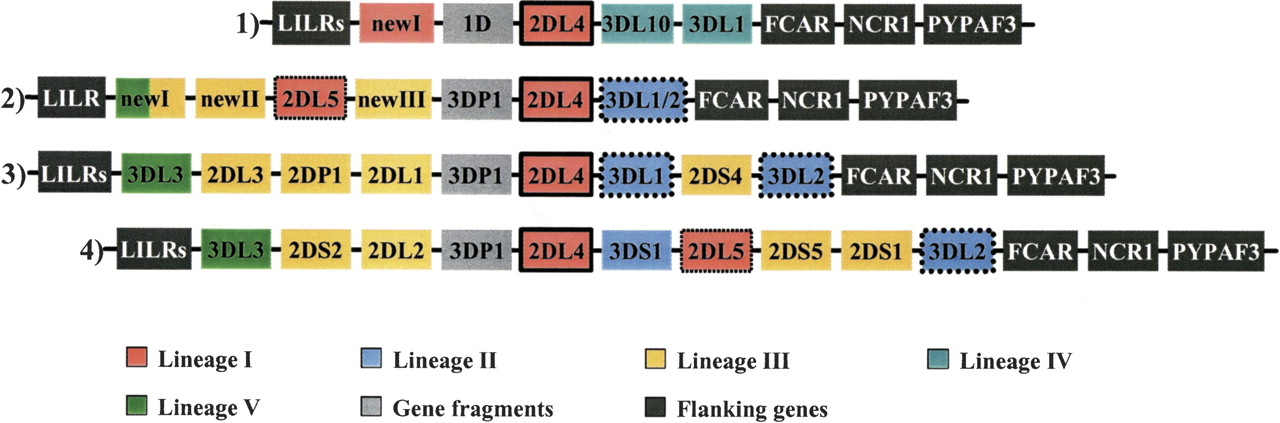
Only two chimp orthologs of the human KIR genes were clearly identifiable: ptKIR2DL4 and ptKIR2DL5. They are both 94% identical at the protein level with their human orthologs. The presence of ptKIR2DL5, in particular, in clone RPCI-43-61P22 confers a resemblance to human haplotypes of type B. Thus the two ptKIR genes that have human orthologs are those that lack an exon encoding the D1 domain.
The gene at the 5′-end of the chimpanzee KIR haplotype ptKIRnewI is similar to KIR3DL3, the human gene at the 5′-end of the locus, and like KIR3DL3 it lacks an exon 6. In the exons encoding the extracellular Ig domains, ptKIRnewI and KIR3DL3 appear orthologous, but in the exons encoding the transmembrane region and cytoplasmic tail, they diverge. This pattern of similarity and divergence is likely the result of a recombination (Table 1). A cDNA that may correspond to an allele of ptKIRnewI has been identified (Rajalingam et al. 2001). The gene at the 3′-end of the chimpanzee KIR haplotype is identical to the ptKIR3DL1/2 cDNA (Khakoo et al. 2000), although the translated cDNA sequence (AF258798) is missing the first 14 amino acids. It appears to be orthologous to human KIR3DL1 in the extra-cellular Ig domains and to human KIR3DL2 in the stem, transmembrane, and cytoplasmic tail. Again the human and chimpanzee KIR genes are seen to have diverged through recombination. The result is that the telomeric part of the KIR locus comprises a single gene, ptKIR3DL1/2, in the chimpanzee haplotype, whereas it consists of three or more genes in human KIR haplotypes. Note that the two ends of the KIR locus, corresponding to the 5′ part of the human KIR3DL3 gene and the 3′ part of the KIR3DL2 gene, are conserved in the chimpanzee KIR haplotype as well as the central region containing KIR3DP1 and KIR2DL4.
Domain and full-length nucleotide comparisons between the chimpanzee and macaque novel genes with previously identified cDNAs and KIR2DP1
Closest sequences (number of differences) | |||||||||
|---|---|---|---|---|---|---|---|---|---|
| Full-length | D0 | D1 | D2 | S/TM/CYT | |||||
| ptKIRnewI | ptKIRCI (23) | ptKIRCI (1) | ptKIRCI (1) | ptKIRCI (0) | KIR2DPI (12) | ||||
| ptKIRCI (13) | |||||||||
| ptKIRnewII | ptKIR2DL6 (23) | ptKIR2DL6 (1) | ptKIR3DL6 (1) | ptKIR3DL6 (0) | ptKIR2DL3 (13) | ||||
| ptKIR2DL6 (2) | ptKIR2DL6 (0) | ptKIR2DL6 (20) | |||||||
| ptKIRnewIII | ptKIR2DL6 (39) | ptKIR2DL6 (4) | ptKIR3DL6 (10) | ptKIR3DL7 (9) | ptKIR3DL4 (10) | ||||
| ptKIR3DL7 (10) | ptKIR2DL6 (9) | ptKIR2DL6 (15) | |||||||
| ptKIR2DL6 (11) | |||||||||
| mmKIRnewI | mmKIR2DL5.1 (3) | mmKIR2DL5.1 (0) | ggKIR3DL3 (25) | mmKIR2DL5.1 (3) | mmKIR2DL5.1 (0) | ||||
[i] Domains have been divided into Ig D0, Ig D1, Ig D2 and the combined sequence of the stem, transmembrane, and cytoplasmic tail (S/TM/CYT).
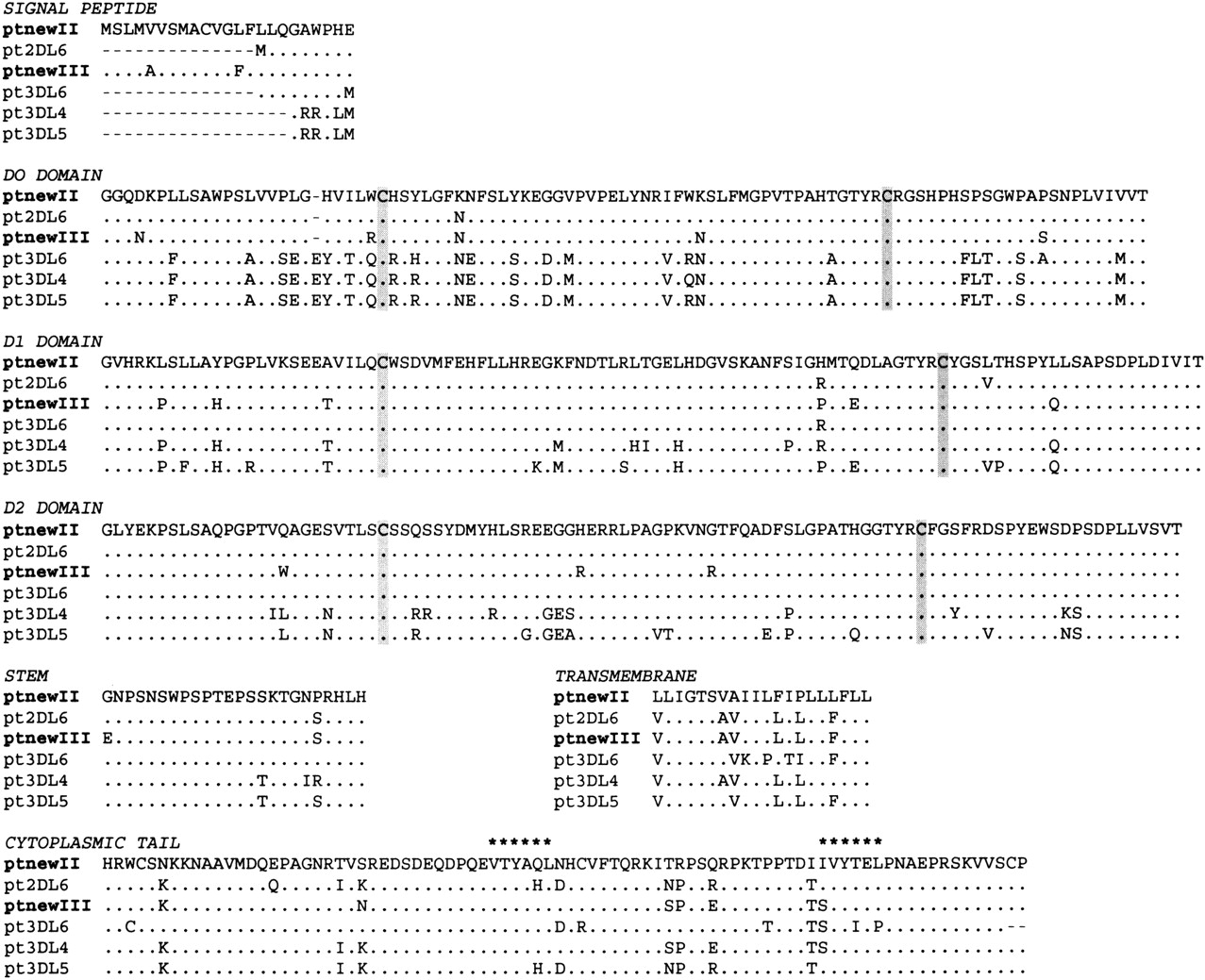
The remaining two ptKIR genes (ptKIRnewII and ptKIRnewIII) are found in the centromeric part of the chimpanzee KIR haplotype, where they flank ptKIR2DL5. These two genes are similar to each other and also to the cDNA ptKIR2DL6 (Table 1; Fig. 2). The gene encoding ptKIR2DL6 has been shown to contain a pseudoexon 3, which is homologous to exon 3 of KIR3DL genes but is not incorporated into mature mRNA. The sequence similarity between pseudoexon 3 of ptKIR2DL6 and the homologous sequences of ptKIRnewII and ptKIRnewIII (1-nt and 4-nt differences, respectively) reveals the possibility that these genes could encode KIR2D, although KIR3D is not ruled out. PtKIRnewII, ptKIRnewIII, and ptKIR2DL6 form a closely related trio of KIR that are very similar to each other in the extracellular domains and are more divergent in the stem, transmembrane, and cytoplasmic domains. Uncertain is whether ptKIR2DL6 is paralogous to both ptKIRnewII and ptKIRnewIII or whether it is allelic to one of them.
Multiple sequence alignment of the novel ptKIRnewII and ptKIRnewIII genes (shown in bold) in the common chimpanzee. Periods (.) indicate identity with ptKIRnewII and dashes (-) indicate the absence of amino acids. Conserved cysteine residues in the immunoglobulin domains are highlighted. ITIM motifs are shown by asterisks. Although closely related to ptKIR2DL6, which is shown to include the D0 domain encoded by pseudoexon 3, it is not clear whether ptKIRnewII and ptKIRnewIII belong to the KIR2D or KIR3D families. The cDNA sequences for ptKIR2DL6 and ptKIR3DL4-6 have been included, and are available under accession numbers AF258806 (ptKIR2DL6), AY122876 (pseudoexon 3 of ptKIR2DL6), AF258800 (ptKIR3DL4), AF258801 (ptKIR3DL5), and AF258802 (ptKIR3DL6).
Analysis of the rhesus macaque KIR region
The 314-kb macaque sequence was assembled from two clones with a 51-kb 100% identical overlap demonstrating that it represents a single haplotype. Five KIR genes, five LILR genes, and the FCAR, NCR1, and PYPAF3 genes were identified in the sequence (Fig. 1). The LILR gene cluster appears to be more divergent than previously assumed (Wilson et al. 2000) and will be described elsewhere. Further cDNA analysis, in order to confirm all KIR genes and gene structures predicted by genomic sequencing, was carried out using blood from the same rhesus macaque animal (25311) sequenced in this study. Within the KIR cluster of genes that spans 86 kb of DNA, one was identified as mmKIR1D, three contained three Ig domains and long cytoplasmic tails (mmKIR3DL), and one contained two Ig domains (mmKIR2DL4). Activating receptors, characterized by short cytoplasmic tails, were absent in both the in silico analysis and in 30 cDNA clones analyzed in the study. Although >100 cDNAs were sequenced, only genes represented by two or more clones were included in the analysis.
The mmKIR1D gene encodes a molecule with only one complete Ig D1 domain. Depending on alternative splicing (Hershberger et al. 2001), variants may contain a novel D2 domain resulting from a frameshift, or have deletions encompassing the entire D2 domain but retain the stem, transmembrane, and cytoplasmic domains. Two cDNA clones sequenced for this haplotype correspond to the variant with a novel stretch of 55 amino acids in the Ig D2 domain resulting in early termination of the protein. Alternatively spliced variants, with exon 4 being completely or partially deleted, were also observed, but these were only represented by one cDNA clone.
The mmKIR2DL4 gene has the highest similarity with a previously identified cDNA sequence named mmKIR2DL4.2 (AF334645), which was known to have an unidentified 3′-end. The last exon, as identified by genomic and cDNA sequencing in this study, is divergent from the human and chimpanzee orthologs in both sequence composition and length, in particular the terminal 67 amino acids in the cytoplasmic tail. Although the primate KIR2DL4 genes have a long cytoplasmic tail and ITIM motifs (only one in human and chimpanzee), the presence of a charged arginine residue in the transmembrane domain indicates an activating function (Vilches and Parham 2002; Kikuchi-Maki et al. 2003). Functional testing of NK cytotoxicity using effector cells from the same animal whose KIR haplotype was sequenced herein (animal 25311) against a rhesus macaque-derived target cell line with down-regulated cell surface MHC-I expression showed levels of activity within the range observed in 15 unrelated rhesus macaques (H. Andersen, pers. comm.). Thus, mmKIR2DL4 or some other activating NK cell receptor encoded by a gene outside of the KIR gene cluster, such as mmCD94/NKG2C, is capable of sending an activating signal and triggering NK cell cytotoxicity (LaBonte et al. 2001).
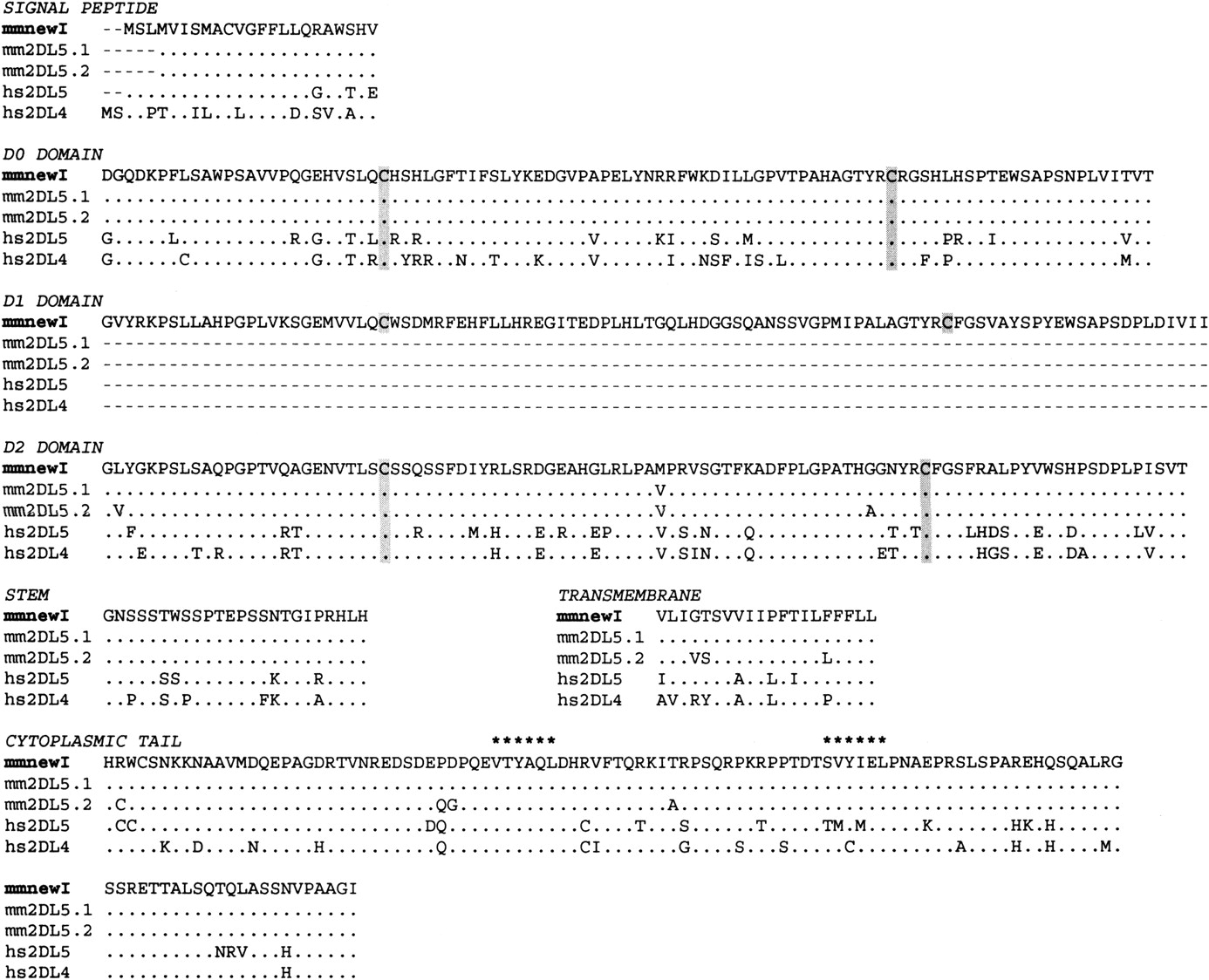
Two KIR genes containing three Ig domains correspond to previously identified cDNA sequences: mmKIR3DL1 and mmKIR3DL10, and apart from the first six amino acids missing in both cDNAs (Q8MK40 and Q8MK31), the sequences are identical at the protein level. The third novel gene, provisionally called mmKIRnewI, is highly related to the cDNA sequence named mmKIR2DL5.1, differing by only three nucleotide substitutions in the coding region (Table 1; Fig. 3). While the exon for Ig D1 in mmKIRnewI is incorporated into mRNA, it may be that mmKIR2DL5.1 is the transcript from an allele in which the exon is not present. Alternatively, it could represent a different but closely related gene. There were no mmKIR2DL5 cDNAs found for the haplotype analyzed here. What is most intriguing is that mmKIRnewI appears to represent an evolutionary intermediate between KIR3D genes and the genes for human KIR2DL4 and KIR2DL5, which have lost exon 4 corresponding to the D1 domain.
Multiple sequence alignment of the novel mmKIRnewI gene in the rhesus macaque (shown in bold). Periods (.) indicate identity with mmKIRnewI and dashes (-) indicate the absence of amino acids. Human KIR2DL4 and KIR2DL5 genes have the D0+D2 structure. Conserved cysteine residues in the immunoglobulin domains are highlighted. ITIM motifs are shown by asterisks. The cDNA sequences are available under accession numbers AAK26807 (mmKIR2DL5.1) and AAK26808 (mmKIR2DL5.2).
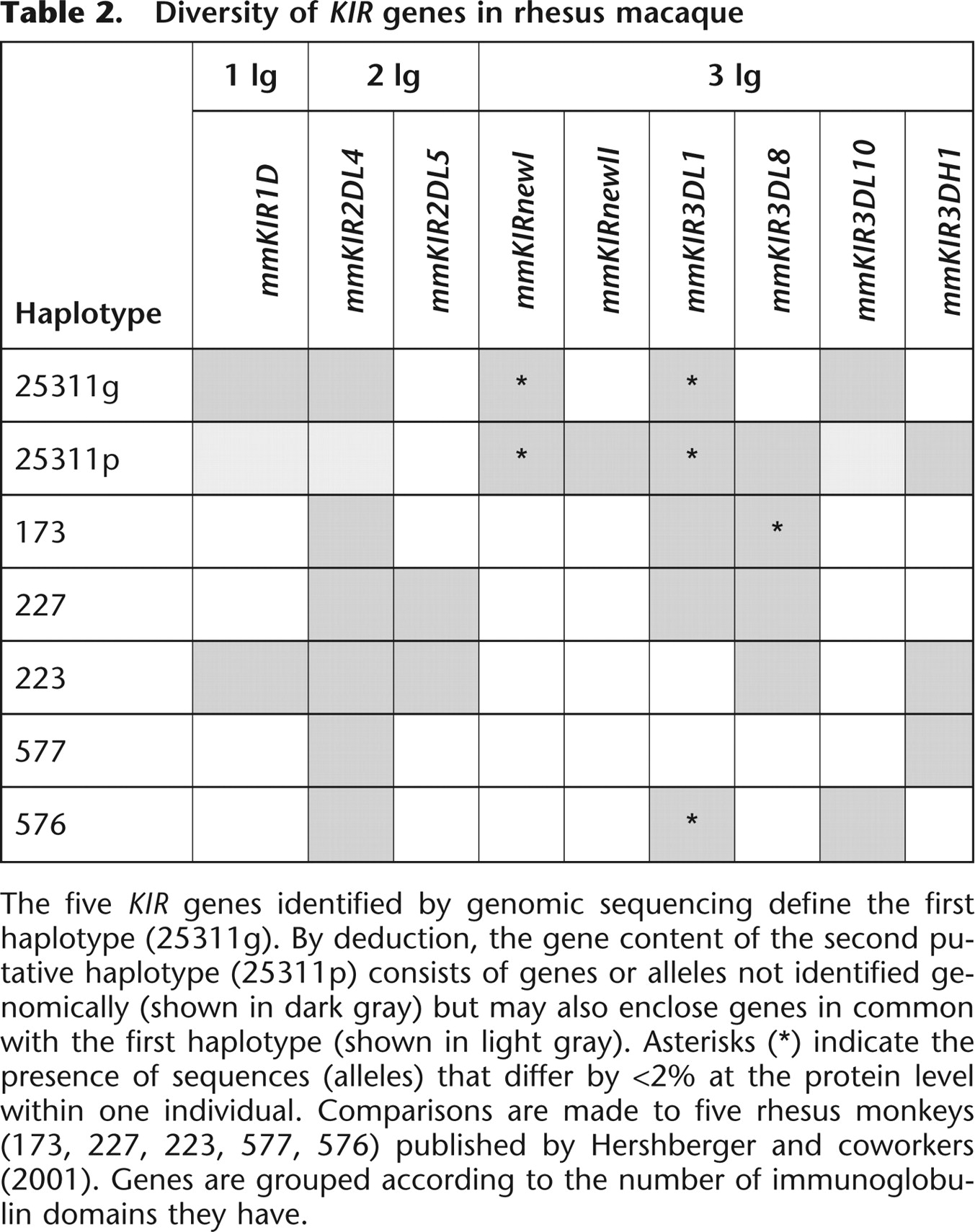
Comparison of the genomic and cDNA data confirmed that, as in humans, different KIR haplotypes exist in non-human primates. Among the cDNAs obtained here were full-length sequences for mmKIR3DL8 and mmKIR3DH1, and a novel sequence named mmKIRnewII, all pointing to the two KIR haplotypes in the animal analyzed being different. The mmKIRnewII gene encodes a protein with three Ig domains and is >2% divergent from other mmKIR3DLs. Its closest relative, with 90% protein identity, is mmKIR3DL7. Two new variants of mmKIRnewI and mmKIR3DL1, which are 98.5% and 98.2% identical at the protein level with the ones belonging to the sequenced haplotype, respectively, were also identified. The KIR3DH molecules resemble KIR2DL4 in their TM domains with the presence of an arginine, but they lack ITIM motifs in the cytoplasmic tail. It is possible their hybrid nature allows them to act as activating receptors (Hershberger et al. 2001). The identification of the KIR sequences reported here, in addition to previously identified cDNAs (Hershberger et al. 2001) from five rhesus macaques, further highlights the diversity of KIR genes in non-human primates (Table 2).
Phylogenetic analysis of the primate KIR genes
Phylogenetic trees (Fig. 4) were constructed using four structural KIR domains, including the three Ig domains and the combined sequence comprising the stem, TM, and cytoplasmic tail. This approach allows for the formation of new KIR genes, for example, by recombination, to be examined (Rajalingam et al. 2004). The branching patterns reflect structural differences but lineage similarities between KIR members.
Phylogenetic analysis of the KIR genes carried out on a domain-by-domain basis, including Ig D0 (A), Ig D1 (B), Ig D2 (C), and the combined stem, transmembrane, and cytoplasmic tail (D). The tree has been constructed using the Neighbor Joining (NJ) method. Novel genes identified in the common chimpanzee and rhesus macaque haplotypes analyzed are shown in bold. Sequences have been grouped into five lineages (I, II, III, IV, V) and are enclosed within boxes. The previously identified ptKIR3DL3 cDNA does not correspond to the human KIR3DL3 gene but rather is allelic to ptKIR3DL1/2.
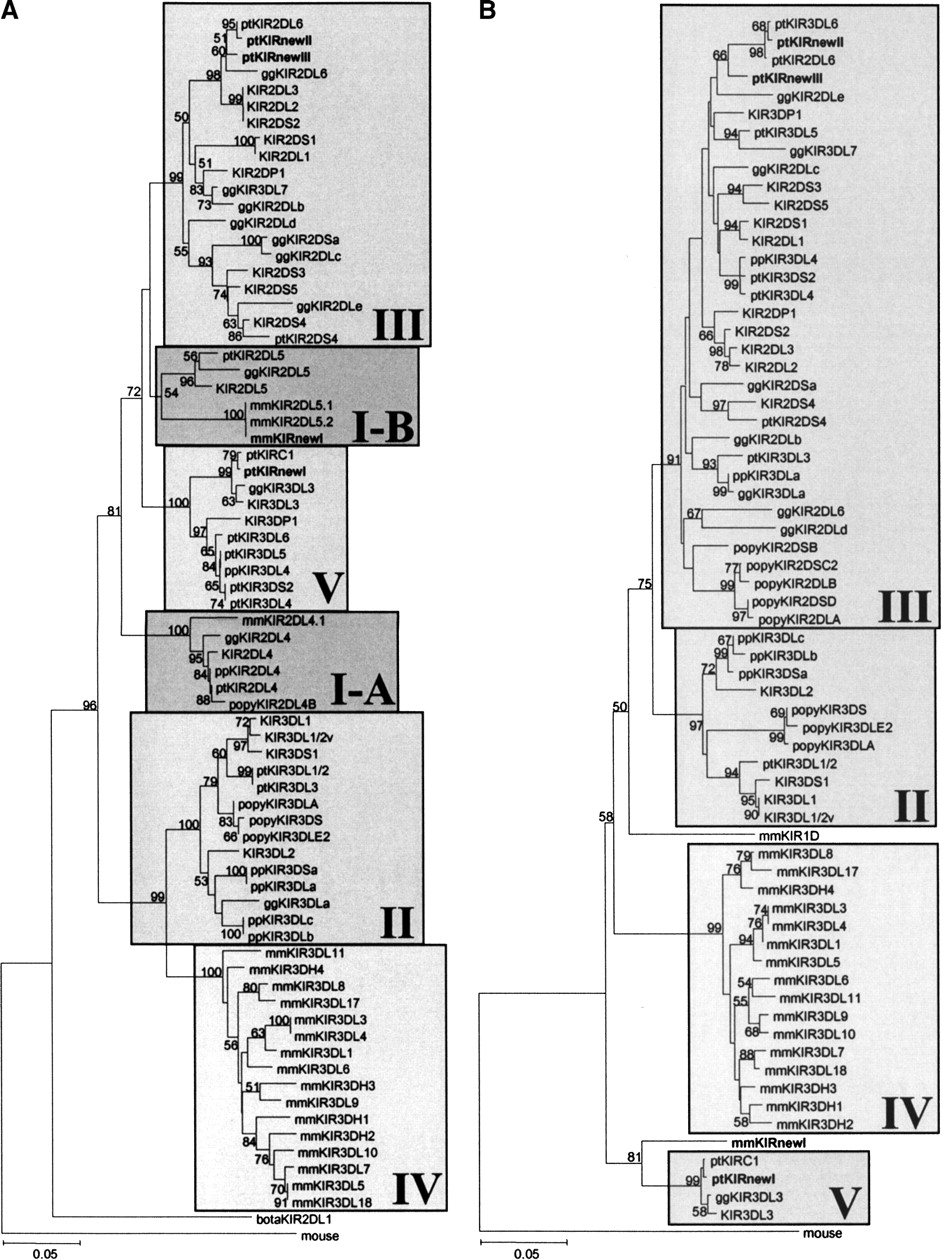
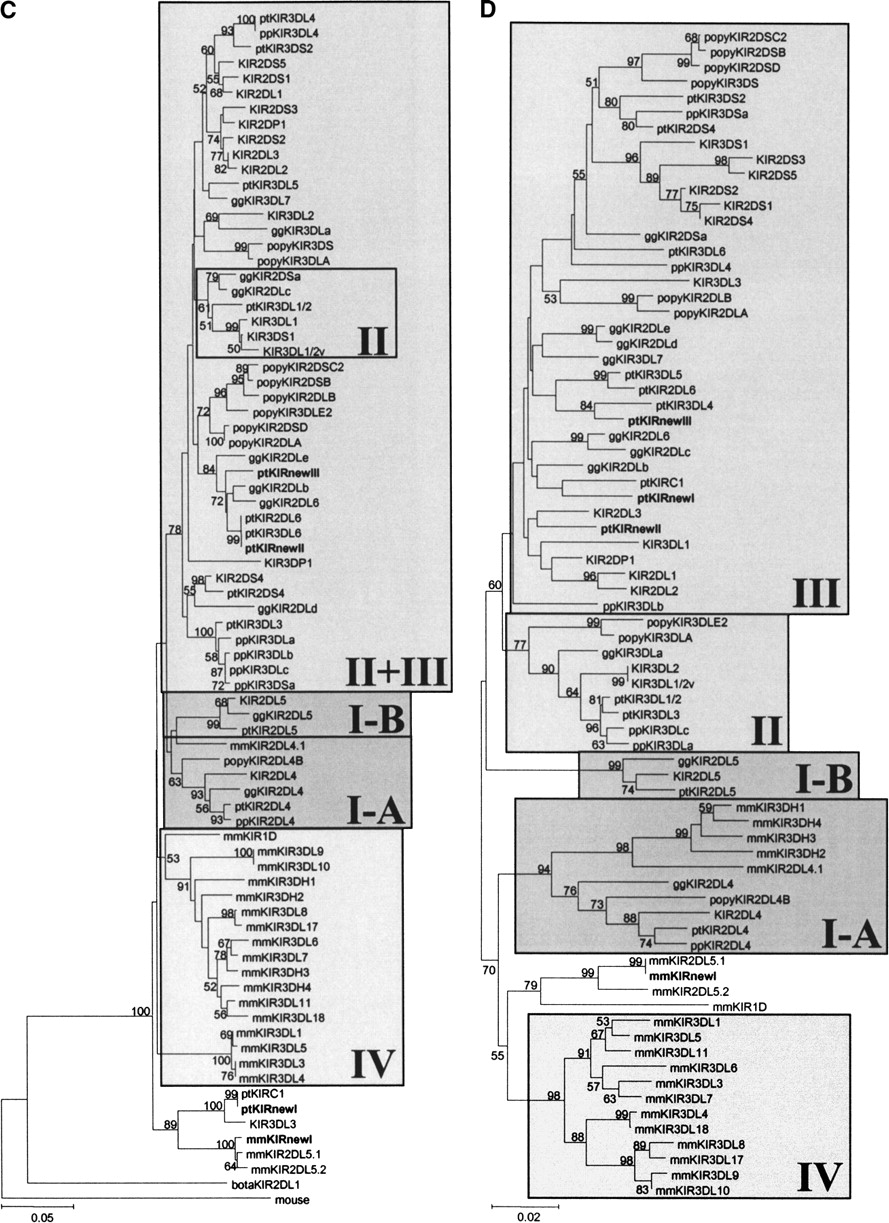
Lineage I contains the KIR2DL4 and KIR2DL5 genes, which have the Ig D0+D2 configuration in common, and mmKIRnewI, which may represent an evolutionary bridge with the D0+D1+D2 structure. KIR2DL4 is the most conserved gene between human, common chimpanzee, and rhesus macaque. Whether it binds HLA-G, a nonclassical MHC class I region gene that is not polymorphic, is not clear (Boyson et al. 2002). Owing to variable phylogenetic clustering, KIR3DL3 is not a representative member of this lineage (Vilches and Parham 2002) and has been assigned to lineage V, although KIR3DL3 and KIR2DL4 are predicted to be descendants from a common ancestor (Martin et al. 2000). The D1 domain of mmKIRnewI is the only rhesus macaque sequence to show affinity with KIR3DL3. All the remaining macaque genes that contain three Ig domains cluster to form lineage IV.
Lineage II encompasses human KIR3DL2, which is known to bind HLA-A, and KIR3DL1, which binds HLA-B. Both ptKIR3DL1/2 and KIR3DS1 are in this group. Lineage III consists of a mixture of KIR genes that have two (D1+D2) or three Ig (D0+D1+D2) domains. The two novel chimp genes, ptKIRnewII and ptKIRnewIII, are also found in the cluster. Species-specific evolutionary processes are likely to have driven the diversity within this branch.
Although the similarity between the human and chimpanzee MHC class I regions is high (Anzai et al. 2003) with the conservation of HLA-A, HLA-B, and HLA-C genes, the MHC organization in the rhesus macaque is more varied (Kulski et al. 2002). Of particular interest is the possibility that the recent duplication event leading to the HLA-C locus, estimated at 21–28 Mya, only occurred in the ape lineage, and to date has not been mapped in monkeys, such as the rhesus macaque (Piontkivska and Nei 2003). By extrapolation, the receptor to this ligand is predicted to be absent in these primates.
Repeat analysis and evolutionary implications
The DNA sequences encompassing the syntenic regions to the LRC of humans in two closely related primates have made it possible to examine the genomic structure of the KIR gene family members. In all three species, they are tightly clustered with relatively short intergenic sequences, share the same direction of transcription, and have similar exon–intron structures, making it likely that they are derived from the same ancestral gene. The insertion of ancient retroelements and Alu repeats within the introns of the KIR genes accounts for the differences in their lengths. In the common chimpanzee and rhesus macaque, for example, a single KIR gene span (including the pseudogenes) varies from 5.4 to 16.1 kb and 8.7 to 14.6 kb, respectively.
Four major retroelements were found to be present in the chimp and macaque KIR intronic regions: MLT1D, MSTB1, MER70B, and LIMA4 (Fig. 5). These have also been identified within the human KIR genes (Martin et al. 2000) and are present in similar locations. Interspersed between and within these retroelements are several Alu repeats, which are useful in dating genes according to the presence of differently aged subfamilies. According to Martin et al. (2000) and based on the analysis of the human KIR cluster, the ancestral KIR gene originated ∼60 to 100 Mya when the four retroelements were inserted. Subsequent duplication events, ranging from 30 to 45 Mya, resulted in the diversification of the KIR genes, which can be classified according to the type and number of Alus located within the ancestral LIMA4 element. For example, KIR2DL4 and KIR3DL3 have an AluSq, indicating a common ancestry, as opposed to KIR3DL1 and KIR3DL2, which have an AluSp and two AluSx elements and have evolved from a different progenitor.
Repeat analysis of the KIR intronic regions showing the presence of ancient retroelements and Alu repeats (not to scale). Genes have been grouped according to their lineages (I, II, III, IV, V). Distinct domains are labeled as follows: signal peptide, D0, D1, and D2 for the Ig domains, stem, transmembrane domain, and cytoplasmic tail. Lineage I genes have a D0+D2 structure. Although the three Ig domains are shown for ptKIRnewII and ptKIRnewIII, it is likely that they contain a pseudoexon 3, indicated by the striped boxes, and express the 2D structure. Splice variants of mmKIR1D may be missing the D2 or TM domains, as indicated by the open boxes.
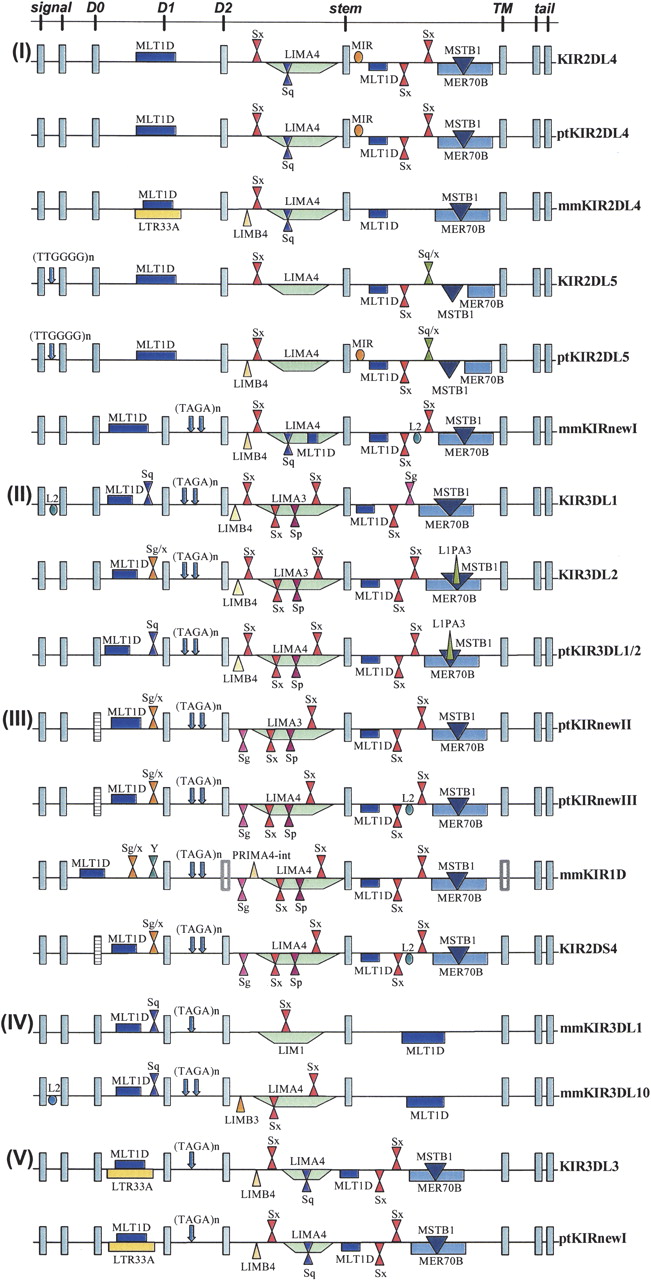
The chimpanzee KIR genes appear to follow a similar pattern of evolution as proposed by Martin et al. (2000). The divergence of ptKIR2DL4 from ptKIR3DL1/2, ptKIRnewII, and ptKIRnewIII is clearly defined by the distinct Alu elements found within the LIMA4 retroelement. In concordance with the phylogenetic analysis (Fig. 4), members of lineage II, such as KIR3DL1, KIR3DL2, and ptKIR3DL1/2, share an AluSx upstream of LIMA4, while ptKIRnewII and ptKIRnewIII have an AluSg and are part of lineage III. The ptKIR3DL1/2 gene shares the same repeat elements of intron 3 with human KIR3DL1 and intron 6 with human KIR3DL2, further demonstrating the commonality between these three genes. As with their human counterparts, the ptKIRnewI gene, which also contains the AluSq element within LIMA4, also appears to be related to ptKIR2DL4, providing further evidence that primate lineage I and lineage V genes share a common ancestor. Notable differences between intronic regions of KIR2DL4 and KIR2DL5 are the presence or absence of the AluSq repeat in the LIMA4 element in intron 4, as well as two types of Alu repeats (AluSx and AluSq/x) in the latter gene.
Repeat elements found in the intronic regions of the rhesus macaque genes are less conserved compared to the human and chimpanzee homologs, although similarities within respective lineages are apparent. Apart from mmKIR2DL4, which has the characteristic AluSq insertion in LIMA4 found in all primate KIR2DL4 genes, this was also observed in mmKIRnewI, which may indicate a unique shared common ancestor, and further supports its clustering with other lineage I genes. Both mmKIR3DL1 and mmKIR3DL10 do not have the MSTB1 or MER70B retroelements in intron 6 that are present in all the other KIR genes analyzed here. Correspondingly, their protein sequences clustered phylogenetically within lineage IV, which comprises only rhesus macaque KIR genes (Fig. 4). The repeat elements in mmKIR1D are highly similar to those present in lineage II and III genes, including human KIR2DS4. Recently, a novel allele of KIR2DS4 has been identified that resembles one of the splice variants of mmKIR1D, characterized by a 22-bp deletion that disrupts the Ig D2 domain and results in the absence of the cytoplasmic tail due to premature termination of the protein (Hsu et al. 2002). Although mmKIR1D found in this haplotype does not encode this particular variant, analysis of the intronic regions does reveal a shared ancestry with the human KIR2DS4 allele. The youngest type of an Alu repeat, AluY, has only been observed in mmKIR1D.
Minisatellite sequences, originally identified in all human KIRs (Trowsdale et al. 2001), were also found in the first intron of all the KIR genes analyzed here, apart from KIR2DL4, in both non-human primates (Table 3). It is known that G+C-rich minisatellites are associated with recombination rates and/or variation of genes (Jeffreys et al. 2000; Boan et al. 2002).
Identification of minisatellites in the first intron of the non-human KIR genes
Gene | Minisatellite repeat motif | Number |
|---|---|---|
| ptKIRnewI | CTGGAGTGGAGATATGGGC | 30 (33) |
| ptKIRnewII | CCTGGAGTGGAGATATGCA | 43 |
| ptKIR2DL5 | AGATATGGGCCTGGAGTGG | 25 (23) |
| ptKIRnewIII | TGGAGATATGGGCCTGGAG | 49 |
| ptKIR3DP1 | TGGAGATATGGGCCTGGAG | 24 |
| ptKIR2DL4 | None | 0 (0) |
| ptKIR3DL1/2 | AGATCTGGGCCTGGAGTGG | 16 (42/28) |
| mmKIRnewI | CTGGAGTGGAGATATGGGC | 30 |
| mmKIR1D | CTGGAGTGGAGATATGGGC | 40 |
| mmKIR2DL4 | None | 0 (0) |
| mmKIR3DL10 | CTGGAGTGGAGATATGGGC | 72 |
| mmKIR3DL1 | CTGGAGTGGAGATATGGGC | 84 (42) |
[i] The numbers of repeats in the equivalent human KIR genes are shown in parentheses. The minisatellites consist of multiple copies of an imperfect 19-bp repeat.
Evolution of the KIR region in primates
Sequence comparisons and phylogenetic analyses have shown that the KIR gene family members have diversified rapidly among primates, and only certain KIR genes remain orthologous among humans, apes, and monkeys. The presence of ancient retroelements indicates that these were derived from a common ancestor that was in existence ∼60 to 100 Mya. The additional insertion of Alu elements are indicative of recent duplication events leading to the diversity in the KIR family.
The expansion of the KIR system in primates, as opposed to the diverse family of Ly49 members in rodents, might have evolved as a functional means of replacing the single LY49like (LY49L) gene present in non-rodent mammals (McQueen et al. 2002). Point mutations have inactivated the LY49L gene in humans, chimpanzee, and gorilla (higher primates), although it appears to be functional in other species, such as cow, baboon, and orangutan. The Ly49 gene also exists as a single copy in domestic cat, dog, and pig, as opposed to mouse, rat, and horse (Takahashi et al. 2004), which have multiple copies. Phylogenetic analysis suggests the Ly49 genes are evolving more rapidly within rodents as compared to their non-rodent mammalian counterparts (Gagnier et al. 2003), mainly as a result of a series of large duplication events involving units of one or more genes (Wilhelm et al. 2002). To date, no mammals have been identified that have multiple Ly49 and multiple KIR genes. Both systems ultimately provide inhibitory and activating receptors, expressed in a diverse NK cell repertoire, for MHC class I molecules.
Functional analysis of NK cell activity mediated through KIR in non-human primates is limited to a recent study showing that chimpanzee and human NK cells exhibit identical receptor specificities for HLA-C through nonorthologous KIR molecules (Khakoo et al. 2000). In the rhesus macaque, virtually all of the functional studies of NK activity performed to date have used the human target cell line K562, despite the phylogenetic divergence between the species and the fact that the rhesus monkey does not appear to have an HLA-C locus. However, recently developed rhesus NK target cell lines with down-regulated cell surface MHC-I expression (H. Andersen, pers. comm.) should help clarify the underlying molecular interactions between macaque KIR and their cognate ligands that regulate NK activity in this species.
The chimp and macaque genomic regions analyzed here represent one haplotype in each species, and do not encompass the full complement of KIR genes present in the genome or population. Interestingly, no activating KIR genes (characterized by short cytoplasmic tails) were identified, suggesting that they either reside in separate loci or their presence might vary within the population. As in humans, different haplotypes vary in gene content in non-human primates. Four novel KIR genes, preliminarily named ptKIRnewI, ptKIRnewII, ptKIRnewIII, and mmKIRnewI, have also been identified genomically in this study, and it is possible that more variants exist as shown by the presence of novel cDNAs, such as mmKIRnewII, in the rhesus macaque. The shortest KIR haplotype in the pygmy chimpanzee, a close relative of the common chimpanzee, only encompasses three genes, KIR3DL3, KIR2DL4, and KIR3DL (Rajalingam et al. 2001). These genes represent either orthologs or paralogs to one of the four framework genes present in all human haplotypes, and are also present in the analyzed common chimpanzee genomic region. Only KIR2DL4 is held in common with rhesus macaque.
Methods
Contig construction and sequencing
The RPCI-43 chimpanzee and CHORI-250 rhesus macaque BAC libraries (Children's Hospital Oakland Research Institute, Oakland, CA) were hybridized with a human KIR2DL4 probe (nucleotides 57132–57418, GenBank accession number AC011501) to identify both inhibitory and activating KIR. The libraries were screened, and positive clones were rescreened by hybridization with a KIR2DL4 probe using Southern and dot blotting. Then 12 chimpanzee and eight macaque BAC clones were selected for further hybridization with human probes for LILRA2 (nucleotides 1340–1686, GenBank accession number U82275) and NCR1 (nucleotides 771–1138, GenBank accession number AJ001383) in order to identify BAC clones that contained the centromeric and/or telomeric ends of the KIR complex, respectively. The BAC clones were mapped into contigs using restriction-digest fingerprinting (Gregory et al. 1997). One chimp clone (RPCI-43-61P22) and two macaque clones (CHORI-250-178N19 and CHORI-250-242L13), covering the respective KIR complexes, were selected for sequencing. The virtual restriction maps from the clones sequenced were compared to the restriction-enzyme fingerprints in order to confirm correct assembly. These clones have flanking framework non-KIR genes, indicating that the complete KIR haplotypes have been sequenced for both species.
The BAC DNA was randomly subcloned (Bankier et al. 1987) into pUC plasmids and sequenced from both ends using the dideoxy chain termination method (Sanger et al. 1977) with different versions of big dye terminator chemistry (Rosenblum et al. 1997). The resulting sequencing reactions were analyzed on various models of ABI sequencing machines, and the generated data were processed by a suite of in-house programs (http://www.sanger.ac.uk/Software/) prior to assembly with the PHRED (Ewing et al. 1998) and PHRAP (http://www.phrap.org) algorithms. The GAP4 program (Bonfield et al. 1995) was used to view and edit the resulting sequence contigs during the finishing process. The finished sequences were submitted to the EMBL/GenBank/DDBJ databases under BX842589 for the common chimpanzee, and BX842590 and BX842591 for rhesus macaque.
Gene identification and genomic characterization
The DNA sequences were analyzed using NIX, a gene identification program (http://www.hgmp.mrc.ac.uk/NIX). The homologous KIR genes in the common chimpanzee and rhesus macaque were classified into distinct groups based on their genomic organization, that is, whether they encoded proteins with two or three Ig domains, and either long or short cytoplasmic tails. Furthermore, following the nomenclature used to describe KIR homologs, the prefixes “pt” for Pan troglodytes and “mm” for Macaca mulatta have been used in the annotation. The naming of KIR alleles has recently been standardized (Marsh et al. 2003) and is followed here. Pairwise alignments were carried out in EMBOSS (Rice et al. 2000) with a gap opening penalty of 10 and a gap extension penalty of 0.5. Intronic sequences were analyzed for retroelements and tandem repeats using the RepeatMasker program (http://ftp.genome.washington.edu/RM/RepeatMasker.html; A.F. Smit and P. Green, unpubl.) and a tandem repeat finder program (Benson 1999).
cDNA analysis
Peripheral blood mononuclear cells (PBMC) were isolated from whole blood of rhesus monkey Mmu-25311 provided by M.B. McChesney (Virology and Immunology Unit, California National Primate Research Center, UC Davis, CA). Total RNA was isolated from the PBMC using Trizol (Invitrogen) and transcribed to cDNA using Superscript II (Invitrogen). Macaque KIR cDNAs were amplified in PCR reactions using eight different pairs of primers. Primers were designed based on alignment of GenBank sequences as well as predicted cDNA structures from the macaque KIR haplotype described in this paper. PCR primer pair sequences were as follows: (1) CATGTYGCTCAYGGTCGTC and CTGGGCTGGAGACAACGA; (2) ATGGTCGTCAGCGTGGYG and TTGTGTCCCTRGARGACCCC; (3) AGCACCATGTCGCTCATGGTCA and GTCGCGCCTTCAGATTCCTG; (4) ATGTCGCTCATGGTCGTTAGCG and CCCTAAGATGCAGACTCACAG; (5) CATGTCGCCCACGGTCGTCAT and CTAAGCAAAGGAGTGCGTTTTC; (6) AGCACCATGTCGCTCATGGTCC and TTGTCTCCCTAGAAGACCCCT; (7) AGCACCATGTCGCTCATGGTCG and ACGGTGGTGCTCATGGATAGA; (8) AGCACCATGTCGCTCATGGTCA and AGGCCTGACTCTGGTGCTCAC. Owing to the high level of sequence similarity, multiple genes were amplified in all reactions, except that for KIR3DH1 and KIR2DL4 (primer pairs 1 and 5, respectively). PCR products were cloned into pCR2.1-TOPO vector (Invitrogen), and 10–20 clones were isolated and sequenced for each PCR reaction. Although >100 cDNA clones were sequenced, only sequences represented by two or more clones were submitted to GenBank and described in this paper.
Phylogenetic analysis
KIR full-length nucleic acid sequences were aligned using CLUSTALX (Higgins et al. 1992), and then corrected manually. Neighbor Joining (Saitou and Nei 1987) phylogenetic trees were reconstructed for each domain using MEGA version 2.1 (Kumar et al. 2001). The p-distance was used with pairwise deletion and 500 bootstrap replicates. All the trees were rooted at the midpoint and bootstrap proportion values <50 were removed.
Footnotes
[1] [The sequence data from this study have been submitted to EMBL/GenBank/DDBJ under accession nos. BX842589–BX842591 and AY728181–AY728190. The following individuals kindly provided reagents, samples, or unpublished information as indicated in the paper: M.B. McChesney.]
[4] Article and publication are at http://www.genome.org/cgi/doi/10.1101/gr.2381205.
[5] Corresponding author. E-mail [email protected]; fax 44-(0)1223-494919.
Acknowledgments
We thank Jie Cheng, Audrey Fraser, Karen Halls, and Matt Jones for technical assistance and the Wellcome Trust for financial support. Part of this work was supported with federal funds from the National Cancer Institute, National Institutes of Health under contract no. NO1-CO-12400. The content of this publication does not necessarily reflect the views or policies of the Department of Health and Human Services, nor does mention of trade names, commercial products, or organization imply endorsement by the U.S. Government.
References
- ↵Anzai, T., Shiina, T., Kimura, N., Yanagiya, K., Kohara, S., Shigenari, A., Yamagata, T., Kulski, J.K., Naruse, T.K., Fujimori, Y., et al. 2003. Comparative sequencing of human and chimpanzee MHC class I regions unveils insertions/deletions as the major path to genomic divergence. Proc. Natl. Acad. Sci. 100: 7708-7713.
- ↵Bankier, A.T., Weston, K.M., and Barrell, B.G. 1987. Random cloning and sequencing by the M13/dideoxynucleotide chain termination method. Methods Enzymol. 155: 51-93.
- ↵Batzer, M.A. and Deininger, P.L. 2002. Alu repeats and human genomic diversity. Nat. Rev. Genet. 3: 370-379.
- ↵Benson, G. 1999. Tandem repeats finder: A program to analyze DNA sequences. Nucleic Acids Res. 27: 573-580.
- ↵Boan, F., Rodriguez, J.M., Mourino, S., Blanco, M.G., Vinas, A., Sanchez, L., and Gomez-Marquez, J. 2002. Recombination analysis of the human minisatellite MsH42 suggests the existence of two distinct pathways for initiation and resolution of recombination at MsH42 in rat testes nuclear extracts. Biochemistry 41: 2166-2176.
- ↵Bonfield, J.K., Smith, K., and Staden, R. 1995. A new DNA sequence assembly program. Nucleic Acids Res. 23: 4992-4999.
- ↵Boyson, J.E., Erskine, R., Whitman, M.C., Chiu, M., Lau, J.M., Koopman, L.A., Valter, M.M., Angelisova, P., Horejsi, V., and Strominger, J.L. 2002. Disulfide bond-mediated dimerization of HLA-G on the cell surface. Proc. Natl. Acad. Sci. 99: 16180-16185.
- ↵Carrington, M. and Norman, P. 2003. The KIR gene cluster. Available from http://ncbi.nlm.nih.gov/entrez/query.fcgi?db=Books, Bethesda, MD.
- ↵Ewing, B., Hillier, L., Wendl, M.C., and Green, P. 1998. Base-calling of automated sequencer traces using phred. I. Accuracy assessment. Genome Res. 8: 175-185.
- ↵Gagnier, L., Wilhelm, B.T., and Mager, D.L. 2003. Ly49 genes in non-rodent mammals. Immunogenetics 55: 109-115.
- ↵Gaudieri, S., Kulski, J.K., Dawkins, R.L., and Gojobori, T. 1999. Different evolutionary histories in two subgenomic regions of the major histocompatibility complex. Genome Res. 9: 541-549.
- ↵Gregory, S.G., Howell, G.R., and Bentley, D.R. 1997. Genome mapping by fluorescent fingerprinting. Genome Res. 7: 1162-1168.
- ↵Grendell, R.L., Hughes, A.L., and Golos, T.G. 2001. Cloning of rhesus monkey killer-cell Ig-like receptors (KIRs) from early pregnancy decidua. Tissue Antigens 58: 329-334.
- ↵Guethlein, L.A., Flodin, L.R., Adams, E.J., and Parham, P. 2002. NK cell receptors of the orangutan (Pongo pygmaeus): A pivotal species for tracking the coevolution of killer cell Ig-like receptors with MHC-C. J. Immunol. 169: 220-229.
- ↵Hershberger, K.L., Shyam, R., Miura, A., and Letvin, N.L. 2001. Diversity of the killer cell Ig-like receptors of rhesus monkeys. J. Immunol. 166: 4380-4390.
- ↵Higgins, D.G., Bleasby, A.J., and Fuchs, R. 1992. CLUSTAL V: Improved software for multiple sequence alignment. Comput. Appl. Biosci. 8: 189-191.
- ↵Horai, S. 1995. Evolution and the origins of man: Clues from complete sequences of hominoid mitochondrial DNA. Southeast Asian J. Trop. Med. Public Health 26: 146-154.
- ↵Hsu, K.C., Chida, S., Geraghty, D.E., and Dupont, B. 2002. The killer cell immunoglobulin-like receptor (KIR) genomic region: Gene-order, haplotypes and allelic polymorphism. Immunol. Rev. 190: 40-52.
- ↵Jeffreys, A.J., Ritchie, A., and Neumann, R. 2000. High resolution analysis of haplotype diversity and meiotic crossover in the human TAP2 recombination hotspot. Hum. Mol. Genet. 9: 725-733.
- ↵Khakoo, S.I., Rajalingam, R., Shum, B.P., Weidenbach, K., Flodin, L., Muir, D.G., Canavez, F., Cooper, S.L., Valiante, N.M., Lanier, L.L., et al. 2000. Rapid evolution of NK cell receptor systems demonstrated by comparison of chimpanzees and humans. Immunity 12: 687-698.
- ↵Kikuchi-Maki, A., Yusa, S., Catina, T.L., and Campbell, K.S. 2003. KIR2DL4 is an IL-2-regulated NK cell receptor that exhibits limited expression in humans but triggers strong IFN-γ production. J. Immunol. 171: 3415-3425.
- ↵Kulski, J.K., Shiina, T., Anzai, T., Kohara, S., and Inoko, H. 2002. Comparative genomic analysis of the MHC: The evolution of class I duplication blocks, diversity and complexity from shark to man. Immunol. Rev. 190: 95-122.
- ↵Kumar, S. and Hedges, S.B. 1998. A molecular timescale for vertebrate evolution. Nature 392: 917-920.
- ↵Kumar, S., Tamura, K., Jakobsen, I.B., and Nei, M. 2001. MEGA2: Molecular evolutionary genetics analysis software. Bioinformatics 17: 1244-1245.
- ↵LaBonte, M.L., Hershberger, K.L., Korber, B., and Letvin, N.L. 2001. The KIR and CD94/NKG2 families of molecules in the rhesus monkey. Immunol. Rev. 183: 25-40.
- ↵Marsh, S.G., Parham, P., Dupont, B., Geraghty, D.E., Trowsdale, J., Middleton, D., Vilches, C., Carrington, M., Witt, C., Guethlein, L.A., et al. 2003. Killer-cell immunoglobulin-like receptor (KIR) nomenclature report, 2002. Tissue Antigens 62: 79-86.
- ↵Martin, A.M., Freitas, E.M., Witt, C.S., and Christiansen, F.T. 2000. The genomic organization and evolution of the natural killer immunoglobulin-like receptor (KIR) gene cluster. Immunogenetics 51: 268-280.
- ↵Martin, M.P., Bashirova, A., Traherne, J., Trowsdale, J., and Carrington, M. 2003. Cutting edge: Expansion of the KIR locus by unequal crossing over. J. Immunol. 171: 2192-2195.
- ↵McQueen, K.L., Wilhelm, B.T., Harden, K.D., and Mager, D.L. 2002. Evolution of NK receptors: A single Ly49 and multiple KIR genes in the cow. Eur. J. Immunol. 32: 810-817.
- ↵Natarajan, K., Dimasi, N., Wang, J., Mariuzza, R.A., and Margulies, D.H. 2002. Structure and function of natural killer cell receptors: Multiple molecular solutions to self, nonself discrimination. Annu. Rev. Immunol. 20: 853-885.
- ↵Piontkivska, H. and Nei, M. 2003. Birth-and-death evolution in primate MHC Class I genes: Divergence time estimates. Mol. Biol. Evol. 20: 601-609.
- ↵Rajalingam, R., Hong, M., Adams, E.J., Shum, B.P., Guethlein, L.A., and Parham, P. 2001. Short KIR haplotypes in pygmy chimpanzee (Bonobo) resemble the conserved framework of diverse human KIR haplotypes. J. Exp. Med. 193: 135-146.
- ↵Rajalingam, R., Parham, P., and Abi-Rached, L. 2004. Domain shuffling has been the main mechanism forming new hominoid killer cell Ig-like receptors. J. Immunol. 172: 356-369.
- ↵Rice, P., Longden, I., and Bleasby, A. 2000. EMBOSS: The European Molecular Biology Open Software suite. Trends Genet. 16: 276-277.
- ↵Rosenblum, B.B., Lee, L.G., Spurgeon, S.L., Khan, S.H., Menchen, S.M., Heiner, C.R., and Chen, S.M. 1997. New dye-labeled terminators for improved DNA sequencing patterns. Nucleic Acids Res. 25: 4500-4504.
- ↵Saitou, N. and Nei, M. 1987. The neighbor-joining method: A new method for reconstructing phylogenetic trees. Mol. Biol. Evol. 4: 406-425.
- ↵Sanger, F., Nicklen, S., and Coulson, A.R. 1977. DNA sequencing with chain-terminating inhibitors. Proc. Natl. Acad. Sci. 74: 5463-5467.
- ↵Shiina, T., Tamiya, G., Oka, A., Takishima, N., Yamagata, T., Kikkawa, E., Iwata, K., Tomizawa, M., Okuaki, N., Kuwano, Y., et al. 1999. Molecular dynamics of MHC genesis unraveled by sequence analysis of the 1,796,938-bp HLA class I region. Proc. Natl. Acad. Sci. 96: 13282-13287.
- ↵Springer, M.S., Murphy, W.J., Eizirik, E., and O'Brien, S.J. 2003. Placental mammal diversification and the Cretaceous–Tertiary boundary. Proc. Natl. Acad. Sci. 100: 1056-1061.
- ↵Takahashi, T., Yawata, M., Raudsepp, T., Lear, T.L., Chowdhary, B.P., Antczak, D.F., and Kasahara, M. 2004. Natural killer cell receptors in the horse: Evidence for the existence of multiple transcribed LY49 genes. Eur. J. Immunol. 34: 773-784.
- ↵Trowsdale, J. 2001. Genetic and functional relationships between MHC and NK receptor genes. Immunity 15: 363-374.
- ↵Trowsdale, J., Barten, R., Haude, A., Stewart, C.A., Beck, S., and Wilson, M.J. 2001. The genomic context of natural killer receptor extended gene families. Immunol. Rev. 181: 20-38.
- ↵Vilches, C. and Parham, P. 2002. KIR: Diverse, rapidly evolving receptors of innate and adaptive immunity. Annu. Rev. Immunol. 20: 217-251.
- ↵Vilches, C., Pando, M.J., and Parham, P. 2000. Genes encoding human killer-cell Ig-like receptors with D1 and D2 extracellular domains all contain untranslated pseudoexons encoding a third Ig-like domain. Immunogenetics 51: 639-646.
- ↵Welch, A.Y., Kasahara, M., and Spain, L.M. 2003. Identification of the mouse killer immunoglobulin-like receptor-like (Kirl) gene family mapping to chromosome X. Immunogenetics 54: 782-790.
- ↵Wende, H., Volz, A., and Ziegler, A. 2000. Extensive gene duplications and a large inversion characterize the human leukocyte receptor cluster. Immunogenetics 51: 703-713.
- ↵Westgaard, I.H., Berg, S.F., Orstavik, S., Fossum, S., and Dissen, E. 1998. Identification of a human member of the Ly-49 multigene family. Eur. J. Immunol. 28: 1839-1846.
- ↵Wilhelm, B.T., Gagnier, L., and Mager, D.L. 2002. Sequence analysis of the ly49 cluster in C57BL/6 mice: A rapidly evolving multigene family in the immune system. Genomics 80: 646-661.
- ↵Wilson, M.J., Torkar, M., Haude, A., Milne, S., Jones, T., Sheer, D., Beck, S., and Trowsdale, J. 2000. Plasticity in the organization and sequences of human KIR/ILT gene families. Proc. Natl. Acad. Sci. 97: 4778-4783.
Web site references
- ↵http://www.hgmp.mrc.ac.uk/NIX; NIX server at the MRC Rosalind Franklin Centre for Genomics Research (RFCGR).
- ↵http://www.phrap.org; the Phred/Phrap/Consed System.
- ↵http://www.sanger.ac.uk/Software/; the Sanger Institute Production Sequencing Software.