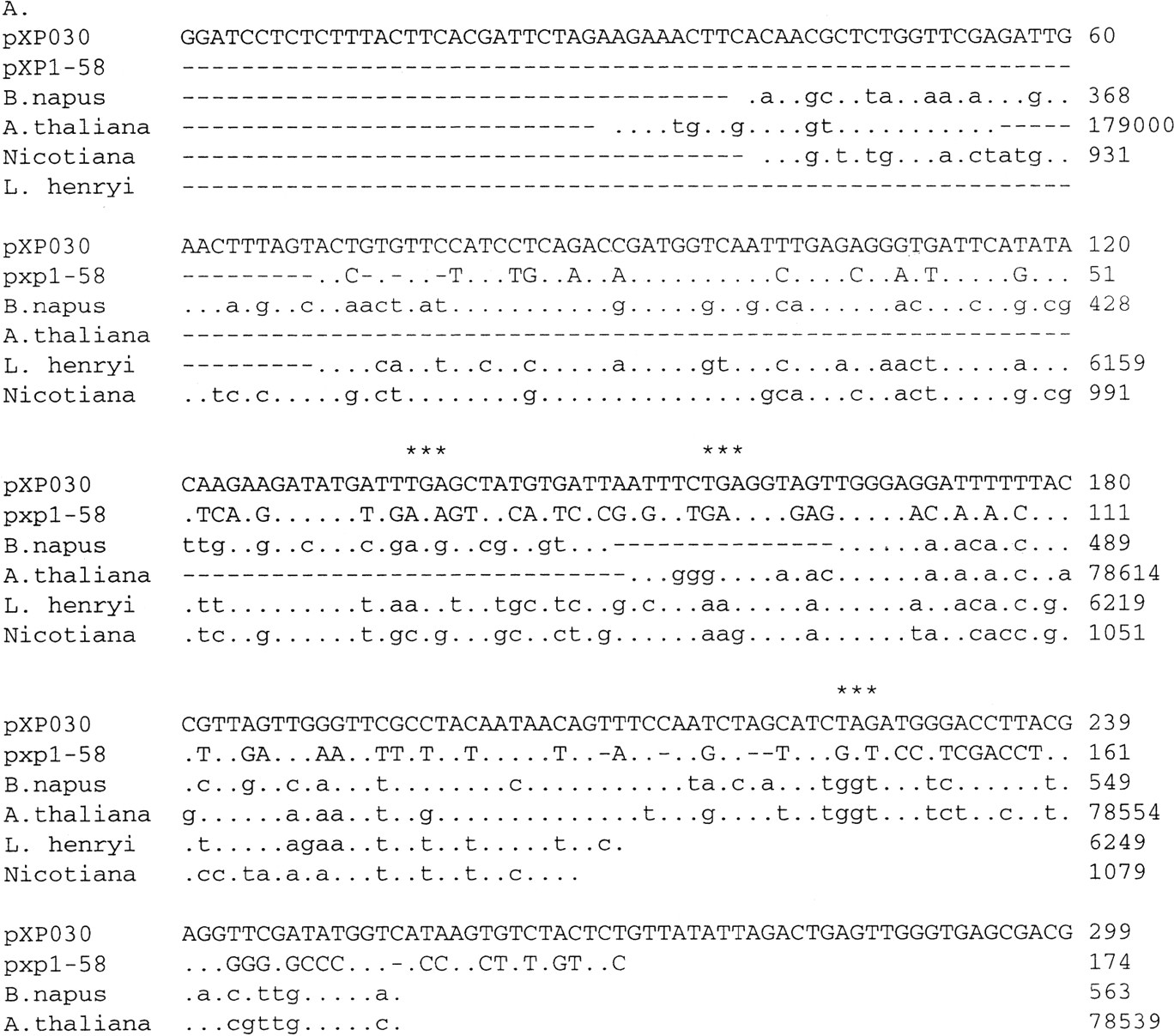
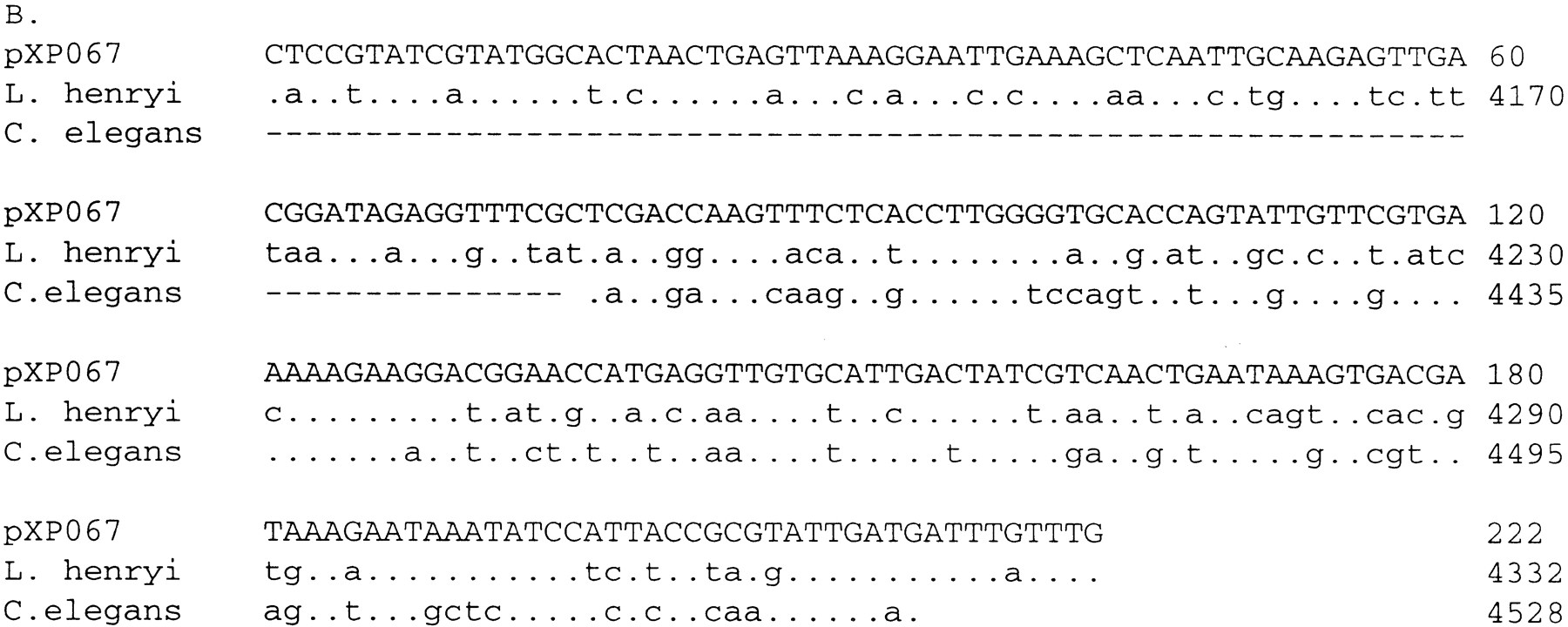

DNA sequence alignments of cotton repetitive elements, pXP030, pXP1-58, pXP067 and pXP1-13 (uppercase letters) with putative retrotransposon sequences from other organisms (lowercase letters). Identical bases are indicated by dots. Sequences without matches or gaps are indicated by dashes. Stop codons are indicated by asterisks. (A) pXP030 and pXP1-58 are multi-aligned with a Brassica napus DNA fragment containing a retrotransposon integrase motif (GenBank accession no.X99804); Arabidopsis thaliana DNA chromosome 4, ESSA I contig (GenBank accession no. Z97342); Nicotiana alataretrotransposon Tna1-2 integrase motif (Royo et al. 1996), and part of the downstream sequence of a L. henryi del transposon (Smyth et al. 1989). (B) pXP067 encodes a region that resembles part of the upstream sequence of a L. henryi del retrotransposon (Smyth et al. 1989). (C) pXP1-13 contains a sequence with similarity to D. melanogaster transposable element HeT-A-RT394 (Biessmann et al. 1992).