


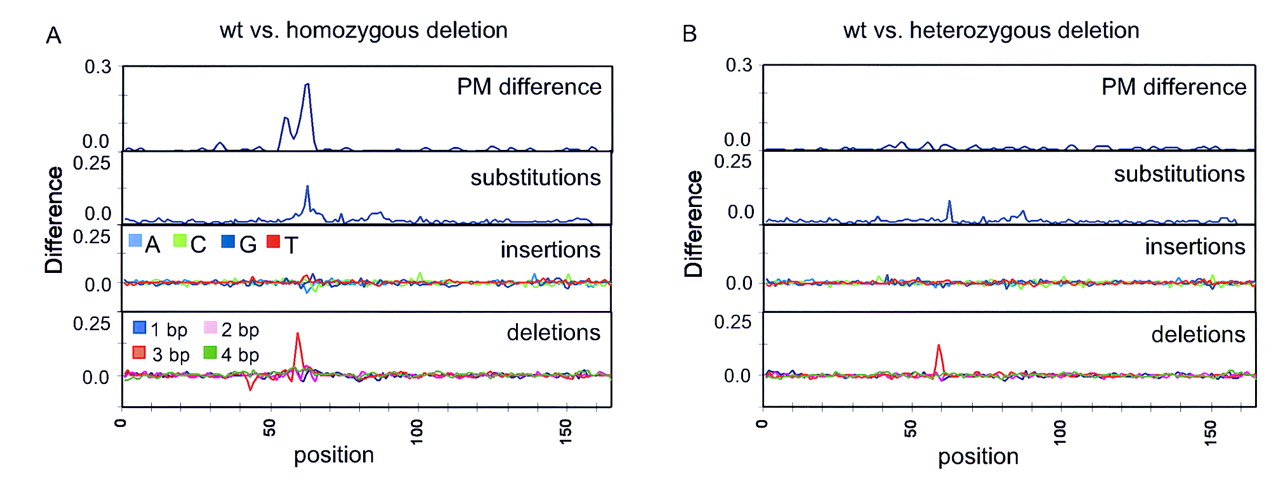
Detection of the ΔF508 deletion in the cftr gene. Wild-type and mutant samples of a 1029-bp region (encompassing F508) of the cftr gene were applied to 8-mer arrays by standard T4 DNA ligation conditions. (A) Mutation scans of a 170-bp region comparing a wild-type cftr target to a target containing a 3-bp ΔF508 (TTT) homozygous deletion. Mutation scans are shown for perfect match (PM) reference, substitution (positive envelope only), insertion, and deletion probes. The PM reference probes (a subset of the substitution probe set) consist of a tiling probe set complementary to the reference sequence. A 3-bp deletion (identified as TTT by the analysis software) was readily detected by the deletion scan. Note that the substitution scan also exhibited a footprint. (B) Mutation scans comparing a wild-type cftr target to a 3-bp ΔF508 artificial heterozygous deletion mutant (mixture of 50% wild-type and 50% homozygous mutant). No footprint was detectable in the PM reference probe scan because DNA with the wild-type reference sequence was present in both samples. However, the deletion scan correctly identified a 3-bp TTT deletion in the heterozygous sample.


