


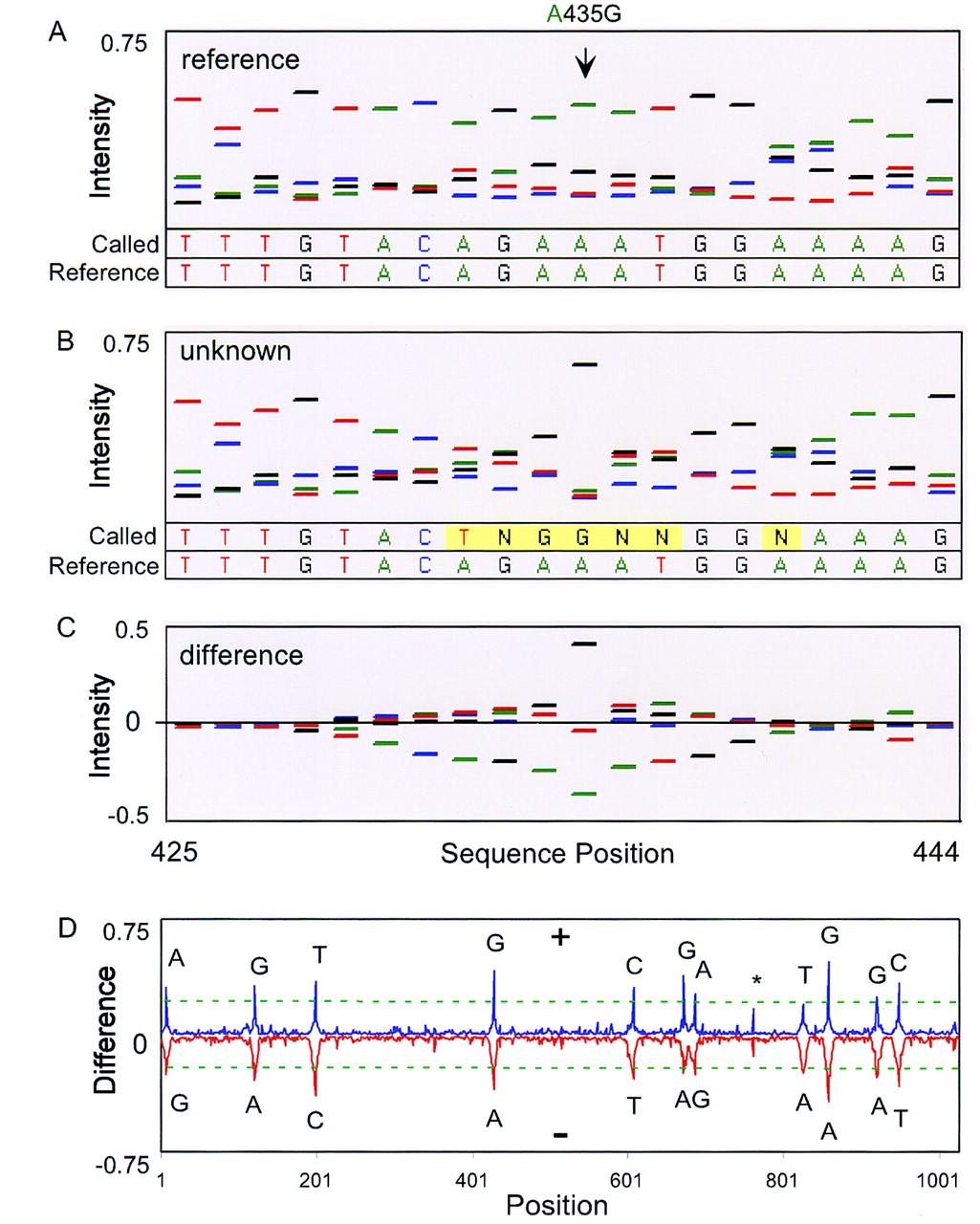
Mutation scanning. A sequence trace (positions 425–444) is displayed for both the (A) reference and the (B) unknown HIV targets described in Fig. 4. The positions highlighted in yellow indicate a base call that is different from the reference sequence (an N base denotes a no call). (C) The arithmetic difference between the traces displayed in A and B. The A435G single-base substitution in the unknown target is identified by the footprint in the difference trace. (D) The positive and negative envelope curves of the difference trace are plotted for 1041 bases of the HIV sequence. Eleven single-base substitutions were correctly identified by their footprint (G14A, A128G, C206T, A435G, T614C, A679G, G693A, A832T, A865G, A927G, T955C). The asterisk denotes a potential mutation, but it is ignored because its footprint is less than the call threshold (broken green line) and its footprint width is narrow.


