


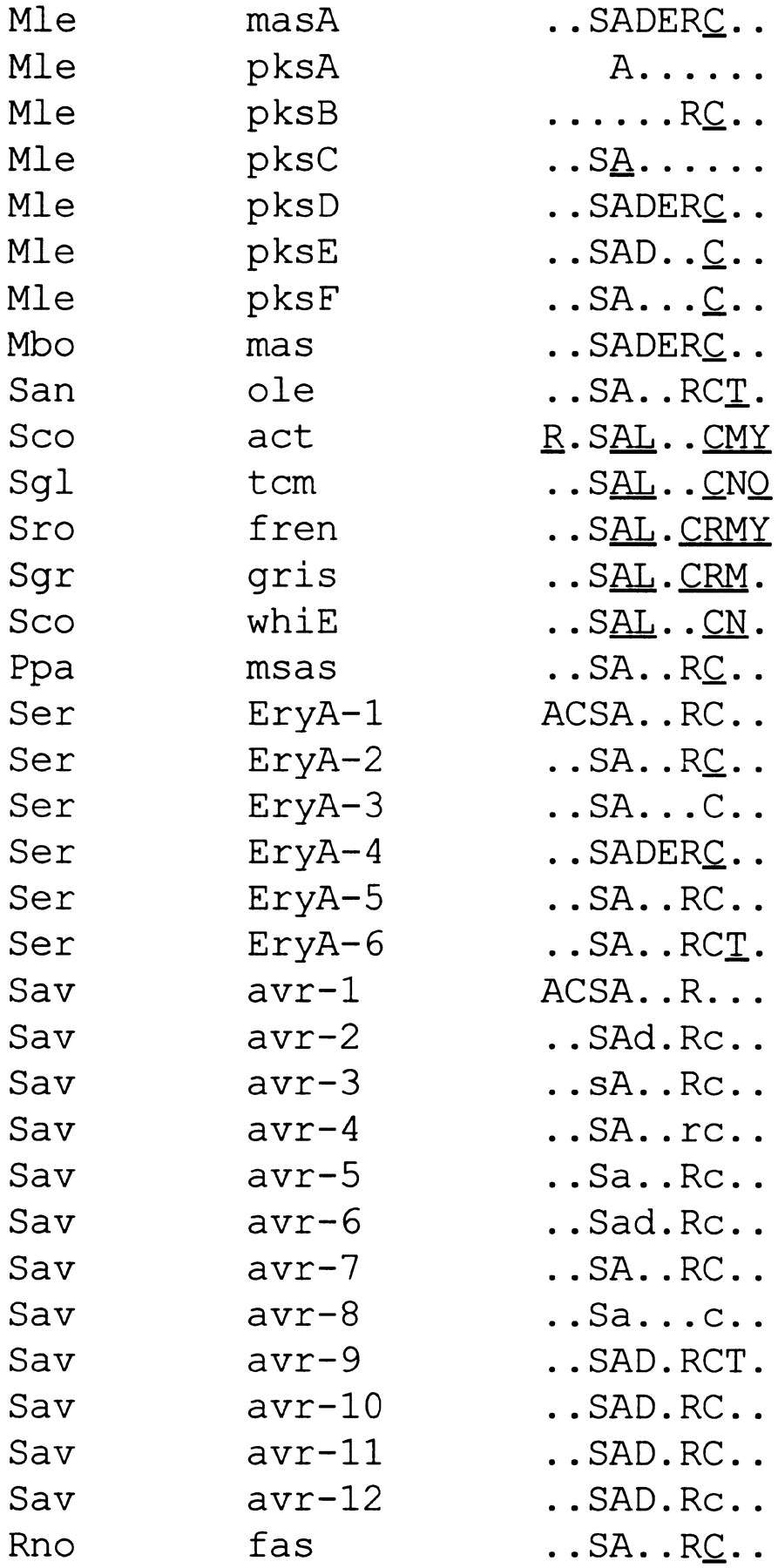
Modular organization and enzymatic motifs in synthetases for fatty acids (fas), mycocerosic acid (mas), methylsalicylic acid (msas), erythromycin (eryA), actinorhodin (act), tetracenomycin (tcm), frenolicin (fren), griseusin (gris), and avermectin (avr) from the following organisms: M. leprae (Mle, this work),Saccharopolyspora erythraea (Ser), Rattus norvegicus(Rno), Penicillum patulum (Ppa), Streptomyces antibioticus (San), S. avermitilis (Sav), S. coelicolor (Sco), S. glaucescens (Sgl), and S. griseus (Sgr). The motifs are abbreviated as follows: (A) acyl transferase; (C) acyl carrier protein; (D) dehydratase; (E) enoyl reductase; (L) chain length factor; (M) aromatase; (N) aromatase/cyclase; (O) O-methyltransferase; (R) ketoreductase; (S) ketoacyl–ACP synthase; (T) thioesterase; (Y) cyclase. Lowercase letters indicate uncertainty in functional assignment (Donadio et al. 1991; Mathur and Kolattukudy 1992). The 5′ end of Mle pksAis missing from our current sequence. Underlines indicate all of the protein domains ending in translational terminators, except for Sav avr modules, where the sequence data are incomplete. The CLF domain appears closer to pksC (P = 8.9e-13) than to masA (P = 0.0018).



