


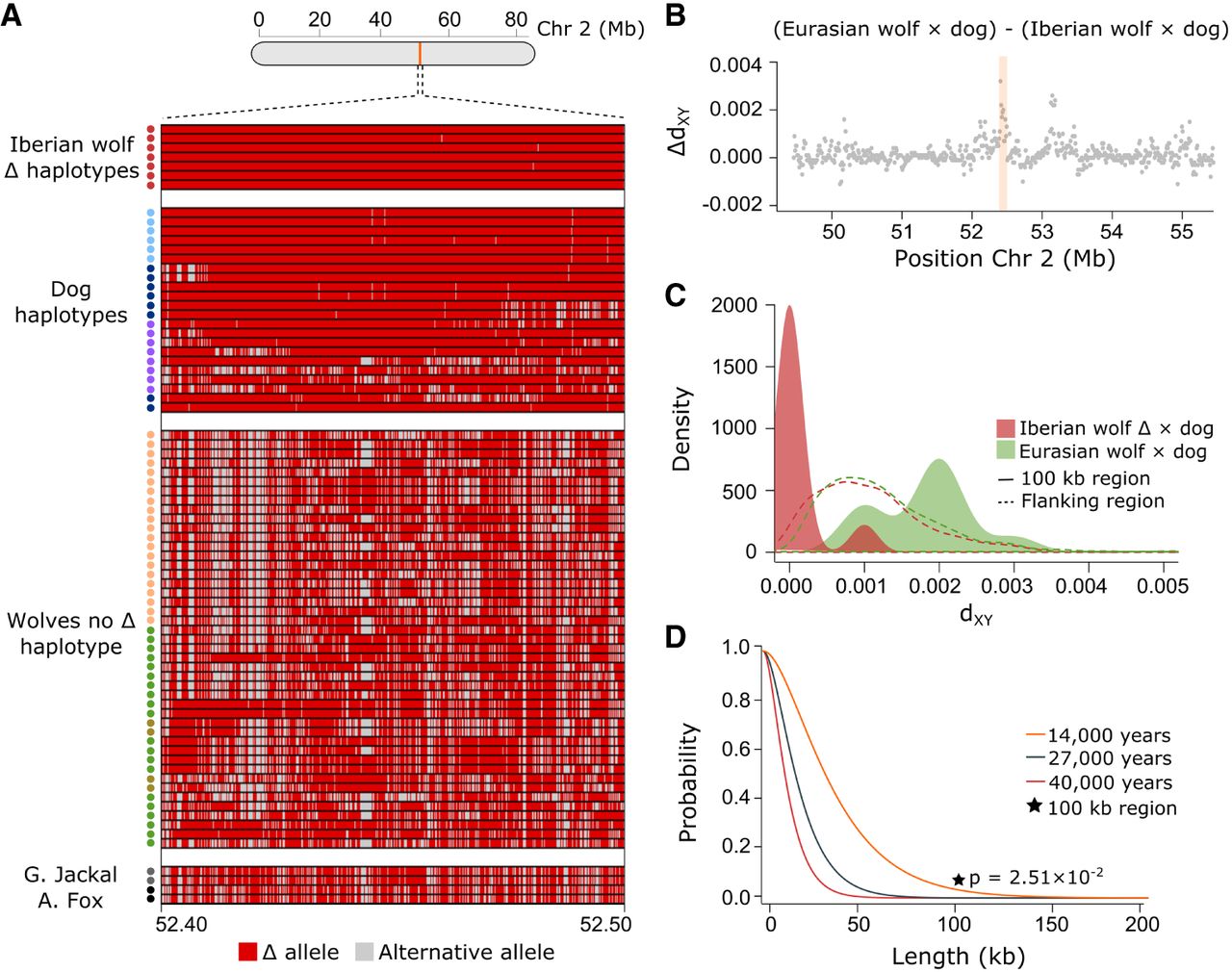
Haplotype sharing and sequence divergence between wolves and dogs. (A) Structure of the ∼100 kb haplotype, represented by 593 SNPs, found within the 500 kb window with the lowest dXY levels between Iberian wolves with the Δblock and dogs (Chr 2: 52.4–52.5 Mb). The top section shows the introgressed haplotype in Iberian wolves (red dots; L590 was homozygous across most positions, carrying two introgressed haplotypes); in the middle are the dog haplotypes (village dogs from Iberia in light blue dots, purebred dogs in dark blue, and village dogs from Asia and Africa in purple), followed by haplotypes found among wolves without the dog Δblock (Iberian in light orange dots, Eurasian in green, and North American in dark yellow). At the bottom are the Golden jackal and Andean fox haplotypes (gray and black dots, respectively). Each row represents a haplotype, and each position is colored according to whether it carries the introgressed allele (Δ in red) or the alternative allele (in gray). (B) Distribution of ΔdXY across all sites within the 6 Mb flaking region surrounding the introgressed block. This test identifies genomic regions with low sequence divergence specific to Iberian wolves and dogs and not in other Eurasian wolves (positive ΔdXY values). The orange bar indicates the position of the 100 kb region represented in A. (C) Density distribution of dXY between Iberian wolves with the Δblock and dogs (red) and other Eurasian wolves and dogs (green) in the 100 kb region (full line) and in the genomic background (dashed line). (D) Probability distribution of maintaining a haplotype of 0–200 kb length owing to ancestral shared variation, assuming a local recombination rate for the Δblock and three divergence time estimates between gray wolves and dogs (represented by distinct colors). The black star indicates the P-value associated with the introgressed haplotype (for 14,000 years ago).



