


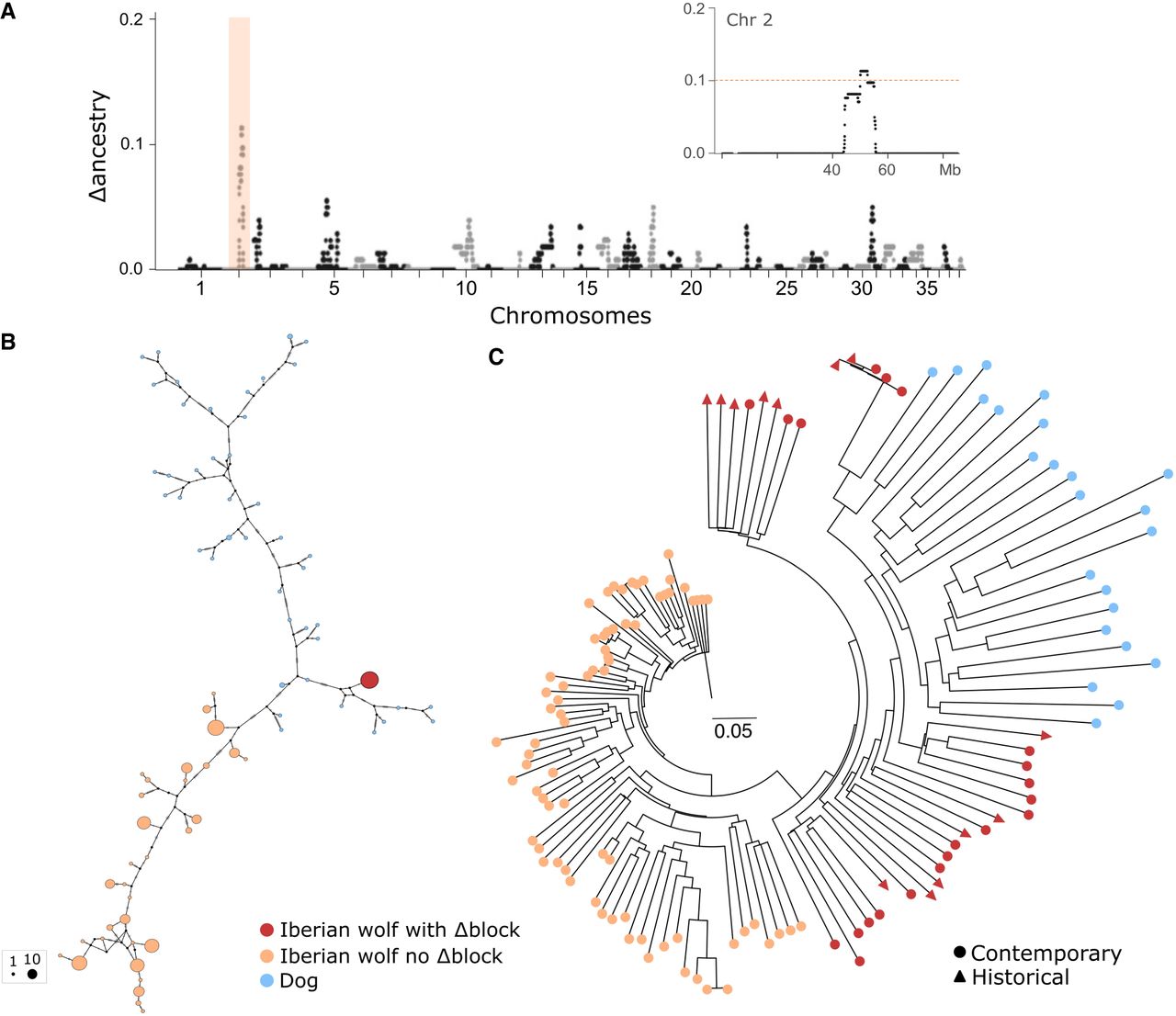
Evidence of a dog block in the Iberian wolf Chromosome 2. (A) Δancestry scores, indicating the excess of dog ancestry across the Iberian wolf genome, based on about 85,000 single-nucleotide polymorphisms from 95 contemporary samples. The Δblock position on Chromosome 2 is highlighted in orange. The inset offers a zoomed-in view of Chromosome 2, with the dashed line indicating the outlier detection cutoff (3 SD from the chromosome mean). (B) Median-joining network of Δblock haplotypes (78 SNPs) for contemporary Iberian wolf samples and village dogs from Iberia. Circle size is proportional to the frequency of each haplotype. (C) Neighbor-joining (NJ) tree for the Δblock using contemporary and historical samples (subset > 60 K SNPs; see Methods) of Iberian wolves and village dogs from Iberia. (B,C) Iberian wolves with and without the dog Δblock are colored in red and pink, respectively, and dogs are in blue. Circles and triangles denote contemporary and historical samples, respectively.



