


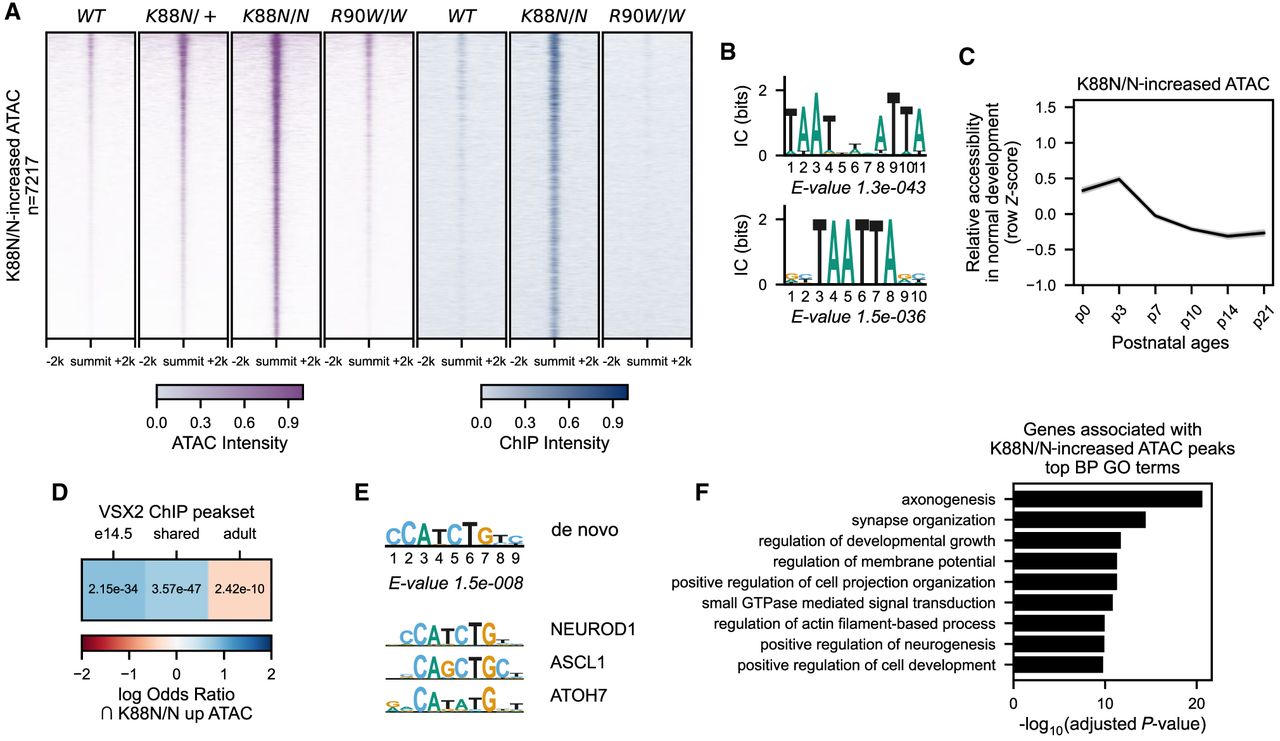
CRX K88N ectopic activity at Q50 HD motifs impedes the silencing of progenitor regulatory programs in developing photoreceptors. (A) Heatmaps depicting the normalized ATAC-seq or CRX ChIP-seq signal intensities at CrxK88N-increased accessible ATAC-seq peaks. (B) PWM logo and enrichment significance E-value of STREME de novo discovered HD motifs. (C) Line plot showing the average developmental accessibility kinetics of CrxK88N-increased ATAC-seq peaks. The developmental ATAC-seq data are from Aldiri et al. (2017). (D) Heatmap depicting the log odds ratio enrichment of embryonic day (e) 14.5 or adult retinal VSX2 binding sites under CrxK88N-increased ATAC-seq peaks. ⋂ indicates the intersection of VSX2 ChIP and K88N/N up ATAC peaks. P-values of Fisher's exact tests are indicated. The VSX2 ChIP-seq data are from Bian et al. (2022). (E) PWM logo and significance E-value of STREME de novo discovered basic helix–loop–helix (bHLH) motif under CrxK88N-increased ATAC-seq peaks. PWM logos of selected retinal progenitor/neurogenic bHLH TFs are given for comparison. JASPAR IDs of the selected TFs can be found in Methods. (F) Barchart showing BP GO term enrichment of genes adjacent to CrxK88N-reduced ATAC-seq peaks.



