


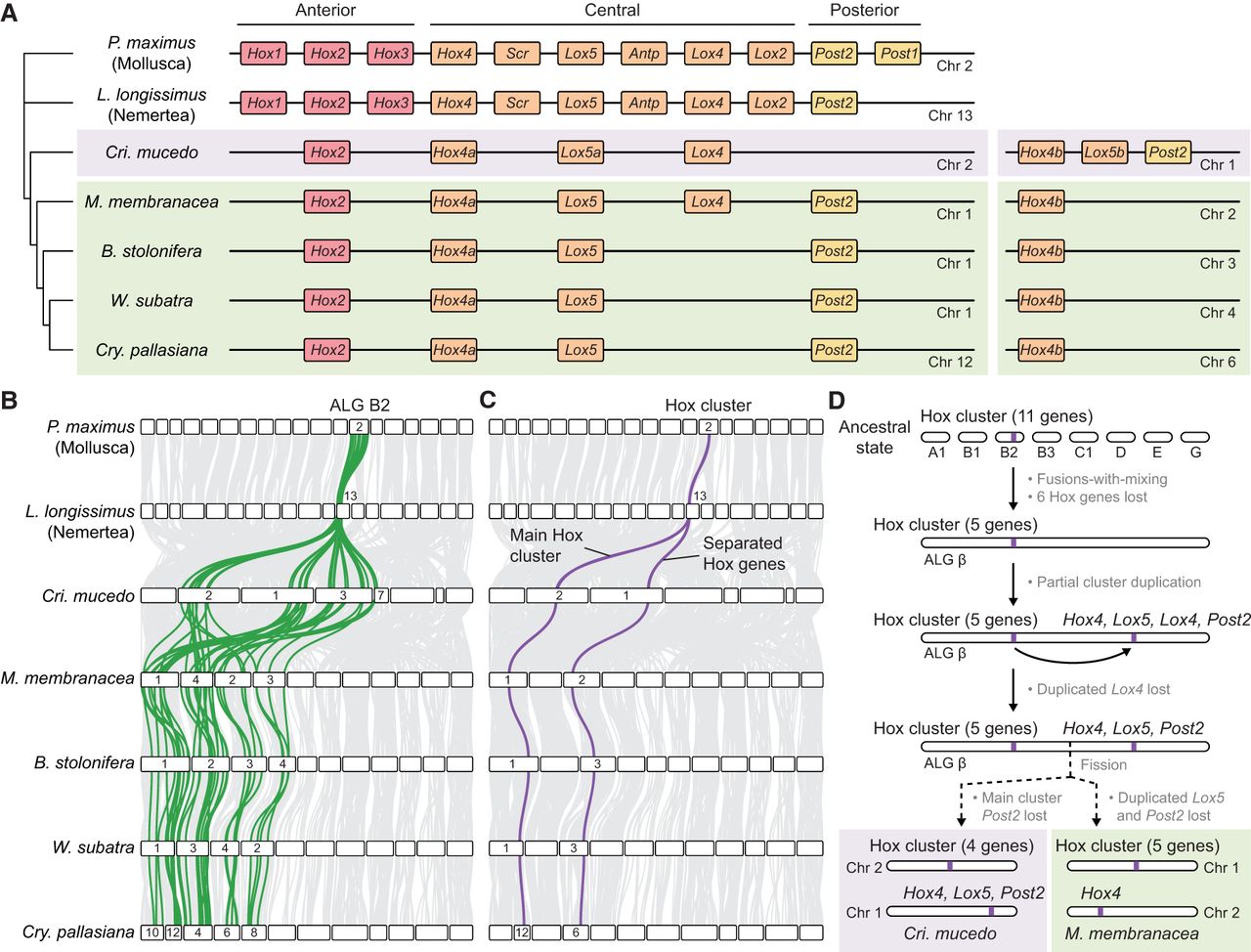
Evolution of the bryozoan Hox cluster. (A, left) Representation of the main Hox cluster of bryozoans and two outgroups: the nemertean L. longissimus and the mollusc P. maximus. Colored rectangles represent Hox genes. Horizontal black lines represent chromosomes. (Right) Separate Hox genes located on different chromosomes. (B) Positions of ALG B2 genes (green) in bryozoan genomes. (C) Positions of Hox genes (purple) in bryozoan genomes. (D) Representation of the evolutionary events that resulted in observed bryozoan Hox gene arrangements. In the bryozoan ancestral lineage, chromosomes containing bilaterian ALGs A1, B1, B2 (including the Hox cluster), B3, C1, D, E, and G underwent sequential fusion events to form bryozoan ALG β; the Hox cluster underwent a partial duplication, copying genes Hox4, Lox5, Lox4, and Post2; and the duplicated Lox4 gene was subsequently lost. In the lineage leading to C. mucedo (Phylactolaemata), the main cluster Post2 was lost, and the chromosome containing ALG β underwent fission, leaving the main cluster on Chr 2 and duplicated genes on Chr 1. In the lineage leading to M. membranacea (Gymnolaemata), the duplicated Lox5 and Post2 were lost, and the chromosome containing ALG β underwent fission, leaving the main cluster on Chr 1 and duplicated genes on Chr 2.



