


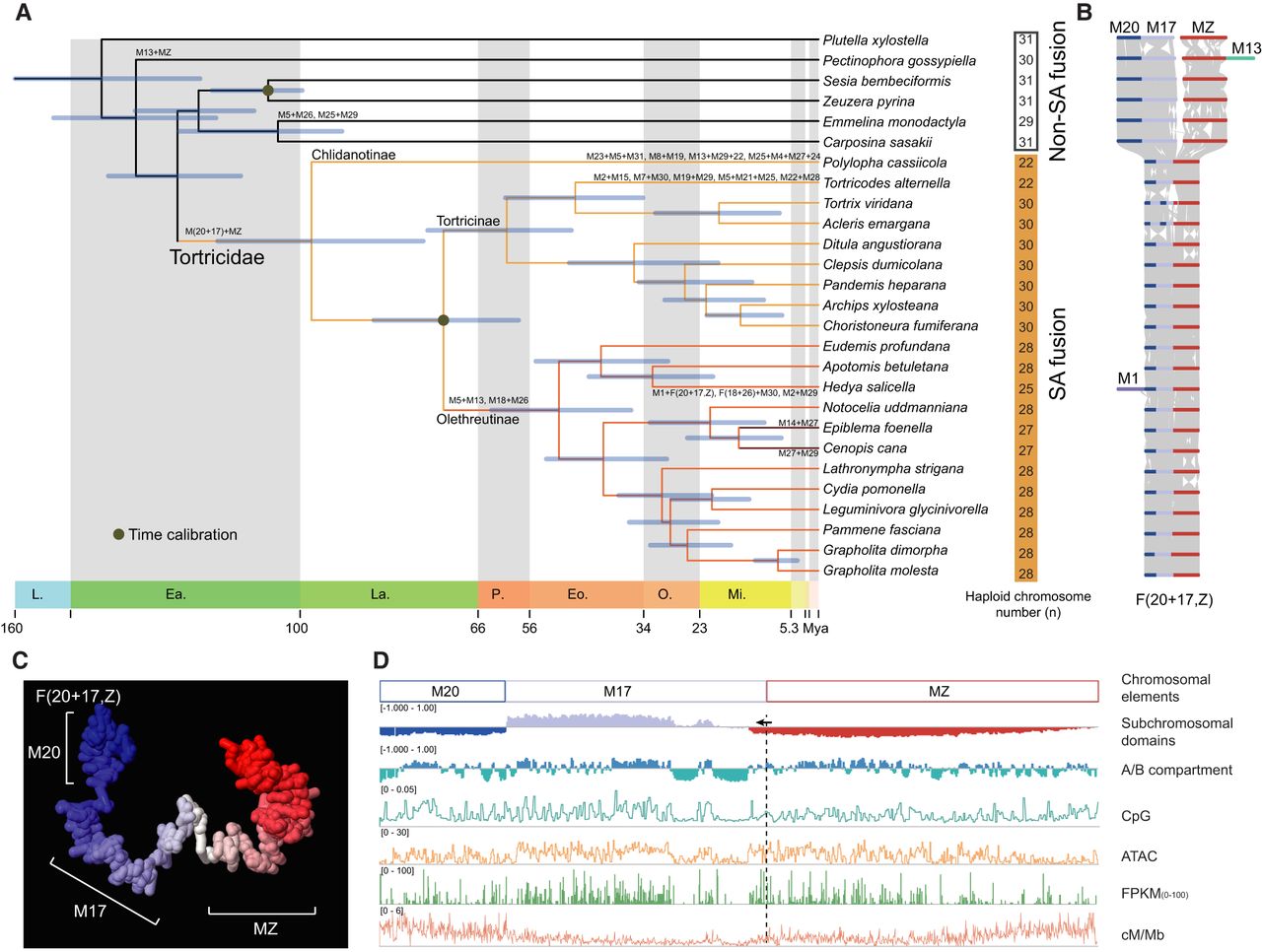
Evolution and features of the neo-Z Chromosome in Tortricidae. (A) Phylogenetic tree for 27 species of Tortricidae and outgroups. All branches had 100% bootstrap support. The node bars show 95% posterior densities for divergence times. Fusion events are marked on the branches. (B) Chromosome synteny of elements involved in SA fusion. (C) Three-dimensional architecture of F(20 + 17,Z) in Grapholita molesta. The white color denotes the fusion position. (D) Multiple features along F(20 + 17,Z) in G. molesta, including chromosome composition, subchromosomal domains, A/B compartments, the frequency of DNA methylation (CpG), the density of chromatin accessibility regions (ATAC-seq), gene expression levels (mean of FPKM, 0–100 are shown), and recombination rates (cM/Mb). The dotted line indicates the position of the SA fusion. The arrow denotes that the domain occupied by MZ has expanded to M17 (∼450 kb).


