


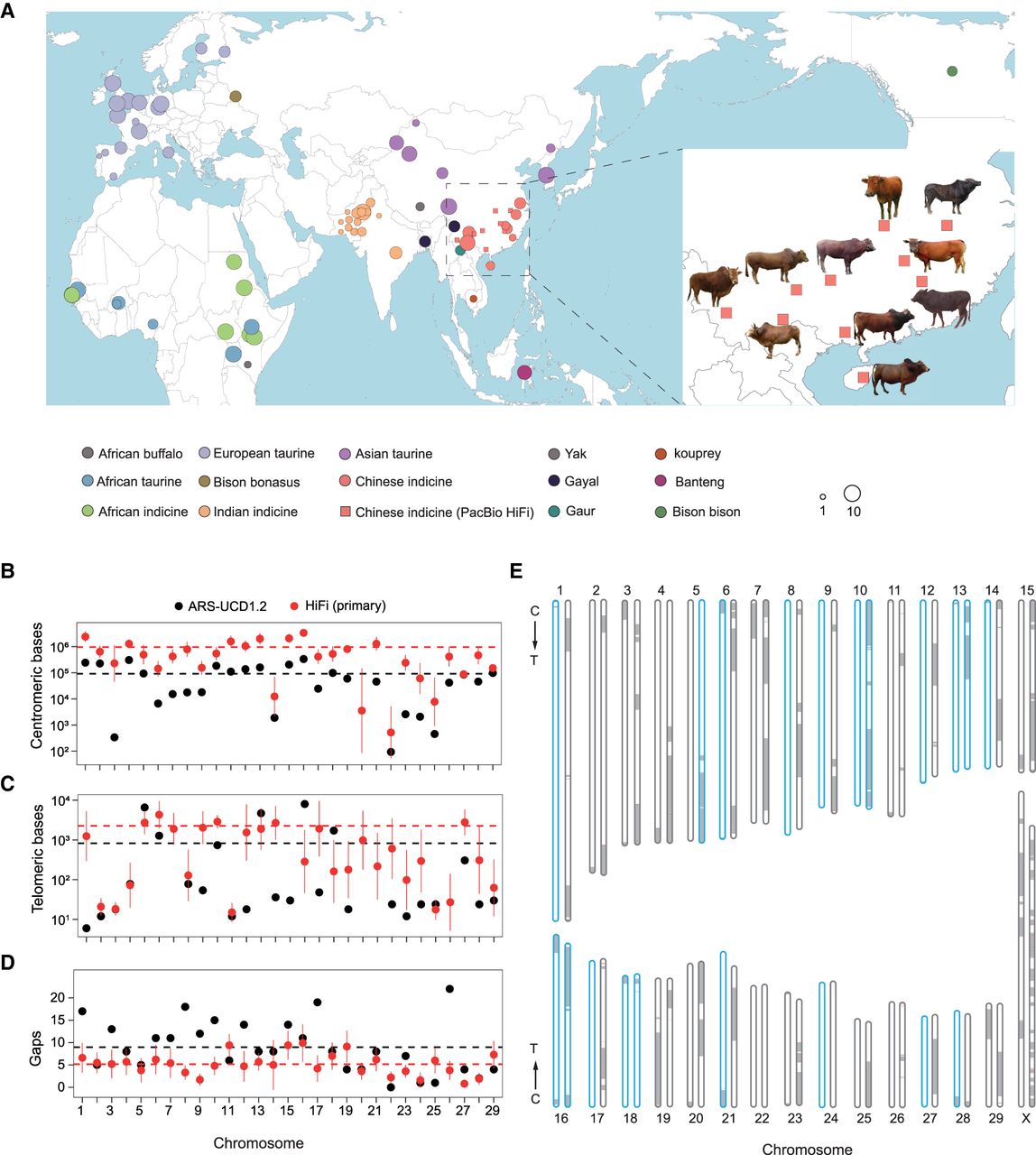
Geographic distribution of the cattle breeds used in this study and the centromeric and telomeric completeness of 10 Chinese indicine assemblies. (A) Each circle represents a cattle breed collected from public databases, with circle size relative to sample size. The squares indicate the PacBio HiFi sequencing data used in our study. (B) Statistical distribution of centromeric bases on each chromosome of 10 Chinese indicine assemblies (red dots) and reference genome ARS-UCD1.2 (black dots), where error bars indicate the 95% confidence interval. Dashed lines represent the mean value for the corresponding color of dots. (C) Similar to B, but the telomeric bases within 10 kb of chromosome ends. (D) The number of scaffold gaps on each chromosome. (E) The chromosome ideogram of Jinjiang cattle primary assembly (left) and ARS-UCD1.2 (right). Scaffolded contigs alternated by white/gray regions across gapped regions, which are colored red. Black arrows show the centromere to telomere of the chromosome, and those generally considered to be end-to-end are blue frames.



