


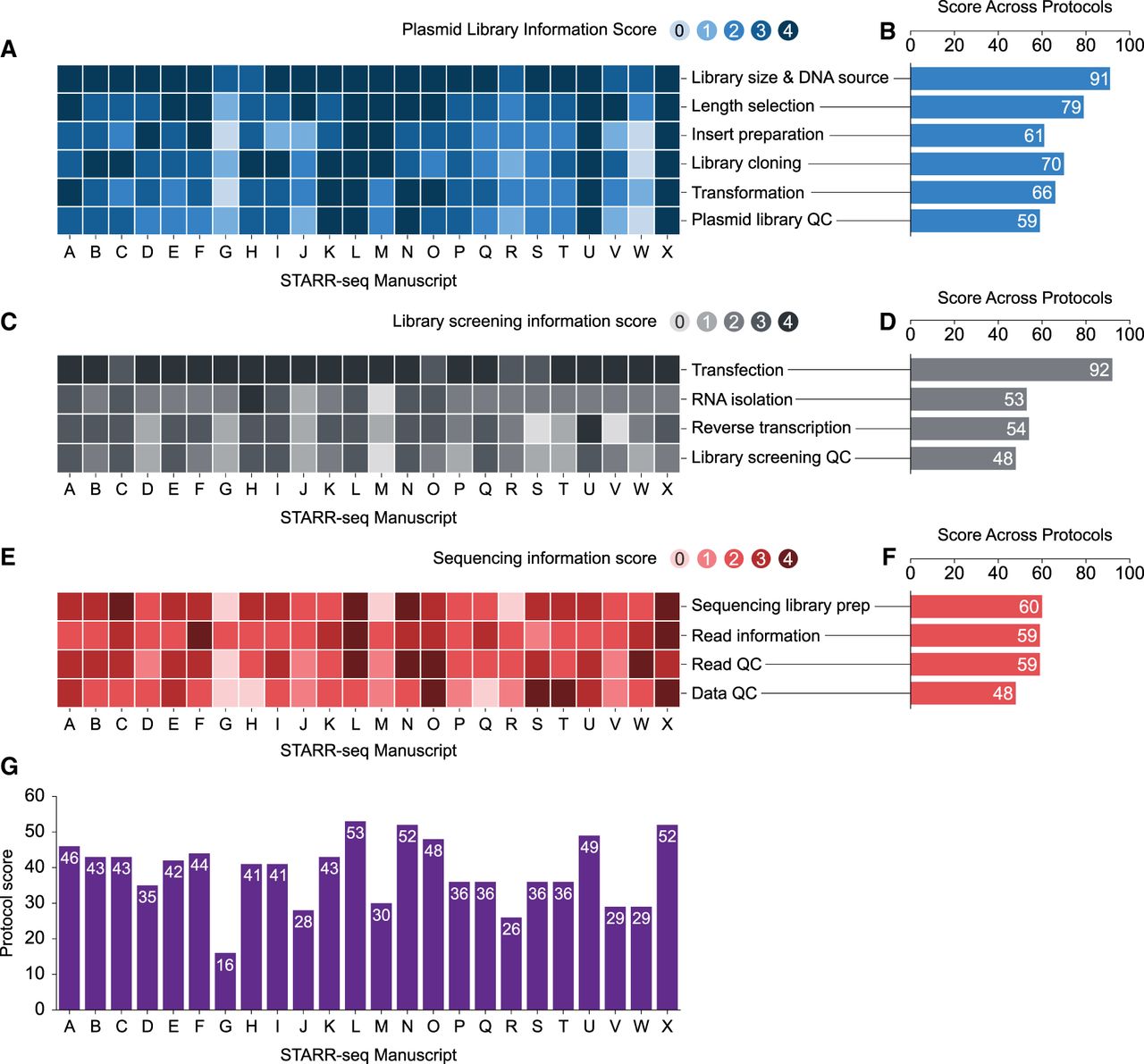
Reproducibility in current STARR-seq studies. (A,C,E) Heatmap shows feature scores for deidentified studies A–X for assay design and plasmid library preparation (A), library screening (C), and sequencing information (E). (B,D,F) Cumulative scores for each feature across studies illustrating reporting trends and highlighting features that are typically well explained or underexplained. (G) Cumulative scores for each assay (A–X) for all features enabling direct comparisons of reproducibility. We observed that critical design factors, such as library scale and source and fragment length, or experimental features, such as transfection, scored three or more across 87.5%–100% of publications, with studies missing only minor details and explanations. In contrast, features such as library screening QC, data QC, and data transparency scored three or more across 16.6%–37.5% of publications.



