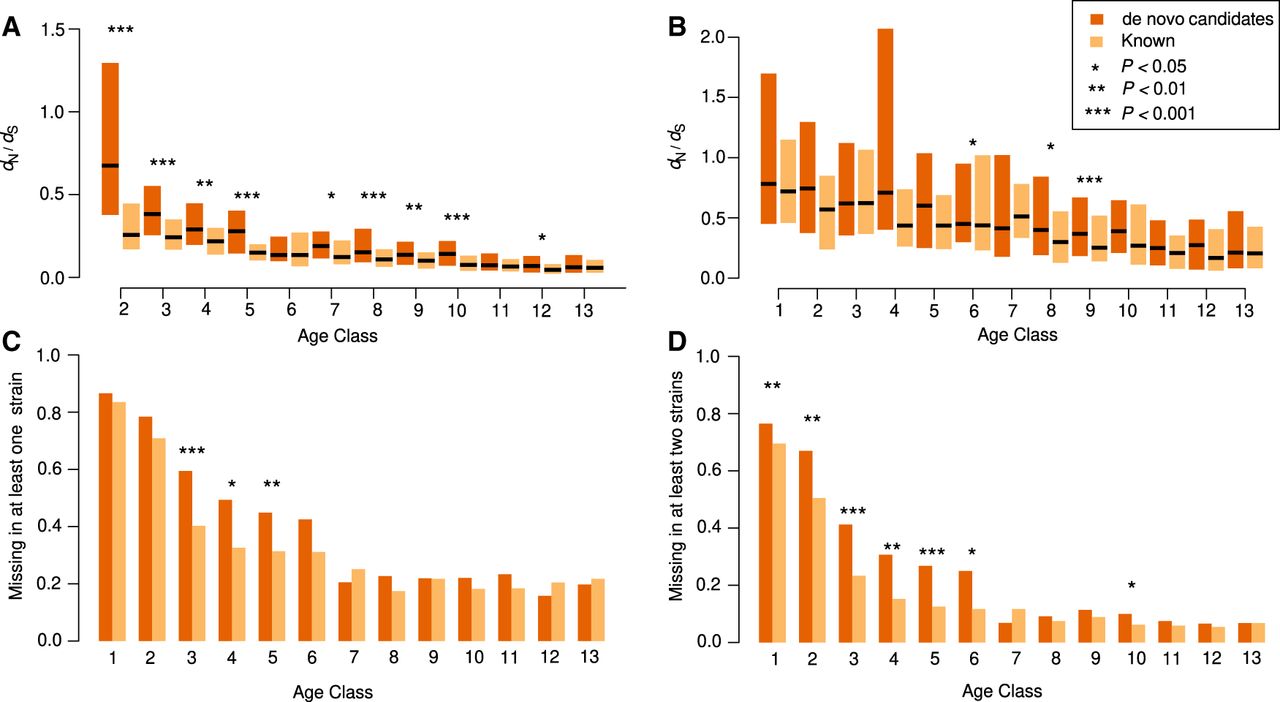
De novo candidates are less constrained and more frequently lost than recent duplicates. (A) The box plot shows the median and interquartile ranges of dN/dS ratios with regard to P. exspectatus orthologs for different age groups. The comparison between de novo candidates and known orthogroups shows evidence that de novo candidates are less constrained than recent duplicates of known gene families. (B) Estimation of evolutionary constraint between the P. pacificus strains PS312 and RSB001 shows a trend toward significantly higher dN/dS ratios of de novo candidates for multiple age classes. (C) The plot shows for each age class the fraction of orthogroups, where an ortholog is missing in at least one P. pacificus strain. Comparison between de novo candidates and known categories shows that de novo candidates are significantly more likely to be lost in three age classes. (D) De novo candidates show an even stronger trend toward higher probabilities of being lost than recently duplicated members of known gene families, if we consider only orthogroups with predicted losses in at least two P. pacificus strains.