


John Sulston (1942–2018)
- Robert H. Waterston, MD, PhD
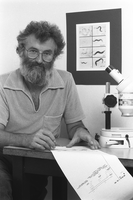
(IMAGE COURTESY OF MRC LABORATORY OF MOLECULAR BIOLOGY)
Any scientist would be proud to have changed the world. John Sulston changed the way we think about biology not once, not twice, but three times: first with his elucidation of the C. elegans cell lineage, then in pioneering genome mapping and sequencing, and lastly through his leadership in promoting open data. Along the way, he showed us how science should be done and how life should be lived.
I met John at the MRC Laboratory of Molecular Biology (LMB) in the early ’70s, where he was a staff scientist. He had been drawn to the LMB by Sydney Brenner's visionary project on C. elegans. After earning undergraduate and graduate degrees from Cambridge University, John did post-doctoral work with Leslie Orgel at the Salk Institute probing the origins of life. By the time I arrived at the LMB, John had devised a method for preserving worms in liquid nitrogen and estimated the worm genome size at 20 times that of E. coli’s. He was applying some of his post-doctoral experience to investigate the neurochemistry of different neurons. While looking at dopamine-containing neurons, he became interested in how the worm detects light touch. But the sharpened wooden sticks that we used to manipulate the worms were blunt instruments, so John devised a simple but elegant tool—one of his eyelashes glued to the end of a toothpick—which allowed him to gently stroke the worm. Soon he had mutants that failed to react to this touch, pioneering the study of mechanosensation in the worm.
In follow-up studies he recognized that the adult worm has more cells than a newly hatched larva, something that contradicted the prevailing view. Because the worm is transparent, John was able to observe individual cells under a microscope, directly in the living animal, and could watch those cells divide. He soon identified 13 cells in the early larva that gave rise to additional neurons for the ventral cord. He noticed that these cells follow a stereotypical series of divisions—a lineage; in several lineages the equivalent cell in each of the lineages died shortly after birth. He recognized that these deaths must be deliberate, thereby launching the field of programmed cell death in the worm.
John went on to elucidate the full pattern of cell divisions in the worm's several larval stages, in collaboration with Bob Horvitz. He made a brief foray into embryonic cell lineaging to settle a dispute, but because others were attempting to determine the embryonic lineage, he focused on other things. Only when others abandoned their efforts a couple of years later did John take on the seemingly impossible task of following all of the cell divisions of the developing embryo. He shut himself in a dark room every day for a year and a half while he mapped the full cell lineage of the worm (see Gitschier [2006] for more), an accomplishment recognized with a share of the 2002 Nobel Prize in Physiology or Medicine.
I got to know John better when I returned to the LMB on a sabbatical in 1985. He and Alan Coulson were developing a clone-based map of the entire worm genome. Seeking a new challenge, John had left it for others to follow up on his marvelous lineage. Molecular biologists at the time were consumed with recovering DNA clones containing genes they were studying, whether in yeast, fly, worm, or human, usually by a tedious process dubbed “chromosome walking.” John reasoned that the process could be accomplished more effectively and efficiently if one had a map of clones of the entire genome. That would mean performing restriction enzyme digests on some 17,000 clones covering the worm's 100 Mb genome, separating the resulting fragments on high resolution gels and measuring their fragment sizes, and then looking for clones with similar patterns, or fingerprints. John loved solving puzzles, but this was a huge challenge, even for John. By the time I arrived, John and Alan had fingerprinted several thousand clones and were doubling the number of clones analyzed each year. During that sabbatical year he made room for me in his lab and I gradually found ways to help. Where others might have been protective or guarded, he welcomed me warmly and openly into his project, starting a close collaboration that was to last almost two decades.
Completion of that map of clones four years later paved the way for sequencing the worm genome as part of the Human Genome Project, directed in its early years by Jim Watson, who had stepped up to lead the National Center for Human Genome Research. John thrived on solving the myriad challenges that we encountered. He attacked whatever step in our process was most limiting at the moment; with each improvement implemented, he turned to the next nettlesome step. As a result, we were able to double our sequence output annually.
We worked more closely than ever, with lots of resulting stories. I'll share just two. Back in 1991 John was sitting in a lounge chair in his back garden on a Sunday afternoon, pondering a computer file on his lap. The file—containing worm genomic DNA sequence in digital form—presented a crucial challenge. Our groups were beginning to churn out sequence data to meet our audacious pilot goal of 3 million bases in three years. The sequencing machines collected the data digitally, but provided the information only on paper, which was piling up on our desks. To make progress, we needed to deal directly with the digital data, but the manufacturer refused to release the file format. The only option was to break the code. By the end of that lovely summer day John had it figured out, as he gleefully related to me on one of our regular phone calls.
As we met with success on the worm genome sequence, John was lured into the Human Genome Project by the Wellcome Trust. The human genome, at 30 times the size of the worm genome, and filled with repeats that complicate its sequencing, presented a daunting challenge. Nevertheless, by the fall of 1994 we had the beginnings of a realistic plan that the Wellcome Trust directors agreed to entertain in December. But the weekend before that meeting, while riding to the lab on a Saturday morning to do his share of the lab work, John was hit by a car and thrown from his bike, fracturing his pelvis and knocking him unconscious. To my amazement, the next day John was talking to me on the phone, telling me that he was going ahead with the meeting on Thursday and that I should cross the pond to join him as planned. I thought that mad, but traveled there just to see John's state for myself. Lo and behold, Thursday came and the doctors allowed David Bentley and me to wheel John down to the Wellcome Trust headquarters, where he gave an inspired account of our plan. The Wellcome Trust bought it, and John went on to play a major leadership role in the Human Genome Project. Despite his aversion to “management,” he drew countless talented people into genomics and built the Sanger Centre into a formidable institution that contributed a third of the finished human genome reference sequence.
John worked to ensure that the Human Genome Project was international in scope. From the very beginning he was also a strong advocate of open science. Building on the tradition of data sharing in the worm community, he made the worm genome map available well before publication, to allow the worm community to exploit this resource to find their favorite genes. In this way he engaged the entire community in tying together the genetic and physical maps to create a complete genome map. Later, he harnessed the growing capabilities of the internet to make raw DNA sequence data available as soon as it came off the machines. He convinced the Human Genome Project Consortium members to embrace similar policies. Critically, he mounted forceful opposition when commercial interests threatened to limit access to human DNA sequence data. His perseverance paid off, and today the human genome DNA sequence is freely available to all.
After the human draft sequence was announced, John stepped down from his leadership role at the Sanger Centre and in 2002 John left science, letting others follow up on his accomplishments. Pursuing his egalitarian moral code, he devoted his efforts instead to ensuring that genome sequence and related research would benefit humanity broadly. He became founding co-chair of the Institute for Science, Ethics and Innovation at the University of Manchester (2008) and chaired the People and the planet report for the Royal Society (2012). Among his many honors, he reluctantly accepted a knighthood in 2001 and last year was made a Companion of Honour.
John remained modest and affable, even after all of his accomplishments and honors. Although often working alone, he delighted in adjourning to the pub to share ideas and reflections on the day. He organized summer punting trips up to The Green Man pub in Grantchester and each year hosted a Guy Fawkes party in his back garden, complete with fireworks and later, with home-crafted Chinese lanterns. Always an avid gardener, he grew more of his own food in later years and firmly embraced local foods to reduce his carbon footprint. He biked everywhere and equipped his home with solar panels, proudly asserting that he and his wife of 50 years, Daphne (Bate) Sulston, were now living carbon-neutral lives. In keeping with that commitment, even when hosts offered, he refused first class travel.
John changed the world. His spirit lives on through his contributions, not only in those of us who had the privilege and experienced the joy of working with him, but in everyone who uses and benefits from the knowledge he provided and the examples he set. He is sorely missed.


