


Cover image
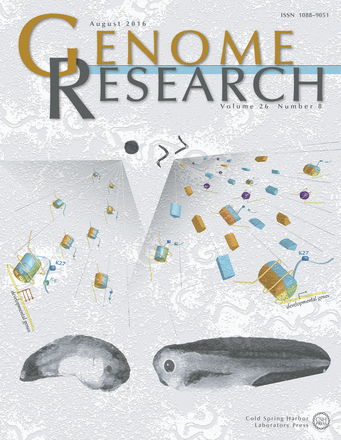
For a long time, it has been assumed that the only role of sperm at fertilization is to introduce the male genome into the egg. In this issue, a study demonstrates that sperm is epigenetically programmed to regulate gene expression in the embryo. During spermiogenesis, a spermatid (round cell, top left) differentiates into a sperm (elongated cell, top right). This process is associated with a remodeling of chromatin from a somatic type with canonical nucleosomes to the sperm chromatin that retains some nucleosomes and acquires sperm-specific proteins. At this transition, developmental genes that were marked by H3K4 and H3K27 methylation in spermatids are remodeled to retain only H3K4 methylation in the sperm. The use of these two types of paternal chromatin to generate embryos results in normal (sperm-derived embryos on the right) or abnormal (spermatid-derived embryos on the left) development to the tadpole stage in Xenopus laevis. The background is a filtered picture of the mature sperm fraction purified from frog testis. (Cover illustration by Angela Simeone, as2363{at}cam.ac.uk. [For details, see Teperek et al., pp. 1034–1046.])

