


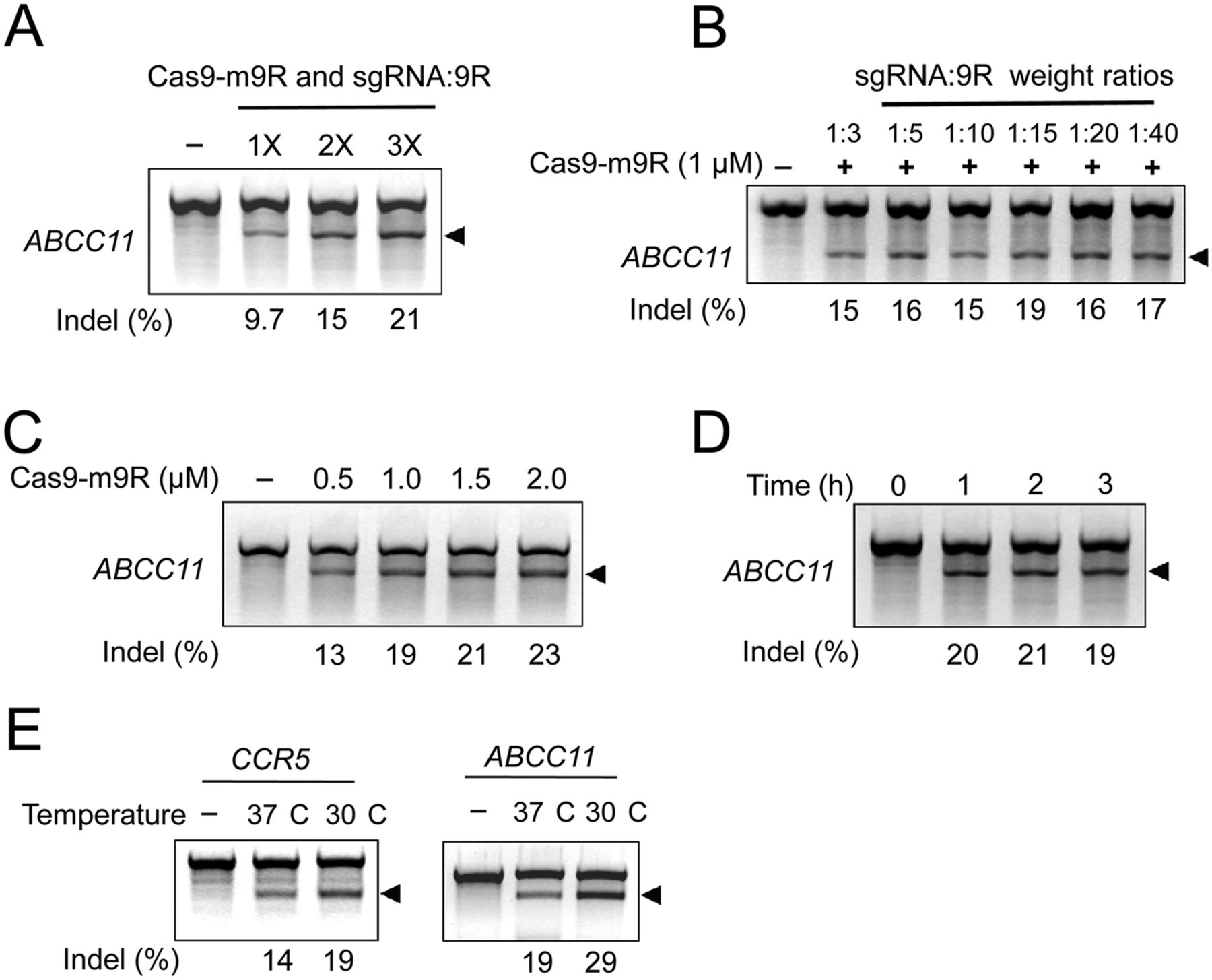
Factors affecting the genome editing efficiency of Cas9-m9R and sgRNA:9R. HEK293T cells were sequentially treated with Cas9-m9R and sgRNA:9R targeting the ABCC11 or CCR5 genes under various conditions, and the resulting mutation frequencies were determined using the T7E1 assay. The arrows indicate the expected position of DNA bands cleaved by T7E1. (A) Multiple treatments with Cas9-m9R and sgRNA:9R increase the mutation frequency. (B) The effect of sgRNA:9R ratios on the mutation frequency. The cells were treated twice with 1 μM Cas9-m9R and 10 μg/mL sgRNA complexed with 9R at various weight ratios. (C) Increasing the Cas9-m9R concentration increases the mutation frequency. The cells were simultaneously treated with various concentrations of Cas9-m9R and 10 μg/mL sgRNA complexed with 9R at a weight ratio of 1:5; this process was repeated three times. (D) The effect of exposure time on the mutation frequency. The cells were sequentially treated with 1.5 μM Cas9-m9R and 10 μg/mL sgRNA complexed with 9R at a weight ratio of 1:5 three times every day for the indicated exposure time per day. The exposure time was controlled by changing the media. (E) Incubating the cells at 30°C instead of 37°C mildly increases the mutation frequencies. Here, the cells were simultaneously treated three times with 1 μM Cas9-m9R and 10 μg/mL sgRNA complexed with 9R at a weight ratio of 1:5.



