


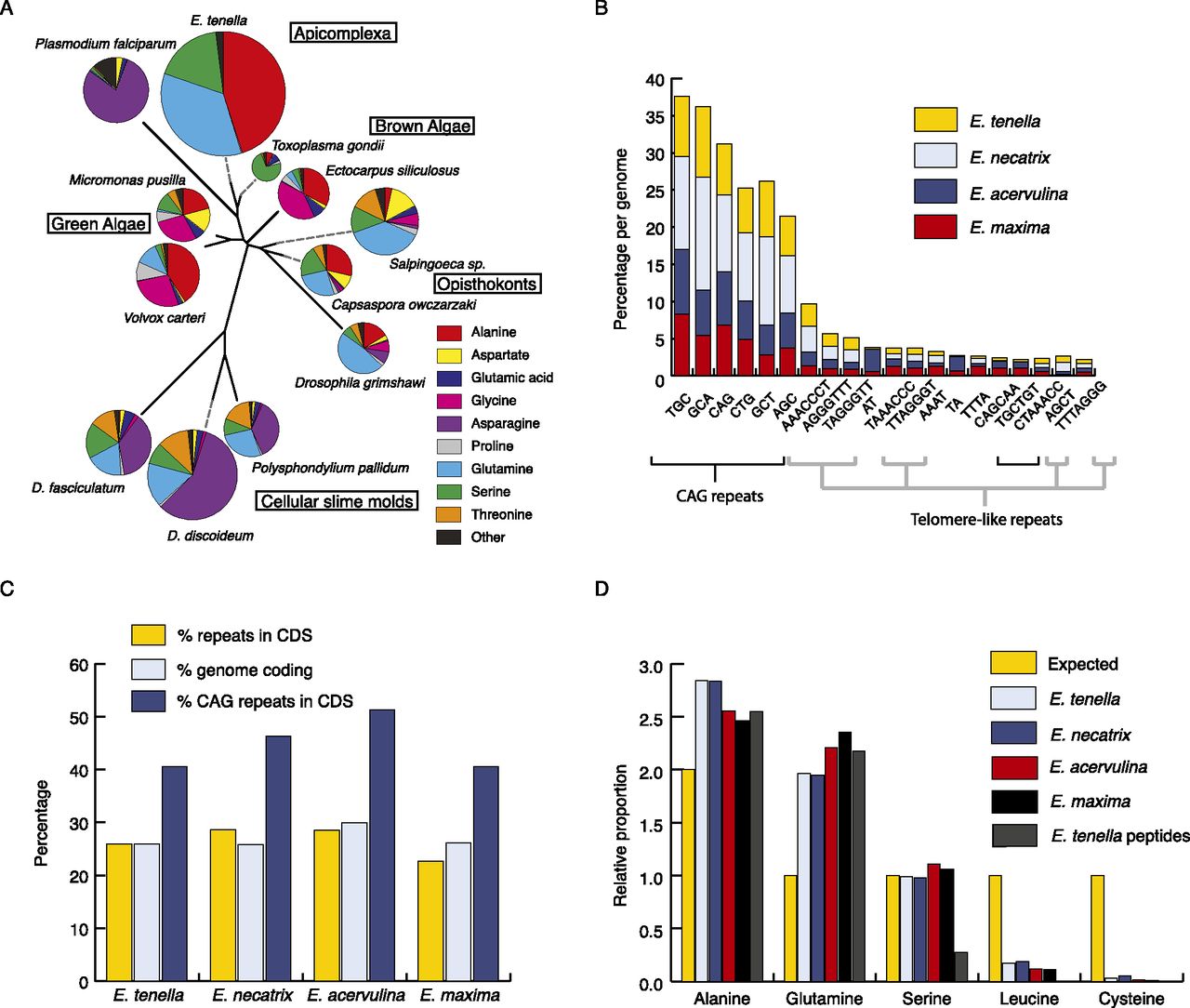
Characterization of HAARs in Eimeria protein sequences. (A) Eimeria tenella has a greater number of HAARs than any other genome sequenced and a distinct distribution of HAAR types compared with other repeat-rich genomes, including Plasmodium falciparum and the more closely related and not especially repeat-rich Toxoplasma. (B) The most common STRs in Eimeria genomes are variations on CAG. The second most common are variations on a telomere repeat which we call telomere-like repeats due to their locations throughout the genome. (C) CAG repeats occur in protein-coding regions of the genome more than expected. (D) CAG repeats can encode strings of one of five amino acids. In Eimeria they tend to encode alanine and glutamine more often than expected, serine as often as expected, and leucine and cysteine more rarely than expected. A very similar pattern is observed in a limited selection of E. tenella peptides derived from proteomics experiments.



