


Mouse SNPs for evolutionary biology: Beware of ascertainment biases
Recently, Harr (2006) used publicly available Single Nucleotide Polymorphism (SNP) data (http://www.well.ox.ac.uk/mouse/INBREDS/) to search the mouse genome for regions of elevated differentiation between the subspecies of the house mouse. If they existed, such regions would be of great interest because they would be likely to harbor the genetic factors causing the partial incompatibility between the subspecies, a phenomenon particularly documented in the case of the European subspecies Mus musculus domesticus and Mus musculus musculus (Storchova et al. 2004; Britton Davidian et al. 2005; Raufaste et al. 2005). Using the 10,265 SNPs spanning the whole genome and that have been typed in seven domesticus and eight musculus wild-derived strains of various geographical origins, Harr reports that 10 regions located on seven different chromosomes show a significantly higher than average regional proportion of SNPs with alleles alternatively fixed in the two subspecies.
Using SNP data in population genetics and evolution, especially for quantifying differentiation or divergence, requires a careful and unbiased choice of SNPs. Ascertainment biases in the SNP discovery and choice processes can have various origins and can sometimes lead to erroneous conclusions (Morin et al. 2004; Clark et al. 2005). Most mouse SNPs have been discovered by comparing the genomes of classical inbred laboratory mouse strains that have long been known (Bishop et al. 1985) to be hybrids between M. m. domesticus (the Western European subspecies) and mice of Asian origin (M. m. musculus and/or Mus musculus castaneus). Recent surveys have shown that the genomes of these strains are mosaics of fragments of various sizes with either of these two origins, the non-domesticus contribution being mostly of musculus origin and representing 20%–30% of the laboratory mouse genomes (Wade et al. 2002; Zhang et al. 2005). When using a panel of such strains to discover SNPs, two situations can occur. In regions of the genome where none of the SNP discovery strains is of musculus origin (or where they all are, but this is unlikely), one should discover only SNPs that are polymorphic in domesticus (respectively, musculus), but should find none of the SNPs that are alternatively fixed between domesticus and musculus. In contrast, all SNPs in the latter category should be discovered in regions where some of the test strains are of musculus origin. We were therefore concerned that the results reported by Harr could be affected by this bias, the regions with high inter-subspecific differentiation they pinpoint being mostly those for which the SNP discovery strains were of different taxonomic origins.
Most of the SNPs in the data set that Harr used were chosen by comparing the full sequences of five strains, from Celera (strains C57/BL/6J, DBA/2J, A/J, 129S1/SvImJ, and 129X1/SvJ) (Pletcher et al. 2004). Among them, those polymorphic between strains A/J, AKR, BALB/cJ, DBA2/J, C57BL/6J, LP/J, I, and RIIIS/J were retained (http://www.well.ox.ac.uk/mouse/INBREDS/). Fortunately, six of the strains used to define or retain these SNPs have been largely resequenced (http://mouse.perlegen.com/mouse/). Because this data set also includes one domesticus wild-derived strain (WSB/EiJ), one musculus (PWD/PhJ), and one castaneus (CAST/EiJ), we could use it to test our hypothesis that the regions of high intersubspecific differentiation detected by Harr are regions where the SNP discovery strains are of mixed origins.
We sliced the genome in fragments of 100 kb, and for each fragment we calculated the resemblance (proportion of identical SNPs) of each of the six SNP discovery strains to PWD/PhJ, from which we subtracted the greater of its resemblances to WSB/EiJ and CAST/EiJ. Positive values of the resulting index thus indicate a musculus origin; negative values, a non-musculus origin. Figure 1 (thin curves) presents the results for the chromosomes on which Harr found significant differentiation peaks. Note that in some regions (such as the distal chromosome 1 and three segments of chromosome 14), the index of the SNP discovery strains oscillates around zero, which prevents classification. This is because in these regions the reference musculus strain (PWD/EiJ) is of domesticus origin (analysis not shown, but a plausible result since the strain comes from the Czech Republic, close to the natural hybrid zone between domesticus and musculus). Barring such regions of the genome, it can be seen in the figure that classification of the genomic regions as musculus or non-musculus is essentially unambiguous based on our index. The figure also shows for comparison the variations of the regional proportion of SNPs alternatively fixed between wild domesticus and musculus using the same data as Harr (thick curve), and points with arrows to the significant peaks of differentiation found by this investigator. Among 10 such peaks, seven lie in regions where some of the SNP discovery strains are obviously of musculus origin. These peaks thus appear to result from the SNP ascertainment bias. However, for the proximal peak on chromosome 2 and that on chromosome 10, no mixed origin of the SNP discovery strains was detected. The results on the proximal peak of the X chromosome are ambiguous because of a gap in the resequencing data, but suggest some musculus contribution in one of the strains. The two former peaks, on chromosomes 2 and 10, and potentially the latter on the X chromosome, could thus be retained as true differentiation peaks, not suffering from the ascertainment bias. It may seem surprising that a high proportion of SNPs were found fixed between the wild domesticus and musculus when the SNPs were discovered among laboratory strains of apparently pure domesticus origin. However, if these genomic regions have undergone recent selective sweeps, most polymorphisms should be rare, which could explain this apparent paradox.
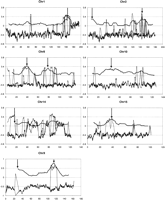
Regional variation along the chromosomes of the resemblance of six resequenced laboratory strains (C57/BL/6J, DBA/2J, A/J, 129S1/SvImJ, AKR/J, and BALB/cByJ) (thin curves) to Mus musculus musculus (strain PWD/PhJ) minus their best resemblance to either Mus musculus domesticus or Mus musculus castaneus (strains WSB/EiJ or CAST/EiJ), compared to the regional variation of the proportion of fixed SNPs between wild-derived domesticus (seven strains) and musculus (eight strains) (thick curve). The former data set is represented in sliding windows of 2 Mb shifted by 100 kb. In the latter data set, windows of 60 SNPs are shifted by 5 SNPs (as in Harr 2006), and arrows indicate the significant differentiation peaks according to Harr's analyses. Chromosome coordinates for this data set were transformed from build 34 to build 36 in order to match the resequencing data set, using the utility provided at the UCSC Bioinformatics Web site (http://genome.ucsc.edu/).
Harr (2006) attempted to verify her findings by sequencing fragments from regions she detected as high and low differentiation in wild-derived domesticus and musculus mice, and found a significantly higher differentiation (as measured by the Gst statistics) in the former category than in the latter, in apparent agreement with her SNP analyses. We believe the agreement is real, but not for the reason given by the author. Although, as we have seen, the ascertainment bias produces many false positives among the high differentiation peaks, it should not contribute to the detection of false low differentiation peaks. Therefore, we suggest that Harr's apparent confirmation follows from her correctly identifying low differentiation regions, but not high differentiation regions as could be claimed without accounting for the ascertainment bias (with the two or three exceptions mentioned above).
Footnotes
-
↵1 Corresponding author.
↵1 E-mail boursot{at}univ-montp2.fr; fax 33-4-67144554.
-
Article is online at http://www.genome.org/cgi/doi/10.1101/gr.5541806.
- Copyright © 2006, Cold Spring Harbor Laboratory Press


