


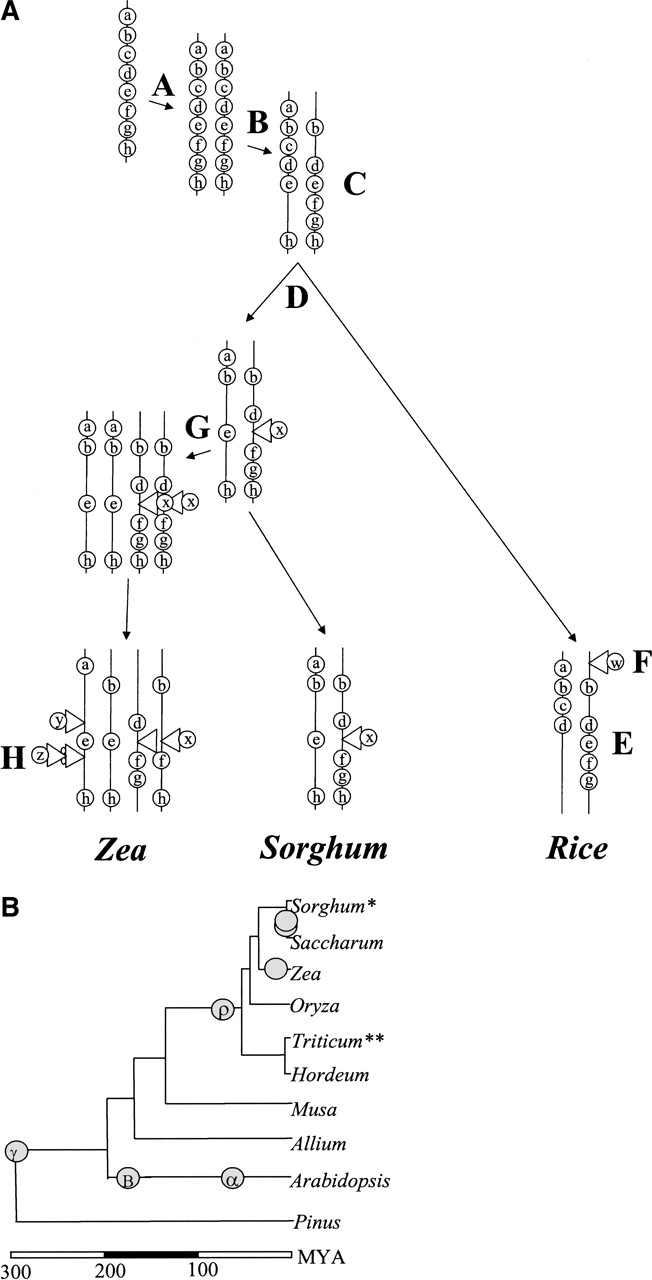
Unraveling the history of cereal gene and genome evolution. (A) A whole-genome duplication A and associated divergence and/or loss B of some members of duplicated gene pairs, determined the gene set that was inherited by all cereals C. After divergence of the cereals from this common ancestor D, continuing gene loss (E: note that locus e has been preserved on one homoeolog in the indicated lineage and the other homoeolog in the alternate lineage, thus changing its linkage relationship to flanking genes) together with the effects of other rearrangement mechanisms such as transposition F, led to incongruities in gene arrangement of modern cereal crops. Additional whole-genome duplications in some lineages such as maize, sugarcane, and wheat G, accompanied by continuing activity of transposition mechanisms H, resulted in further differentiation of the modern gene repertoire and order from that of the ancestral cereal order. Finished sequences of genomes representing the major taxonomic groups within the cereals will permit unraveling of the nature and timing of many of the events that account for such differences, as well as inference of the general organization of the genome of their common ancestor. (B) Phylogenetic relationships among selected Poaceae lineages. Current thinking on the approximate relationships among the major lineages discussed are illustrated. (*) The Sorghum genus includes a recently formed polyploid, Johnson grass (S. halepense). (**) The Triticum lineage includes several recently formed polyploids, most notably tetraploid T. durum (durum wheat) and hexaploid T. aestivum (bread wheat).



