


Cover image
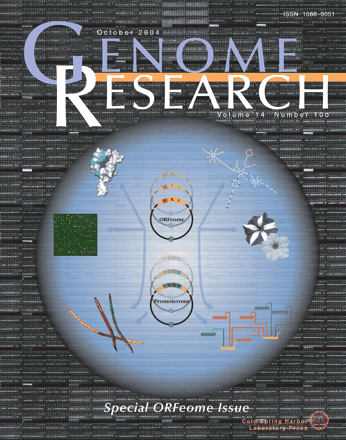
Cover Together with metabolites, proteins and RNAs form complex biological systems through highly intricate networks of physical and functional interactions. Large-scale studies aimed at a molecular understanding of the structure, function, and dynamics of proteins and RNAs in the context of biological networks require novel approaches and technologies. This special issue of Genome Research features strategies for the high-throughput construction and manipulation of complete sets of protein-encoding open reading frames (ORFeome), gene promoters (promoterome) and noncoding RNAs, as predicted from genome and transcriptome sequences. ORFeome and promoterome resources can be used to (from left clockwise) (1) characterize cellular transcriptomes through microarray analyses, (2) initiate structural proteomics efforts based on high-throughput protein production and subsequent three-dimensional structure determination, (3) map interactome networks with yeast two-hybrid system and pull-down mass spectrometry strategies, (4) experimentally perturb cellular networks using RNAi, (5) model regulatory networks by systematically analyzing protein-DNA interactions, and (6) initiate localizome projects in vivo by reconstituting promoter-ORF constructs fused to GFP-like proteins. Each band is one of ~8, 100 full-length ORFs amplified by PCR and analyzed by gel electrophoresis. (Cover design by Philippe Lamesch, Dana-Farber Cancer Institute, Harvard University University. [For details, see Rual et al., pp. 2128–2135])

