


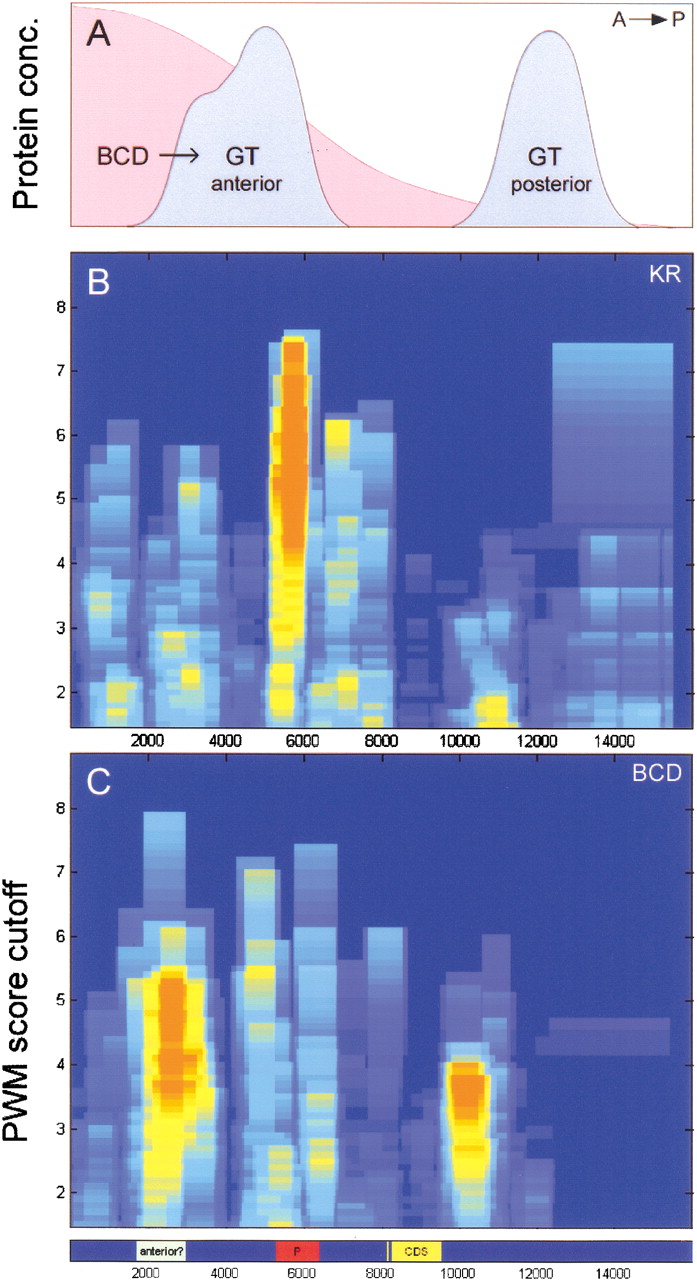
Discovery of CRM sequences using clustering of single motifs. Results of mapping of cis-regulatory modules in the giantlocus are shown in comparison with the distribution of known functional elements. (A) Relative distribution of Bicoid and Giant expression patterns along the embryo. (B) The distribution of Kruppel and (C) the distribution of Bicoid clusters. Besides the known posterior enhancer (Berman et al. 2002), the method indicates the presence of two Bicoid clusters upstream and downstream of the gene. Notice that the Bicoid cluster located downstream of thegiant CDS (B, in position ∼10000) contains low-affinity Bicoid sites (PWM is below 4.2, the established optimal cutoff for Bicoid; see Table 1) and does not represent a candidate CRM. We also found that this sequence consists of several long direct repeats (∼100 bp), which is not typical for DrosophilaCRMs. In contrast, the upstream candidate region contains a very strong cluster of closely spaced high-affinity Bicoid sites.


