


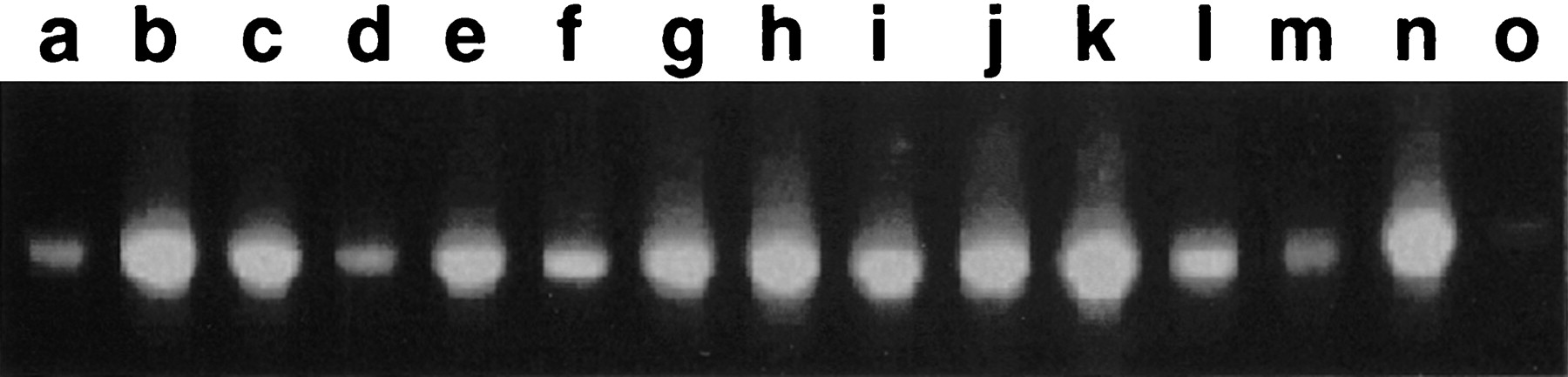
Detection of env-class retrotransposons by rt domain in genomic DNA of diverse angiosperms. A 390-bp domain specific to the group of gypsy-like retrotransposons containing envwas amplified by PCR using primers p1 and p2 and resolved by agarose gel electrophoresis. The samples consisted of the following: (a) Arabidopsis thaliana (Columbia); (b)Brassica olearecea (var. botrytus); (c) Citrus sinensus; (d) Betula sp.; (e)Pisum sativum; (f) Dianthus sp.; (g) Nicotiana tabacum (SR1); (h)Anenome nemorosa; (i) Secale cereale; (j) Triticum aestivum; (k) Hordeum vulgare; (l) Avena sativa; (m)Oryza sativa; (n) Echinodrus muricatus; (o) Nymphaea carerulea. The phylogenetic relationships between most of these species has been displayed earlier (Suoniemi et al. 1998). All angiosperms tested (not all shown) were positive; all tested older plant groups including a fern (Neprolepsis exaltata), Psilotum, a cycad (Cycas circinalis), and conifers in the Pinaceae were negative.


