


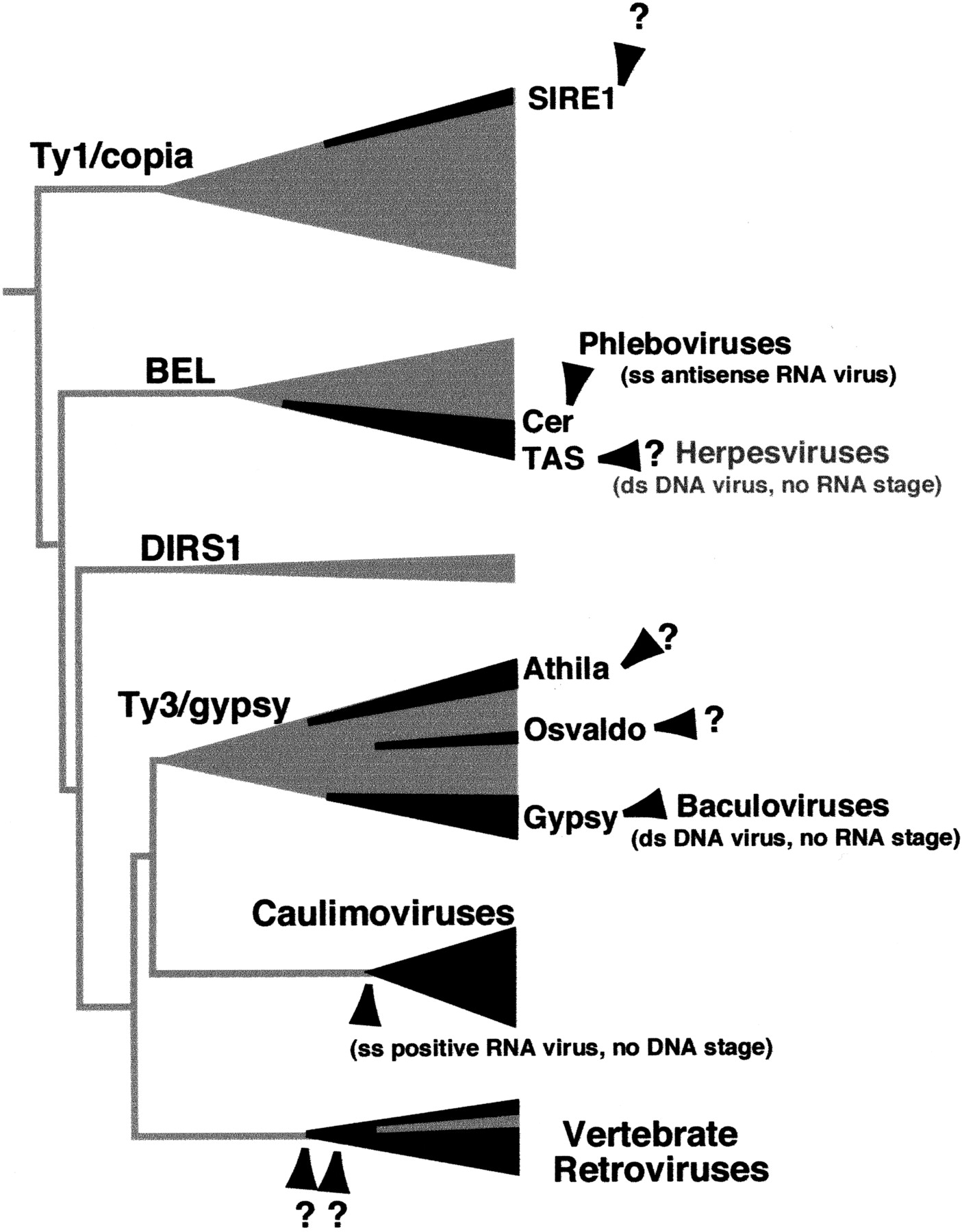
Schematic of env-like gene acquisitions in the evolutionary history of LTR-retrotransposons. The LTR retrotransposable elements are divided into six clades, each represented by a triangle. The height and width of the triangles represent the age (presumed without accounting for horizontal transfers) and current known diversity of each clade, respectively. Thus, although the DIRS1 clade has representatives in slime mold, fungi, and nematodes, indicating an ancient history, it is not as abundant as the other clades. Eight possible instances of anenv-like gene acquisition can be found and are indicated by the black regions. In four of these cases, the evolutionary origins of this env gene have been traced back to the viral source indicated. The strongest evidence was found in the Gypsy and Cer cases. The origins of the other four env-like genes remain unknown. In the case of the vertebrate retroviruses and the plant caulimoviruses, most members have an env gene, which has subsequently been lost in some endogenous vertebrate retroviruses. The exact number of env gene acquisitions in vertebrate retroviruses is unclear.



