


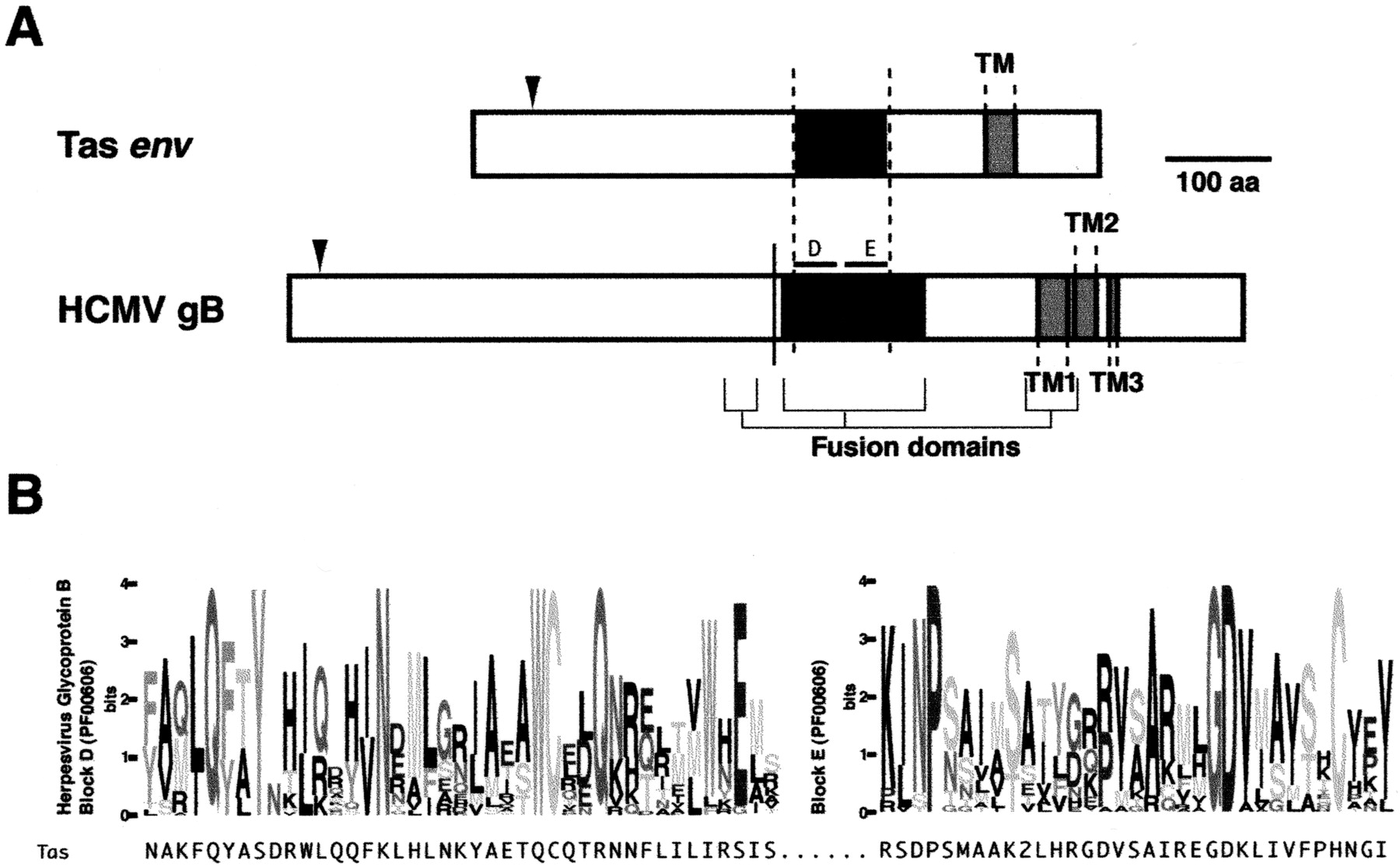
Possible similarity of the Tas env-like gene to herpesviral glycoprotein gB. (A) The Tas envelope gene consists of a predicted leader signal peptide and a carboxyl-terminal transmembrane domain. In the central portion, a region of homology is found between the Tas gene and a segment of the herpesviral glycoprotein gB. A schematic of the gB glycoprotein of the human cytomegalovirus is also presented. HCMV gB has three transmembrane domains at its carboxyl-terminal end (TM1–TM3). TM1 and two other segments implicated in the fusogenic (cell attachment and membrane fusion) properties of gB are indicated with brackets. The central segment that is believed to be responsible for fusion (indicated by a black box) corresponds to the blocks D and E shown in (B). (B) The gB glycoproteins are represented as a series of conserved blocks (Block PF00606- BLOCKS + database), of which only blocks D and E (shown in Logos format) show homology with Tas (corresponding sequence shown below each Logo).



