


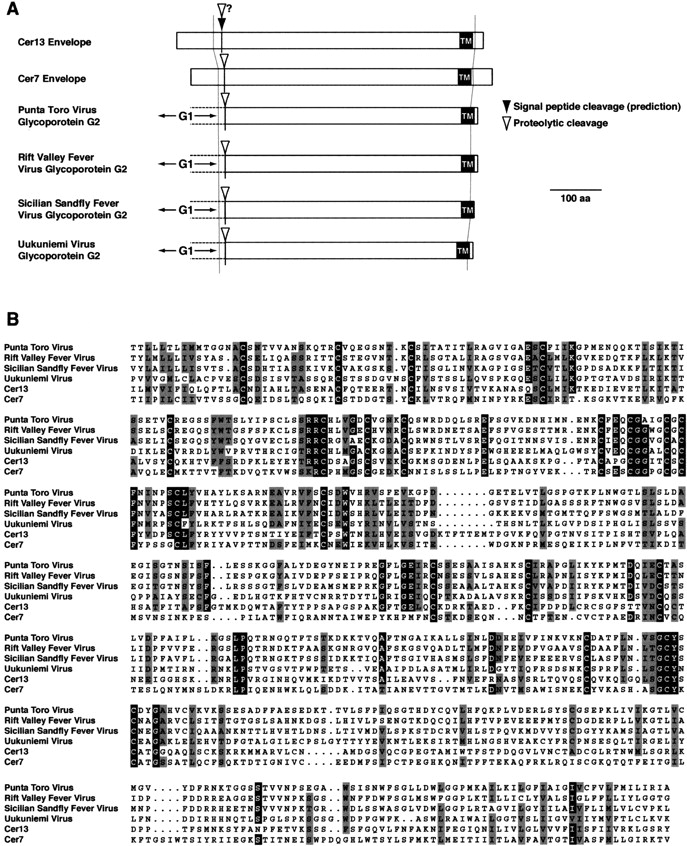
(A) Schematic representation of the env-like genes from Cer7 and Cer13, and the G2 glycoproteins from Phleboviruses. In the case of Cer7, a leader signal peptide has been proposed whose cleavage site is indicated. For the Phleboviruses, a polyprotein of three proteins, N-Sm, G1, and G2 is proteolytically processed into the individual proteins. It is likely that the Cer7 and Cer13env-like genes are processed in a fashion similar to G2. The transmembrane (anchors) regions of each protein are indicated and the thin gray lines indicate the area shown in the multiple alignment in (B). Although not indicated, several potential N-glycosylation sites are predicted in both env and glycoprotein genes. The multiple alignment is shaded to an 80% consensus using MacBoxshade with gray and black shading representing similar and identical resides respectively. In particular, note the 19 conserved cysteines believed important for the correct folding of the glycoproteins.



