


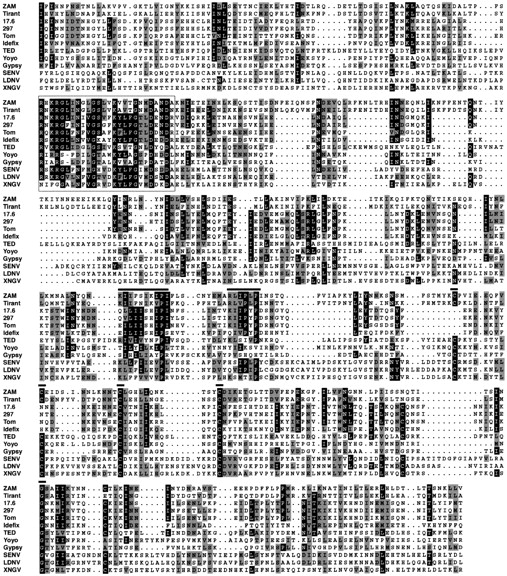
Multiple alignment of the errantivirus env genes and 'related' baculovirus ORFs. The alignment is shaded using MacBoxshade to a 50% consensus with gray and black shading indicating similar and identical residues, respectively. The boxed region corresponds to the Logo in Fig. 3. The different errantivirus sequences (accession numbers) used are ZAM (AJ000387), Tirant (Z93507), 17.6 (P04283), 297 (C24872), Idefix (AJ009736), and Gypsy (M38438) from Drosophila melanogaster; Tom (Z24451) from D. ananassae; TED (C36329) from Trichoplusia ni. Also shown are the baculoviruses,Spodoptera exigua nucleopolyhedrovirus SENV (AAF33539.1),Lymantria dispar nucleopolyhedrovirus, LDNV (AAC70316); andXestia c-nigrum granulovirus, XNGV (AF162221_27). Note that the homology extends to beyond the block (regions overlined) including cysteine residues that may be important for mediating interactions between the two proteolytic products of the env gene. Other baculovirus ORFs that show homology (not shown) are Autographa californica nucleopolyherdrovirus, ACNV (P41428); Orygia pseudotsugata nuclear polyhedrosis virus, OPNV (O10282);Bombyx mori nucleopolyhedrosis virus, BMNV (L33180).



