


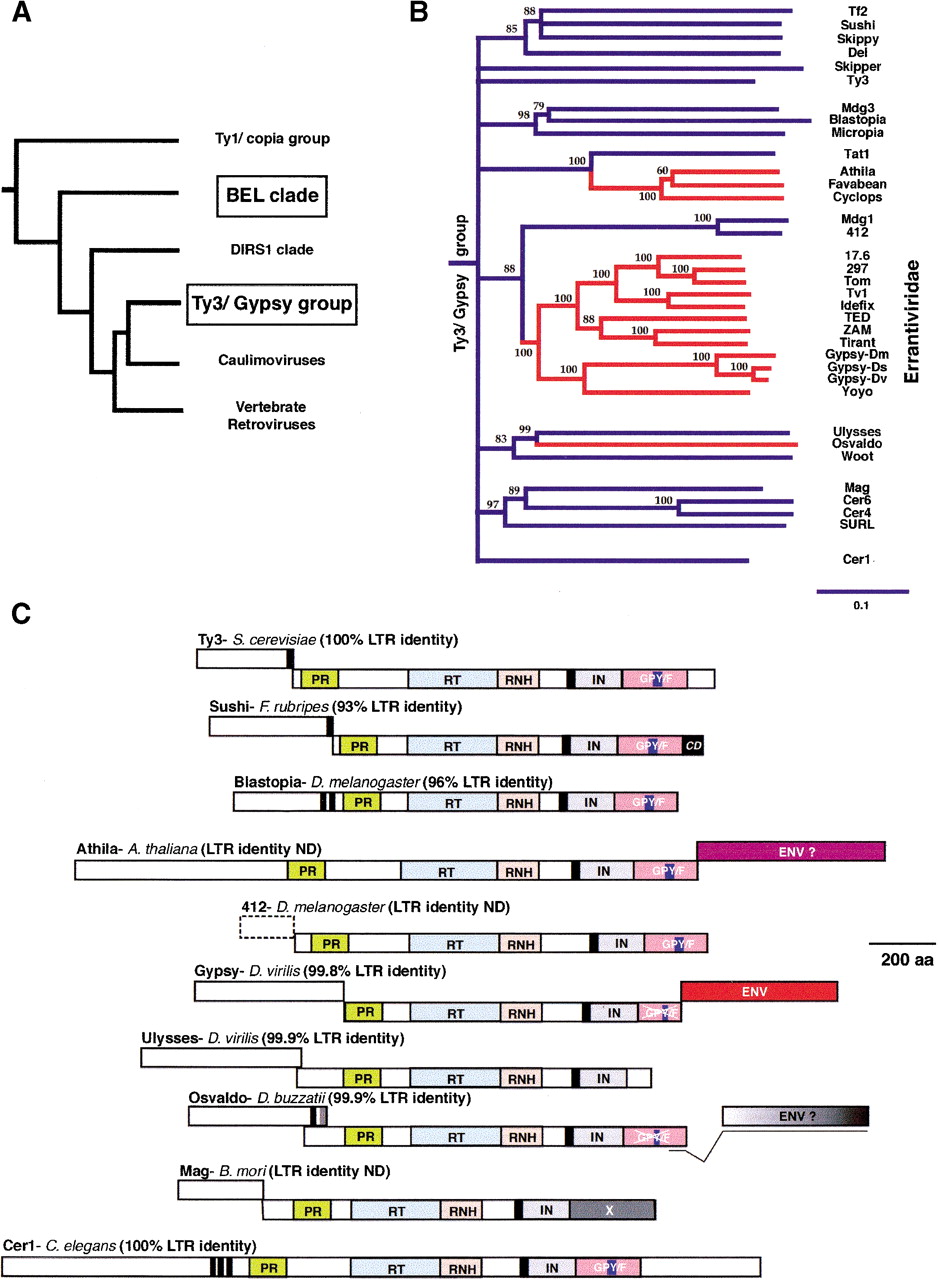
The Ty3/ gypsy family of LTR retrotransposons. (A) Schematic of the LTR-containing retrotransposable elements and related viruses, with the Ty3/ gypsy group highlighted. The LTR retrotransposons are divided into six groups (clades) based on a phylogeny of their RT domains (Xiong and Eickbush 1990). (B) A neighbor-joining phylogenetic analysis of representative sequences from the Ty3/ gypsy group. Lineages highlighted in red have been shown to contain a third ORF, putatively an env-like gene. Bootstrap values and divergence scales are indicated. Nodes with < 50% bootstrap support have been collapsed. (C) ORFs from representatives from the Ty3/ gypsy group are schematized to the scale indicated, with the various enzymatic and structural modules highlighted. Three instances of an env-like gene are represented. In some instances, the carboxyl-terminal extension to the core integrase domain contains a GPY/F domain (degenerate in Gypsy and Osvaldo). The Mag lineage bears a different carboxyl-terminal extension (X). The percent LTR identity is a good indicator of the age of a particular element insertion (LTRs are identical in sequence at the time of insertion).



