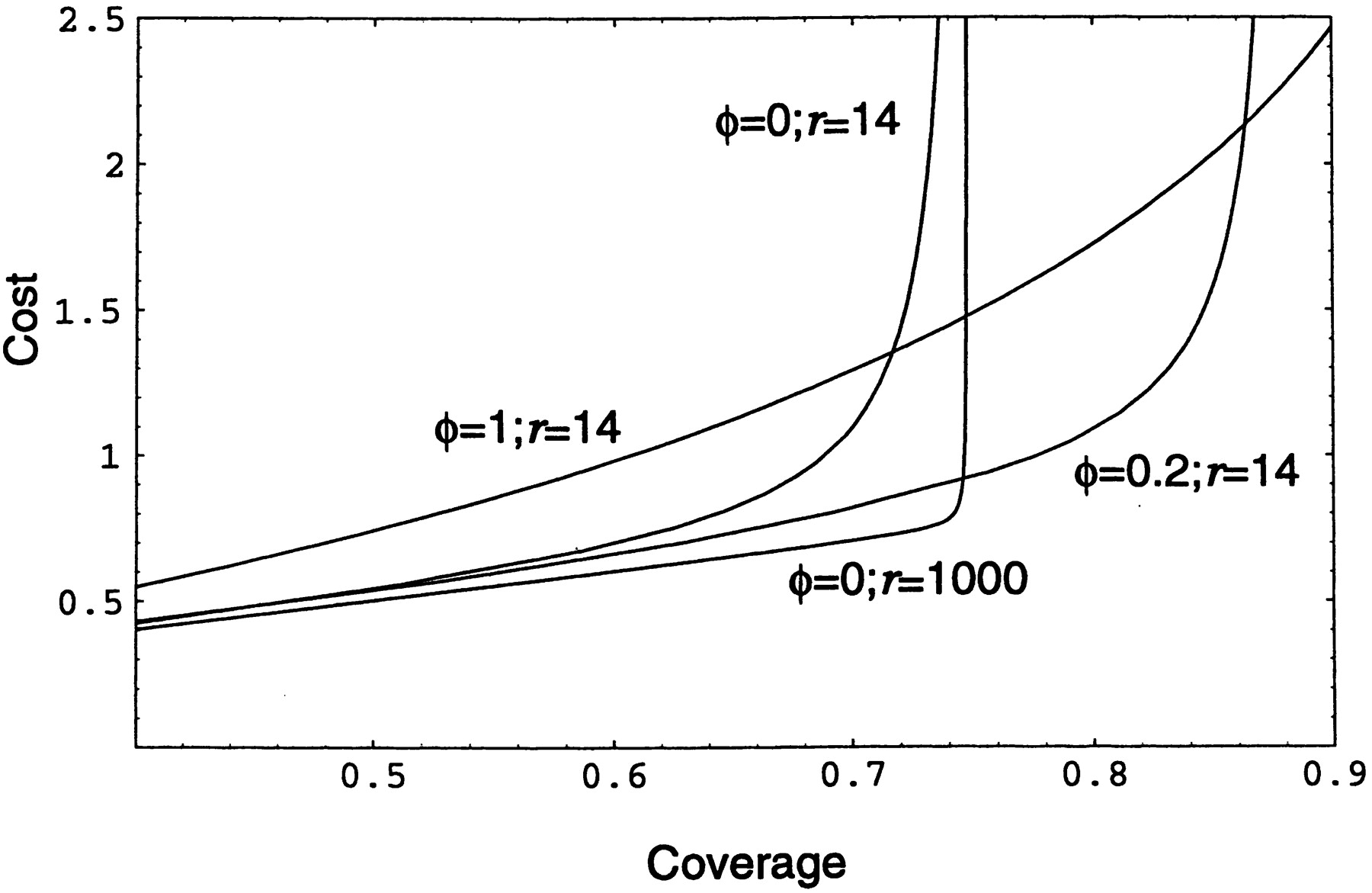
Parking costs as a function of coverage. For small to moderate values of coverage, parking costs are roughly proportional to coverage, demonstrating that the cost burdens of screening and of overlap inefficiency are initially quite small. Near the jamming limit, these costs rise sharply as the number of screening operations to identify an appropriate clone for sequencing rises sharply. Dropping the cost of screening by almost two orders of magnitude provides only a marginal benefit shortly before the jamming limit. Allowing modest overlaps permits progress toward higher jamming limits at little cost increase. The curve for φ = 0 and r = 14 intersects the curve for φ = 0.2 and r = 1000 at 0.4493 coverage. In practice, the curve for φ = 1 and r = 14 would run at a slightly lower cost, as no screening would actually be done (any screening results would be ignored). For screening by partial sequencing, this cost savings would be small, as it would apply only to clones not fully sequenced. If this factor is taken into account, the curve for φ = 0 and r = 1000 also must be slightly adjusted. We left the curves unadjusted to facilitate comparison of the parameterization of the underlying equations.