


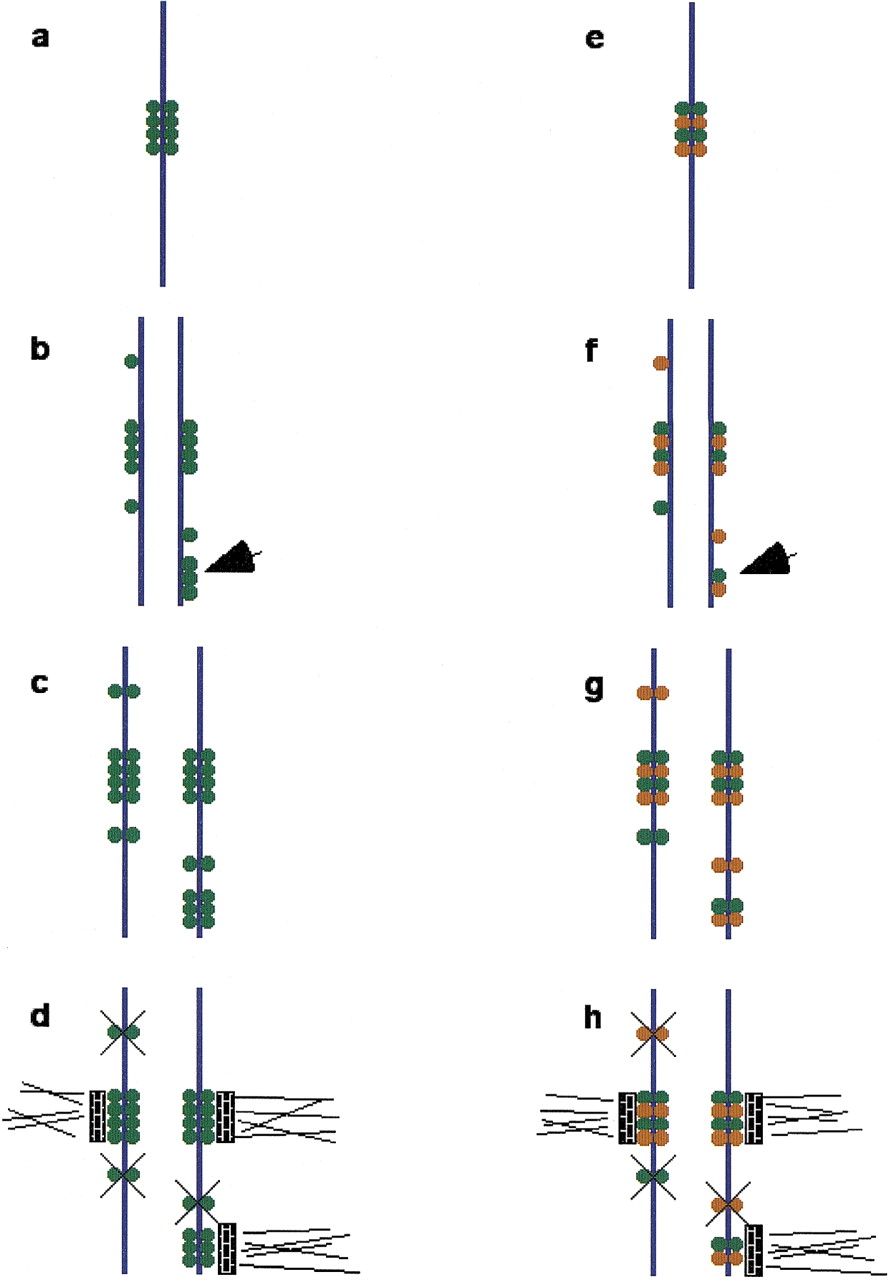
Neocentromeres may arise spontaneously. In (a), a centromere is denoted through interaction of an epigenetic identity mark (green circles) with the chromosome (blue lines). During or after replication (b), the mark is recruited preferentially to DNA that is already associated with the mark, but errors in incorporation yield few sporadic misincorporated marking factors in other parts of the genome. By chance, a local concentration of the centromere mark was incorporated in 10q (arrowhead). These marks are sufficient to recruit more marking factor (c), establishing epigenetically stable potential centromeres. Only potential centromeres of sufficient size (mass of DNA and/or protein) are matured and nucleate kinetochores (d), including the bona fide centromere, as well as the 10q neocentromere. In this case, the active centromeres differ from potential centromeres quantitatively. Alternatively, centromeres may differ qualitatively from potential centromeres. In (e) the centromere is marked by an overlap of more than one centromere identity factor (green and orange circles). Each factor is subject to ectopic incorporation (f). Each factor epigenetically and independently templates the incorporation of like factors (g). In this model, active centromeres are restricted to the subset of potential centromeres where both identity factors are present (arrowhead). The coincidence of centromere identity factors at the bona fide centromere assures that its activity will be stable, and the rare overlap of the two factors defines a neocentromere (h).



