


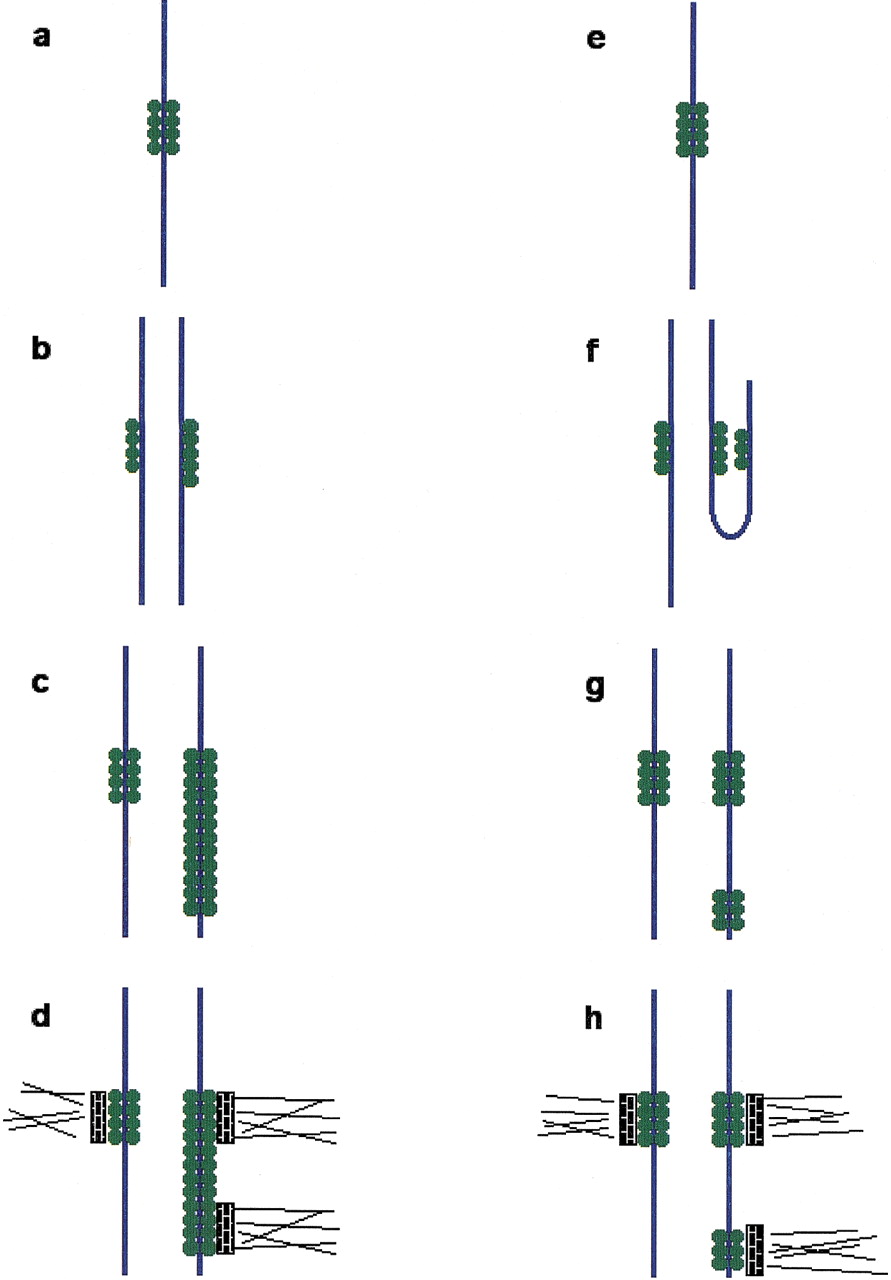
Neocentromeres can arise processively. In (a), a centromere is denoted by association of an epigenetic mark (green circles) with the chromosome (blue lines). In (b) the DNA is replicated, and the mark associates with both chromatids. As the mark is templated to the newly synthesized strand (c), there is some incorporation onto non-centromeric DNA that juxtaposes the centromere. This allows the centromere to increase in size, or to move along the chromosome. Finally, in metaphase (d), kinetochores (blocks and thin lines) are nucleated onto marked DNA, causing dicentric formation on the progenitor to mardel(10). Alternatively, spreading may occur in trans. In (e), the centromere is marked and has sharp boundaries. During or after replication (f), there is a transient interaction between the centromere and an unrelated locus on the same or a different chromosome. (g) Templating of the centromere identity mark assures that this ectopic centromere matures, just as the endogenous centromeres do. Both centromere and neocentromere are capable of nucleating a kinetochore (h), resulting in a dicentric chromosome which undergoes breakage-fusion-bridge during cell division (McClintock 1938).



