


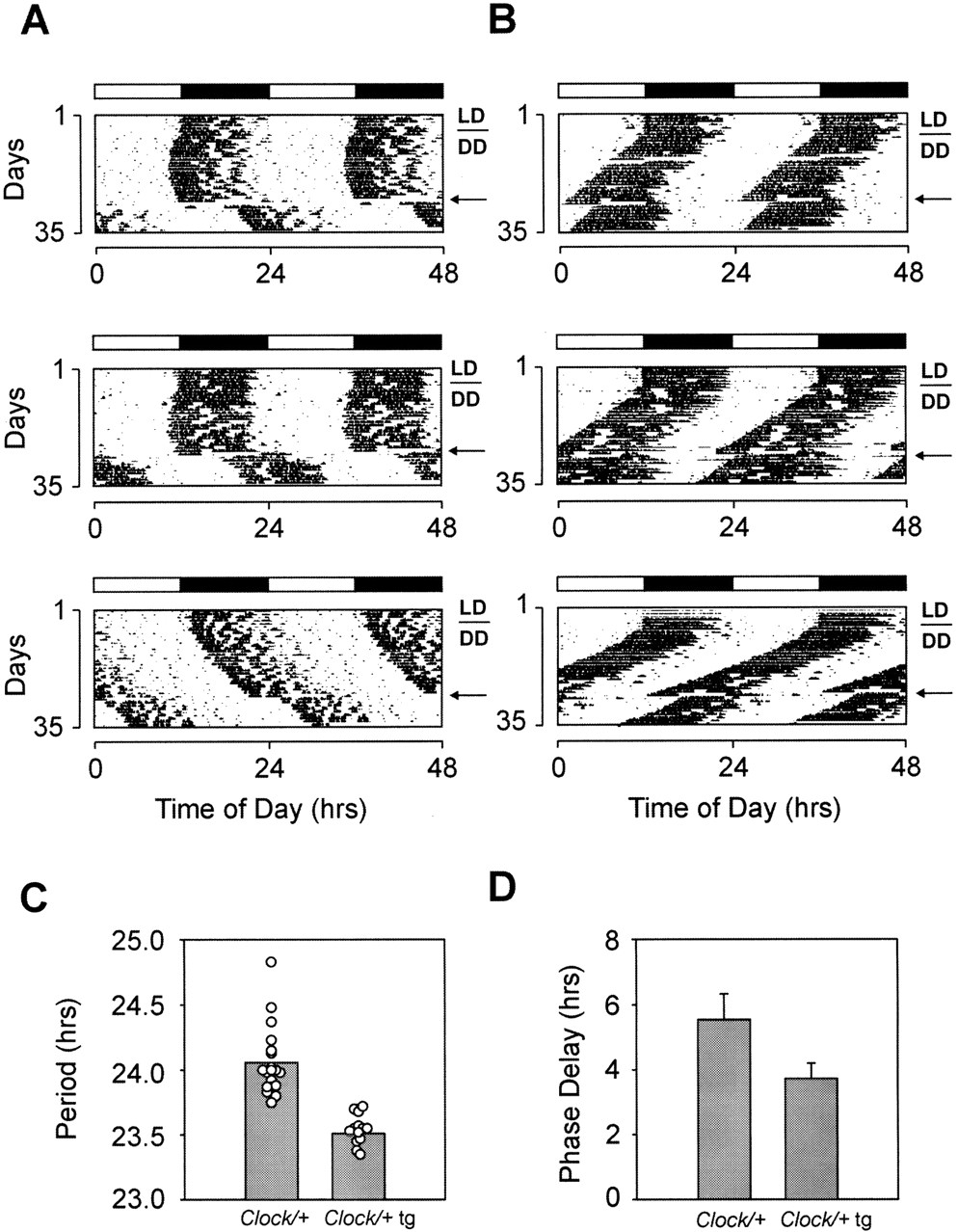
The BAC 49 transgene rescues Clock/+ mutant phenotype. Wheel-running activity records and period estimates of Clock/+ F1 transgenic mice and their nontransgenic littermates are shown. A total of 19 control and 15 transgenic animals were tested for their circadian phenotype. All animals were maintained on an LD12:12 cycle for 1 wk (LD) and were transferred into constant darkness (DD) on the day indicated by the bar to the right of each actogram. All animals received a saturating 6-h light-pulse at CT17 after a 21-d exposure to DD (indicated by an arrow). (A) Activity records of three individual Clock/+ mice without the BAC 49 transgene. Light pulse results in an average phase delay of 5.645 ± 0.706 h. (B) Activity records of three individual Clock/+ mice with the BAC 49 transgene. Light pulse results in an average phase delay of 3.77 ± 0.453 h. (C) Period estimate inClock/+ nontransgenic mice and Clock/+ transgenic (tg) mice. Average period length in Clock/+ mice is 24.04 ± 0.06 h (n = 19), while average period length inClock/+ tg mice is 23.51 ± 0.052 h (n = 15). The difference in average period is significant by t-test analysis (P <0.00001). (D) Phase delay response to a light pulse in Clock/+ nontransgenic mice and Clock/+ transgenic (tg) mice. Average phase delay in Clock/+ mice is 5.645 ± 0.706 h (n = 10), while average phase delay in Clock/+ tg mice is 3.77 ± 0.453 h (n = 11). The difference in average phase delay is significant byt-test analysis (P <0.03).


