


Novel regulator inhibits toxic protein aggregates in Huntington’s disease
April 23, 2015 – Huntington’s disease is a neurodegenerative disorder characterized by huntingtin protein aggregates in a patient’s brain, but how these aggregates form is not well understood. In a study published online today in Genome Research, researchers developed a novel computational strategy to identify interaction partners of the huntingtin protein and discovered a novel factor that suppresses misfolding and aggregation.
|
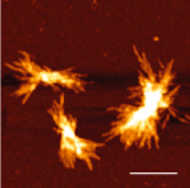
Huntington’s disease is caused by an expansion of glutamine residues in the huntingtin protein, altering its function and ultimately resulting in toxic aggregation of huntingtin fragments in neurons. Proteins that interact with the glutamine-expanded huntingtin protein are thought to strongly influence the formation of the aggregates. “The challenge that remains is if there are many proteins interacting with the huntingtin protein, we cannot easily determine which are relevant for disease and which are not,” said Erich Wanker from Max Delbrück Center for Molecular Medicine and corresponding author of the study. |
|
By combining large datasets of protein-protein interactions and filtering by brain-specific gene expression in patients with and without Huntington’s disease, the scientists narrowed potential interactors to 13 candidates, including 7 that are known targets in Huntington’s disease.
The researchers followed up on one candidate, CRMP1, because of its expression in brain and not elsewhere in the body. Using cell-based model systems and Drosophila, they found CRMP1 overexpression reduces hungtingtin aggregation and cellular toxicity, while reduced CRMP1 results in increased aggregation and toxicity. In cell-free assays, CRMP1 slows the spontaneous self-assembly of huntingtin fragments with glutamine expansions.
“CRMP1 was not regarded as a therapeutic target so far, now it is worth exploring as a potential target,” said Wanker.
Scientists from Max Delbrück Center for Molecular Medicine, Humbold University of Berlin, Charté-Universitaetsmedizin Berlin, University of British Columbia, Free University of Berlin, King’s College London, and University of Algarve contributed to this study. This research was funded by the Deutsche Forschungsgemeinschaft (DFG), the Federal Ministry of Education and Research (BMBF), HDSA Coalition for the Cure, the European Union, and the Helmholtz Association.
Media contacts:
The authors are available for more information by contacting: Barbara Bachtler, Max Delbrück Center for Molecular Medicine (MDC) Berlin-Buch (bachtler{at}mdc-berlin.de, +49-309-406-3896).
Interested reporters may obtain copies of the manuscript via email from Peggy Calicchia, Administrative Assistant, Genome Research (calicchi@cshl.edu, +1-516-422-4012).
About the article:
The manuscript will be published online ahead of print on 23 April 2015. Its full citation is as follows:
Stroedicke M, Bounab Y, Strempel N, Klockmeier K, Yigit S, Friedrich RP, Chaurasia G, Li S, Hesse F, Riechers SP, Russ J, Nicoletti C, Boeddrich A, Wiglenda T, Haenig C, Schnoegl S, Fournier D, Graham RK, Hayden MR, Sigrist S, Bates GP, Priller J, Andrade-Navarro MA, Futschik ME, Wanker EE. 2015. Systematic interaction network filtering identifies CRMP1 as a novel suppressor of Huntingtin misfolding and neurotoxicity. Genome Res doi: 10.1101/gr.182444.114
About Genome Research:
Launched in 1995, Genome Research (www.genome.org) is an international, continuously published, peer-reviewed journal that focuses on research that provides novel insights into the genome biology of all organisms, including advances in genomic medicine. Among the topics considered by the journal are genome structure and function, comparative genomics, molecular evolution, genome-scale quantitative and population genetics, proteomics, epigenomics, and systems biology. The journal also features exciting gene discoveries and reports of cutting-edge computational biology and high-throughput methodologies.
About Cold Spring Harbor Laboratory Press:
Cold Spring Harbor Laboratory Press is an internationally renowned publisher of books, journals, and electronic media, located on Long Island, New York. Since 1933, it has furthered the advance and spread of scientific knowledge in all areas of genetics and molecular biology, including cancer biology, plant science, bioinformatics, and neurobiology. The Press is a division of Cold Spring Harbor Laboratory, an innovator in life science research and the education of scientists, students, and the public. For more information, visit our website at http://cshlpress.org/
Genome Research issues press releases to highlight significant research studies that are published in the journal.

