

Research
Epigenetic characterization of pseudogenes across human tissues
- First Published April 15, 2026


Research
Mus caroli and Mus pahari genomes" > Repeat associated mechanisms of genome evolution and function revealed by the Mus caroli and Mus pahari genomes
- First Published March 21, 2018

Research
Great ape Y Chromosome and mitochondrial DNA phylogenies reflect subspecies structure and patterns of mating and dispersal
- First Published February 16, 2016

Research
Analysis of variable retroduplications in human populations suggests coupling of retrotransposition to cell division
- First Published September 11, 2013

Research
The origin, evolution, and functional impact of short insertion–deletion variants identified in 179 human genomes
- First Published March 11, 2013

Resource
GENCODE: The reference human genome annotation for The ENCODE Project
- First Published September 5, 2012
Research
Understanding transcriptional regulation by integrative analysis of transcription factor binding data
- First Published September 5, 2012
Resource
ChIP-seq guidelines and practices of the ENCODE and modENCODE consortia
- First Published September 5, 2012

Resource
A comprehensive molecular cytogenetic analysis of chromosome rearrangements in gibbons
- First Published August 14, 2012

Research
Copy number variation analysis in the great apes reveals species-specific patterns of structural variation
- First Published August 8, 2011

Resource
CNVnator: An approach to discover, genotype, and characterize typical and atypical CNVs from family and population genome sequencing
- First Published February 7, 2011

Research
C. elegans" > Diverse transcription factor binding features revealed by genome-wide ChIP-seq in C. elegans
- First Published December 22, 2010

Research
Gene amplification as double minutes or homogeneously staining regions in solid tumors: Origin and structure
- First Published July 14, 2010

Letter
Evolutionary descent of a human chromosome 6 neocentromere: A jump back to 17 million years ago
- First Published May 1, 2009

Methods
MSB: A mean-shift-based approach for the analysis of structural variation in the genome
- First Published November 26, 2008

LETTER
Sequencing human–gibbon breakpoints of synteny reveals mosaic new insertions at rearrangement sites
- First Published November 24, 2008


LETTER
A genomic analysis of RNA polymerase II modification and chromatin architecture related to 3′ end RNA polyadenylation
- First Published May 16, 2008

LETTER
Systematic evaluation of variability in ChIP-chip experiments using predefined DNA targets
- First Published February 7, 2008


PERSPECTIVE
Ancestral genomes reconstruction: An integrated, multi-disciplinary approach is needed
- First Published October 19, 2006




LETTER
A genome-wide survey of structural variation between human and chimpanzee
- First Published September 16, 2005

LETTER
Assessing the limits of genomic data integration for predicting protein networks
- First Published July 5, 2005
LETTER
Punctuated duplication seeding events during the evolution of human chromosome 2p11
- First Published June 17, 2005

LETTER
Multi-species microarrays reveal the effect of sequence divergence on gene expression profiles
- First Published May 2, 2005

LETTER
Insertion of Telomeric Repeats at Intrachromosomal Break Sites During Primate Evolution
- First Published August 12, 2004
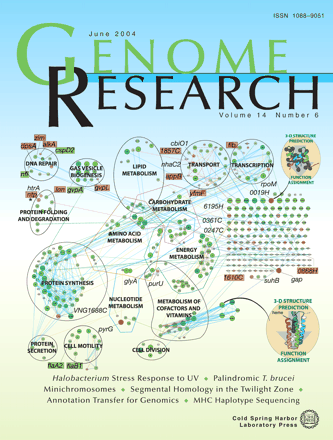
Methods
Annotation Transfer Between Genomes: Protein–Protein Interologs and Protein–DNA Regulogs
- First Published June 1, 2004

ARTICLE
Analysis of Segmental Duplications and Genome Assembly in the Mouse
- First Published May 3, 2004

LETTER
Millions of Years of Evolution Preserved: A Comprehensive Catalog of the Processed Pseudogenes in the Human Genome
- First Published December 1, 2003

METHODS
Spectral Biclustering of Microarray Data: Coclustering Genes and Conditions
- First Published April 1, 2003

LETTER
Complex Events in the Evolution of the Human Pseudoautosomal Region 2 (PAR2)
- First Published January 14, 2003

LETTER
Neocentromeres in 15q24-26 Map to Duplicons Which Flanked an Ancestral Centromere in 15q25
- First Published January 1, 2003

LETTER
Systematic Learning of Gene Functional Classes From DNA Array Expression Data by Using Multilayer Perceptrons
- First Published November 1, 2002

ARTICLE
Identification and Analysis of Over 2000 Ribosomal Protein Pseudogenes in the Human Genome
- First Published October 1, 2002

LETTER
Molecular Fossils in the Human Genome: Identification and Analysis of the Pseudogenes in Chromosomes 21 and 22
- First Published February 1, 2002

LETTER
Relating Whole-Genome Expression Data with Protein-Protein Interactions
- First Published January 1, 2002

LETTER
Annotation Transfer for Genomics: Measuring Functional Divergence in Multi-Domain Proteins
- First Published October 1, 2001

INSIGHT/OUTLOOK
Interrelating Different Types of Genomic Data, from Proteome to Secretome: 'Oming in on Function
- First Published September 1, 2001
LETTER
Whole-genome Trees Based on the Occurrence of Folds and Orthologs: Implications for Comparing Genomes on Different Levels
- First Published June 1, 2000
ARTICLE
CAGGG Repeats and the Pericentromeric Duplication of the Hominoid Genome
- First Published November 1, 1999
ARTICLE
Extreme Reduction of Chromosome-Specific α-Satellite Array Is Unusually Common in Human Chromosome 21
- First Published October 1, 1999