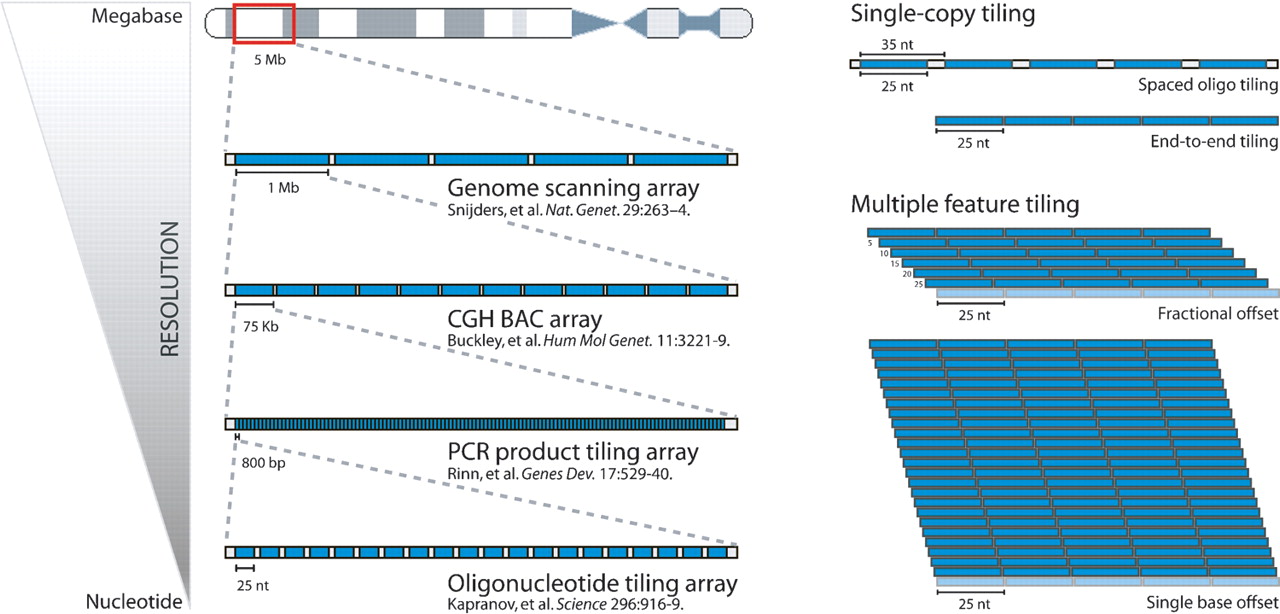
(Left) Evolution of genomic tiling arrays. Representing large spans of genomic DNA with bacterial artificial chromosome (BAC) clones facilitates global experimentation using relatively few array features, at the expense of low-tiling resolution. Higher-resolution designs using PCR products or oligonucleotides allow precise mapping of transcripts and regulatory elements, but require labor-intensive or technologically sophisticated approaches to implement. (Upper right) Linear feature tiling with gapped and end-to-end oligonucleotide placement. (Lower right) Overlapping tiles using fractional offset (e.g., one 25-mer probe placed every 5 nt) and single-base offset placement. The latter strategy provides a finer-resolution tiling of the genomic sequence, and can give a more precise indication of where hybridizing sequences are located on the chromosome.