


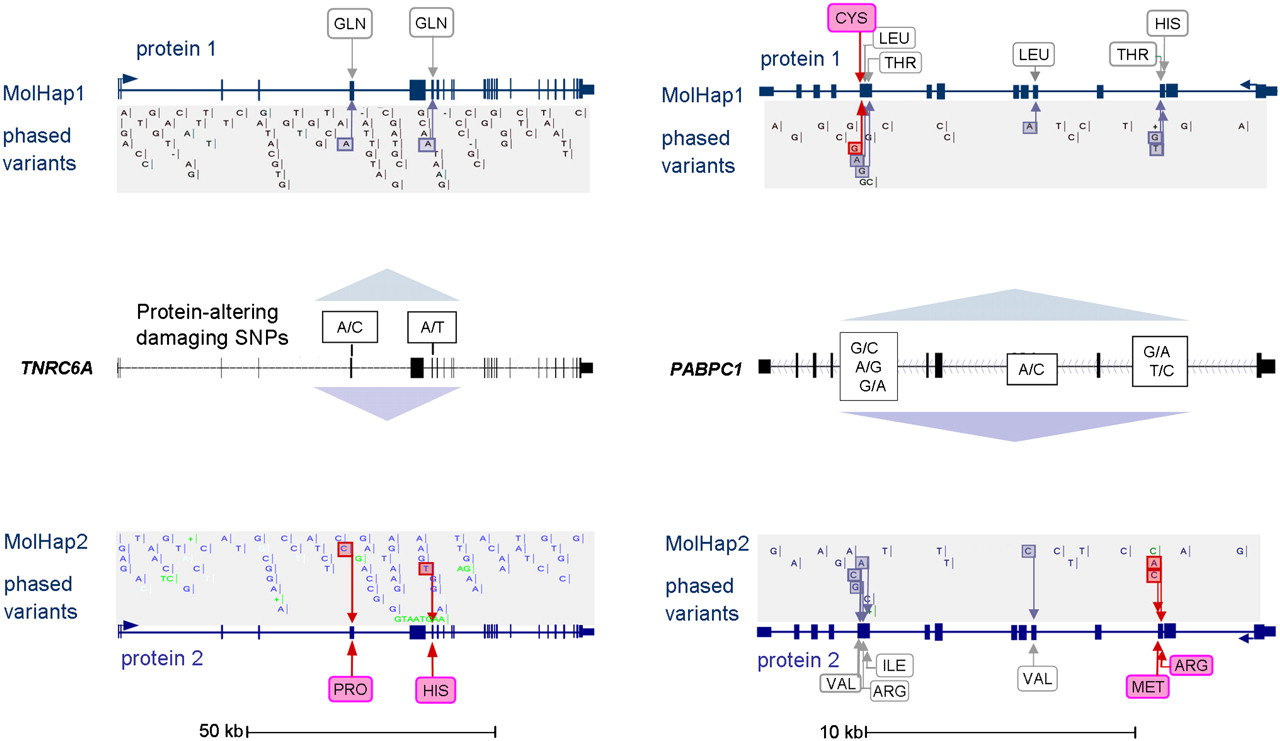
Examples of cis vs. trans configurations of potentially protein damaging mutations. Damaging mutations shown in pink. In cis (left), both mutations reside on the same chromosome, thus the second protein is left intact, shown for the TNRC6A gene. Mutations of TNRC6A may contribute to gastric and colorectal cancer development. In trans (right), multiple damaging mutations affect both haplotypes, shown for PABPC1 which has been associated with esophageal cancer progression and poor prognosis. Gene–gene interaction between TNRC6A and PABPC1 seems to play a role in miRNA silencing (Huntzinger et al. 2010), indicating global relevance of phase. All variants assigned to each of the two molecular haplotypes are shown, including nonsynonymous SNPs which have no predicted damaging effect on the protein (amino acids in gray boxes).



