


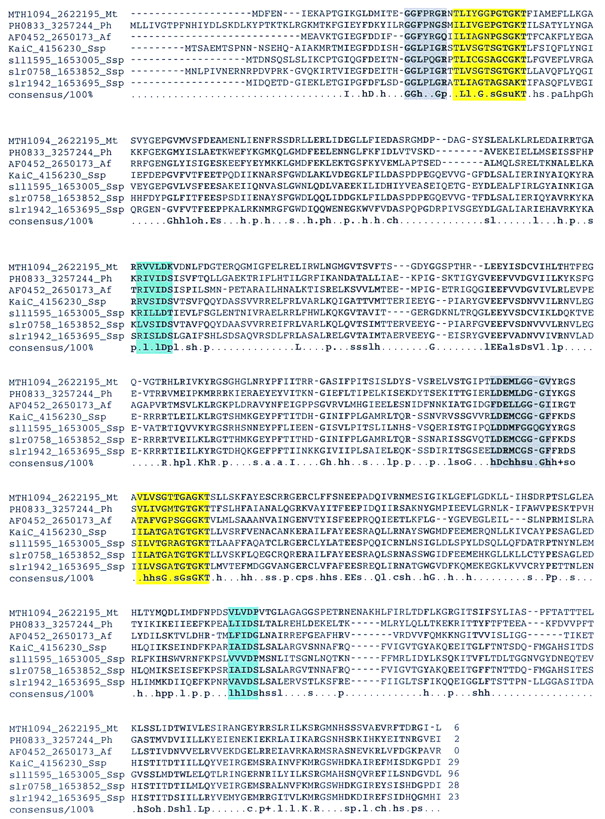
The unusual family of RecA-type ATPases with duplicated ATPase domains conserved in archaea and cyanobacteria. The designations are the same in Figs. 8 and 9 except that consensus residues are not highlighted. Instead, the highlighting shows the P-loop involved in the binding of the phosphates of ATP (yellow), the Mg-binding motif (cyan), and the glycine-rich amino-terminal motif that is typical of the RecA family of ATPases. Note the duplication of the predicted ATPase domain that encompasses all these motifs. KaiC is the cyanobacterial protein that is a component of the circadian rhythm system (Ishiura et al. 1998); the remaining proteins have not been experimentally characterized.



