


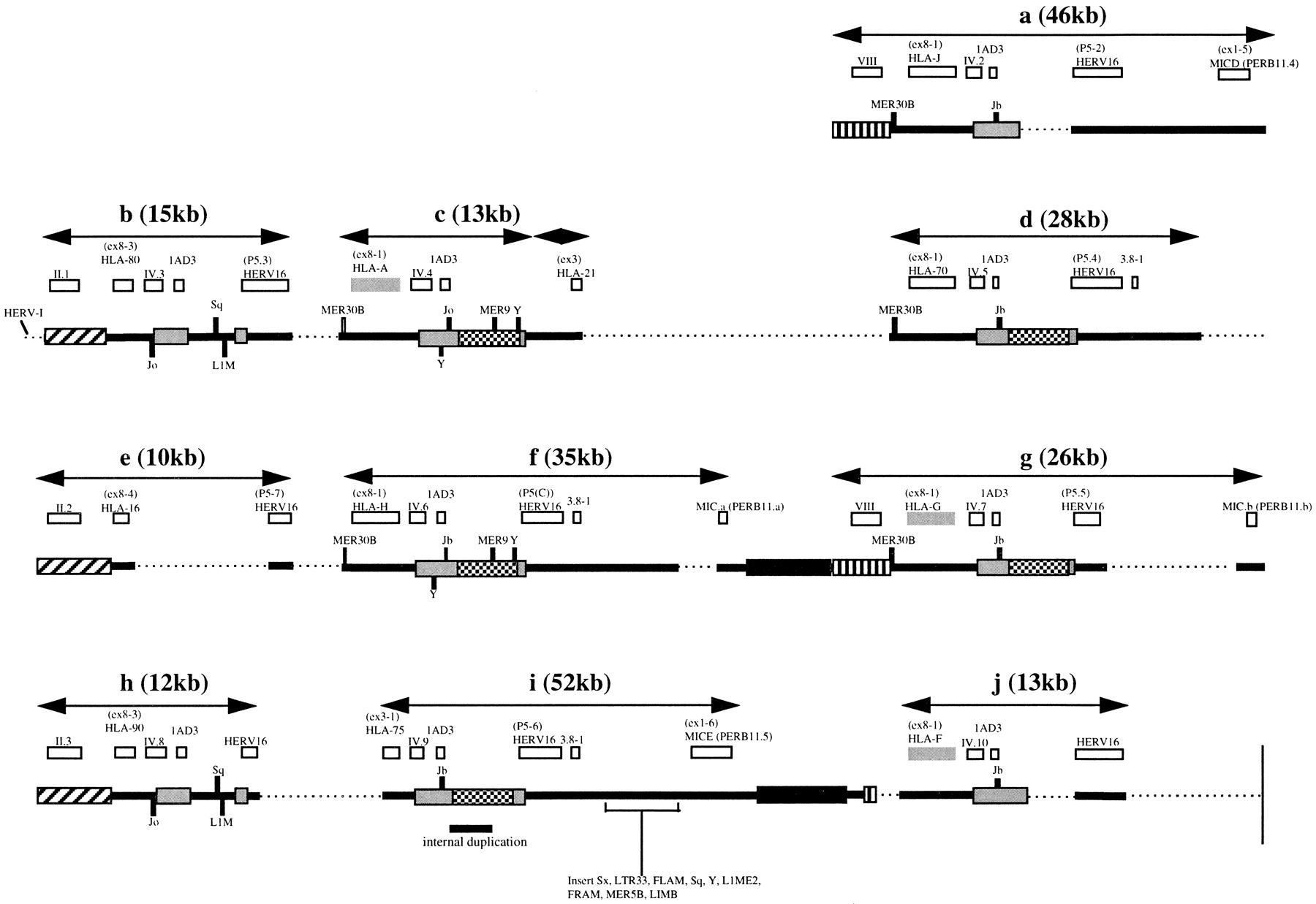
Truncations and indels of the alpha block segments associated with HERV-16 and other retroelement sequences. Schematic diagram of the retroelement content of the alpha block segments. The multicopy gene families are indicated above the bar by open boxes. Transcribed genes of the HLA class I and MIC (PERB11) family are indicated by shaded boxes. Retroelements are indicated by black vertical bars positioned above or below the horizontal boxes and bars to indicate orientation. The Alu retroelements are shown as their subtypes. Common clusters of retroelements are represented as follows: (hatched box) THE1C, L1PA, MER, and L1ME3A; (vertically lined bar) L1MB, MIR, MER20,Alu FRAM, LIM, and L2; (diagonally lined box) L1M4, MER21B, MSTB, and MSTA; (solid box) L1MB, L1M4, L1MB, FAM,Sx, Jb, MLT2D, L2, L1MB, and MER20; (dotted bar) L2, MLT1E, MLT, MLT1F, and LTR16B. (Dotted lines) Predicted indels. The duplicated segments are indicated by double arrows. The internal duplication within segment i, containing the retroelements from MLT to MER, is shown by a horizontal line. The end of the AF055066 sequence is indicated by a vertical line in segment j. For simplicity, the HCGIX sequences have not been included as they overlap the MIC (PERB11) members (Pichon et al. 1996c). HCG families II, IV, and VIII are represented by their respective roman numerals.



