


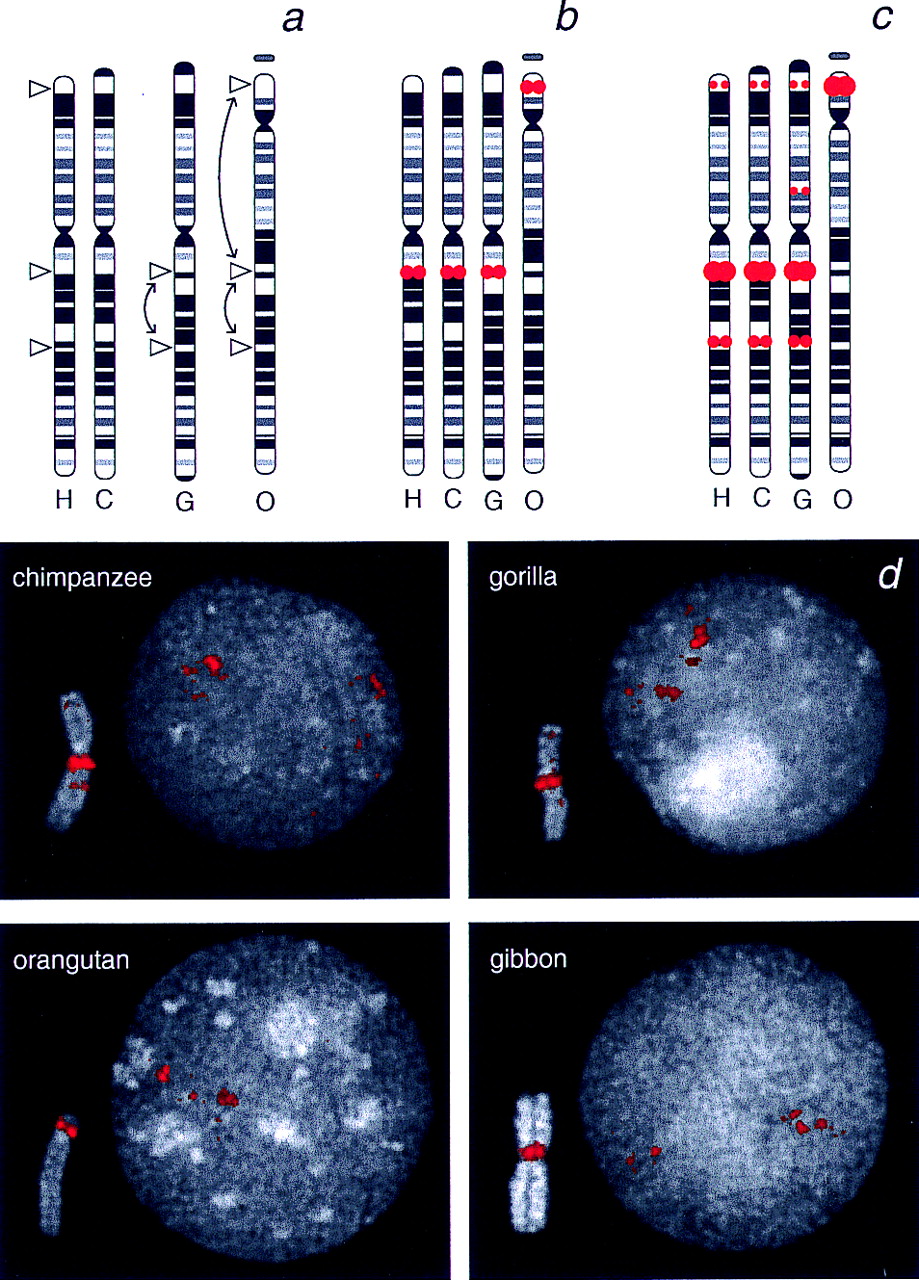
Comparative FISH analyses of WS-region segments on nonhuman primate chromosomes. (a) Idiograms of chromosome-7 orthologs in human (H), chimpanzee (C), gorilla (G), and orangutan (O) are taken fromYunis and Prakesh (1982) and used to indicate the positions of the breakpoints of inversions that have occurred during primate evolution. (b) Summary of the locations of FISH signals produced by a human ELN-containing BAC (RG030E19) on human, chimpanzee, gorilla, and orangutan chromosomes. Sequences in this ELN-containing segment appear single copy in all species and map to the expected locations, based on the known inversions. The ELN segment maps in gibbon near the centromere of a chromosome that has been shown by chromosome painting to contain sequences orthologous to human chromosome 7 (not shown; Jauch et al. 1992). (c) Summary of the locations of FISH signals produced by a human p47–phox-containing BAC on hominoid chromosomes (see Fig. 3and d for corresponding FISH images). (d) Representative images of metaphase chromosomes (insets) and interphase nuclei (main panels) from chimpanzee, gorilla, orangutan, and gibbon after FISH with a human p47–phox-containing BAC (RG350L10). Local duplication of p47–phox sequences within the region corresponding to human chromosome 7q11.23 is evident in all species, both from the size of the signal in metaphase and the cluster of multiple dots in interphase. Additional cross-hybridizing sequences are detected in 7p22 and 7q22 in chimpanzee and in 7p22, 7p13, and 7q22 in gorilla. Bands are indicated using nomenclature from the human karyotype.


