


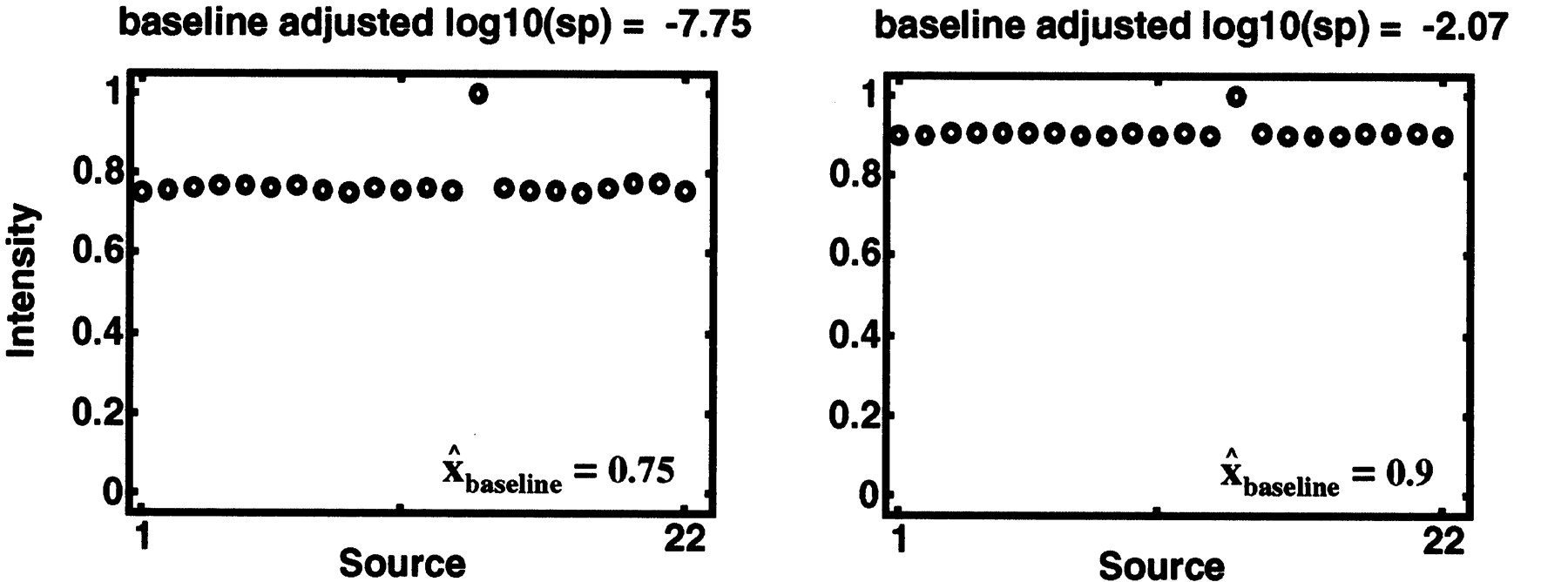
Discordancy statistical significance adjusted for baseline position. Synthetic intensity data vs. source for several different baselines, [0.25, 0.5, 0.75, and 0.9], are plotted. In each case, the number of samples (n = 22), the maximum intensity (xn = 1), and the traditional Dixon significance probability [log10(sp) = −20] are kept fixed. Constant Dixon statistical significance, regardless of baseline position, is achieved deliberately in these synthetic data by adjustingx n −1 according to equations 1–6. Hence, the gap (xn − x n − 1) necessarily decreases as the baseline increases; yet, the traditional Dixon statistical significance remains unchanged. The closer the baseline is to the maximum allowed intensity (i.e., 1), the less statistical confidence we can have in an outlier assessment. As can be seen in each panel, the baseline adjusted statistical significance decreases as the baseline increases toward the allowed maximum. The erosion of statistical confidence from the traditional Dixon significance as baselines are continuously increased toward the allowed maximum is plotted in Fig. 7 (see also Table 1).


