


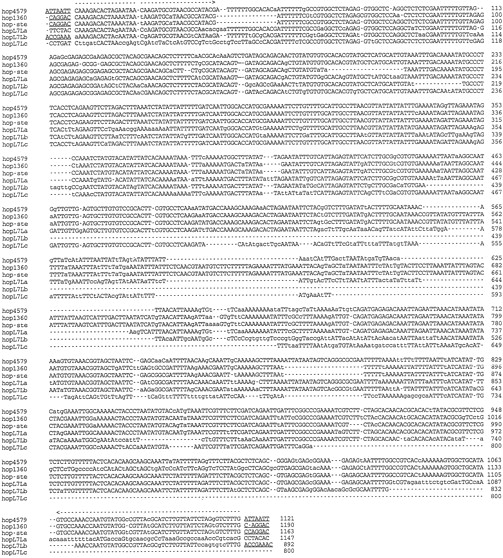
A DNA sequence comparison of three Hoppel elements (a, b, and c) within cosL7L with the previously described Hoppel sequences made with ClustalW (Thompson et al. 1994) on the default settings. The similarity in sequence is shown in uppercase letters, whereas differences from the most common base are shown as lowercase letters. The location of the inverted repeats is shown by the broken arrow above the sequences; while the location of the short tandem repeats are indicated by an underlined sequence. (Broken lines) Indicate gaps to facilitate alignment. The nucleotide count is given at right. The abbreviation hop4579 is Hoppel4579 (accession no. X78388), hop1360 is Hoppel1360 (accession nos. M55078 and M38659), hop-ste is a composite assembly of sequences from two adjacent elements (accession no. Z11734) in which the sequences 985-1 are joined to 2837–2660 at a common MluI site. The hopL7La, hopL7Lb, and hopL7Lc sequences are from cosmid L7L.



