


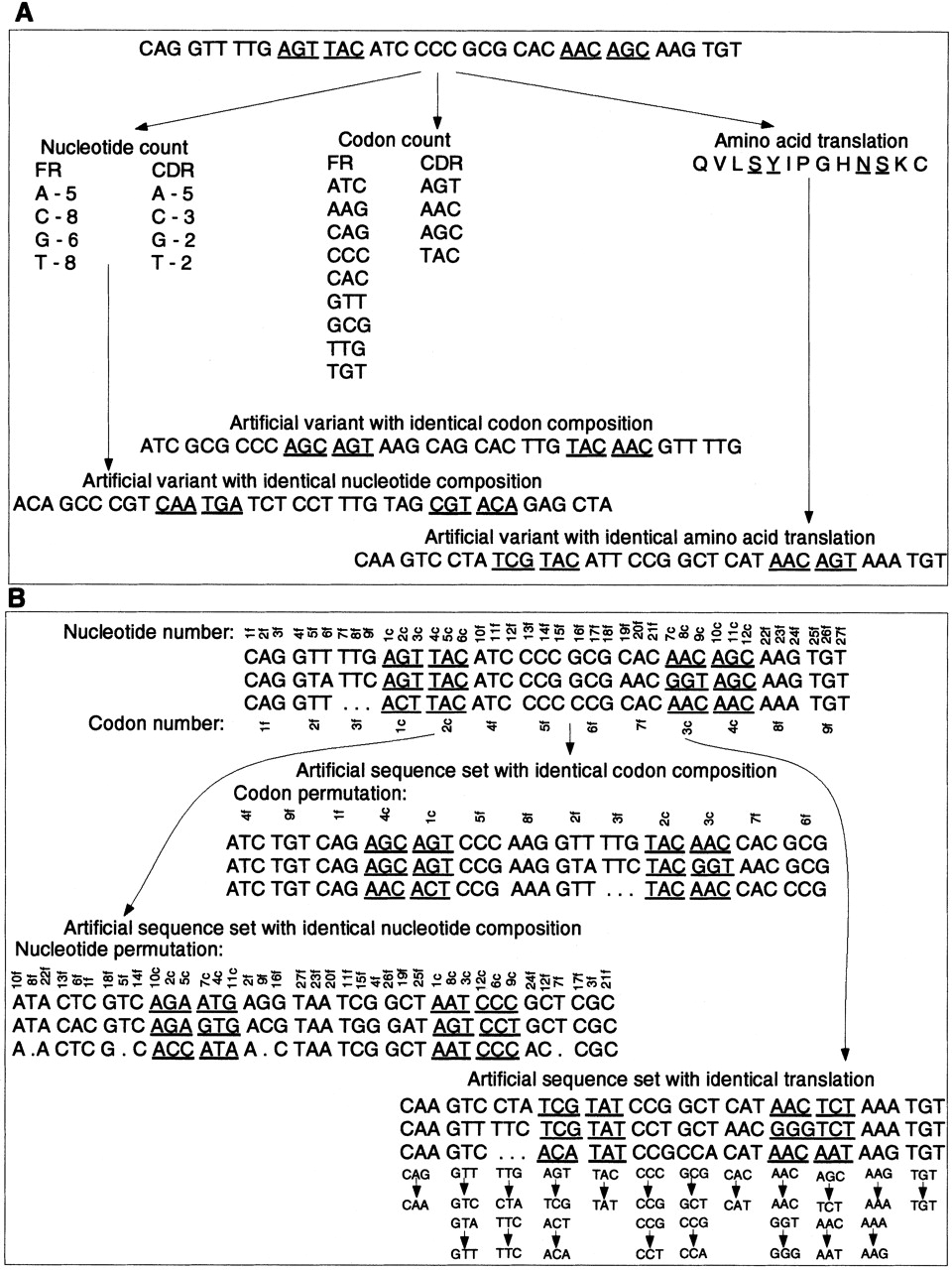
Sketch of the algorithm for generating artificial variants of (A) individual gene sequences. The nucleotides in FR and CDR are pooled separately. An artificial sequence is then constructed by sampling, without replacement from the pool of FR and CDR, respectively. Similarly, FR and CDR codons are separately pooled. To construct the FRs and CDRs of an artificial variant, FR and CDR codons are sampled, without replacement, from the respective pools of codons. Finally, the gene sequence is translated into the amino acid sequence. Then, for each amino acid position, one of the possible synonymous codons is chosen, with uniform probability for the artificial variant. (B) A family of gene sequences. The nucleotide positions in the alignment are numbered separately for FRs and CDRs. A permutation of these indices is generated and used to construct a complete artificial set of sequences. Then, the codon sites in the alignment are numbered, the indices permuted, and the permutation used to construct variant sequence sets with identical codon composition. Finally, the sequences are aligned and translated. At each amino acid position in the alignment, a new set of permutations over each of the synonymous codons is generated. The alignment is then traversed, and an artificial set of sequences is constructed by replacing the codon that appears in the real gene at that position with the one corresponding to it in the permutation.



