


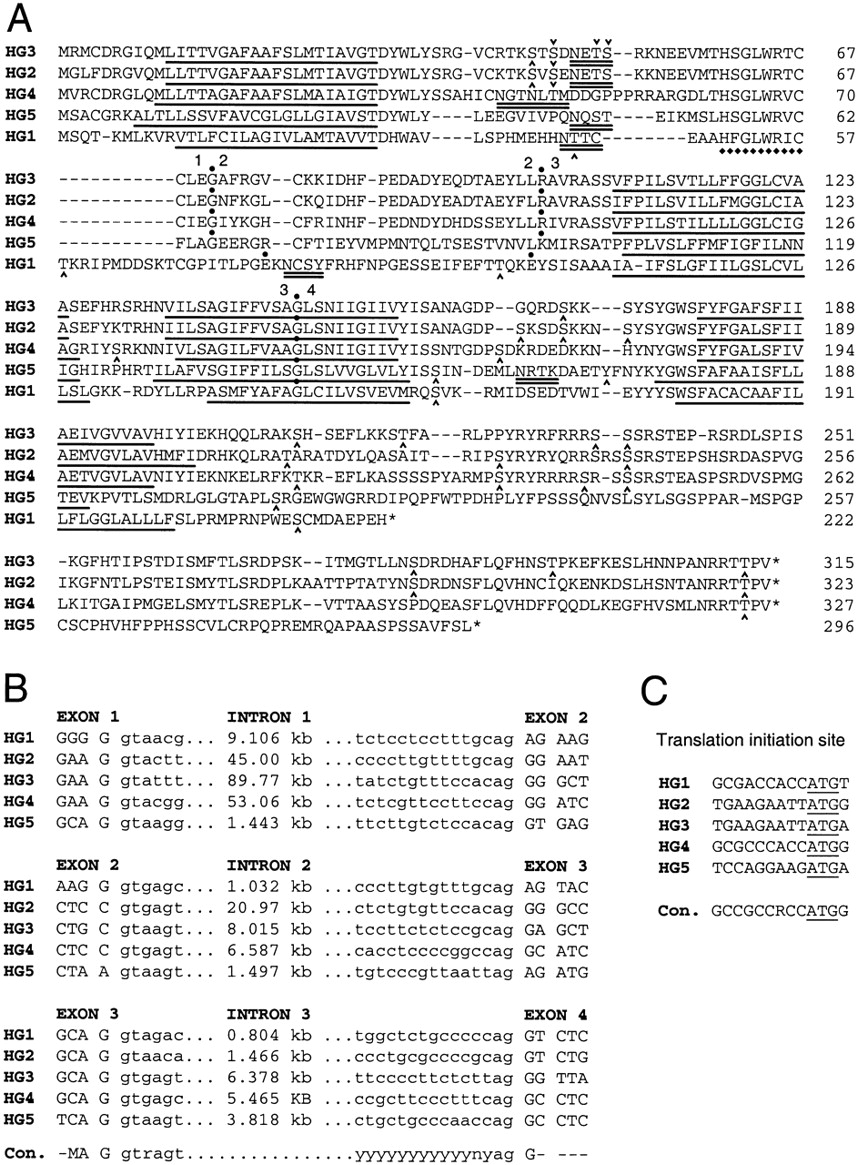
(A) Amino acid alignment of the voltage-dependent Ca2+ channel γ1–5 subunits. The relative positions of the three introns are indicated by dots, and the adjacent exons are numbered 1–4. The location of putative transmembrane domains predicted by the program TMpred (Hofmann and Stoffel 1993) are underlined (see Fig. 2). Dashes indicate gaps introduced to maintain optimal alignment. HG1, 2, 3, 4, and 5 were translated from sequences of the human genes CACNG1–CACNG5, respectively, with conceptual splicing at positionally conserved splice sites. ConsensusN-glycosylation sites are double-underlined. Potential phosphorylation sites, indicated by carets (^), are consensus targets for one or more of the following: cAMP/cGMP-dependent protein kinase (Prosite PDOC00004), protein kinase C (PDOC00005), casein kinase II (PDOC00006), and tyrosine kinase (PDOC00007). Potential protein kinase C phosphorylation sites at amino acids 50 and 51 of HG2 are not marked. A single nontransmembrane region of well-conserved amino acid sequence is indicated by diamonds (♦). (B) Comparison of the intron–exon splice junctions and intron sizes of the humanCACNG1–5 genes (HG1–5). Exon sequences are in uppercase letters; intron sequence in lowercase. Consensus splice acceptor and donor motifs (Mount 1982) are indicated at the bottom. (C) Alignment of CACNG1–5 translation initiation sites. The consensus translation initiation motif (Kozak 1984) is shown at the bottom. The putative first methionine codon is underlined. The sequences of the CACNG2 and CACNG3genes are identical for 9 nucleotides preceding the start codon; however, this sequence is a poor match to the consensus (thymine is the most uncommon residue at positions −1 and −2 of vertebrate translation start sites, 9% and 11%, respectively). (M) A or C; (R) purine; (Y) pyrimidine; (N) any base.



